
May 10, 2026
SanDisk: +490% YTD. Western Digital: +169%. Who’s Next?
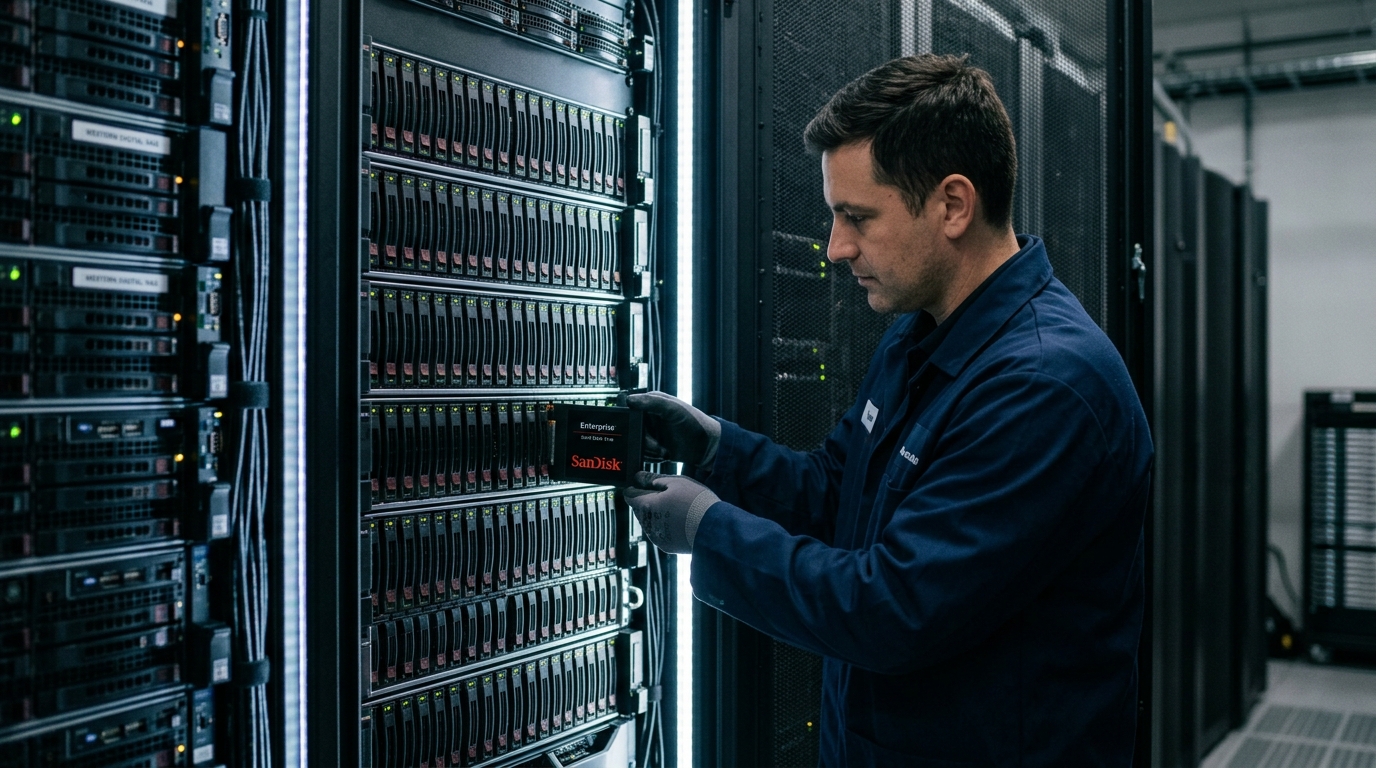
AI needs storage. Right now, there isn’t enough of it.
The GPU trade got all the attention. SanDisk got all the returns.
Up approximately 490% year-to-date, SNDK has quietly become one of the best-performing stocks in the entire market – not on speculation, but on some of the most dramatic fundamental improvement in recent memory. Western Digital has added around 169% over the same stretch. Neither company is a household name in AI discussions. That disconnect is exactly the point.
Here’s the thing: for two years, the AI infrastructure conversation started and ended with chips. GPUs, HBM, CoWoS packaging. What’s been underappreciated is the layer below – the NAND flash and hard drives that store everything those chips process. Every training run, every inference request, every agentic workflow produces data. That data has to live somewhere. And right now, the companies that provide that somewhere are running out of capacity to keep up.
Analyst Price Targets
- Bernstein – Outperform | SNDK raised to $1,700
- Cantor Fitzgerald – Buy | SNDK raised to $1,800
- Mizuho – Outperform | SNDK raised to $1,625
- Morgan Stanley – Overweight | SNDK target $1,100
- Cantor Fitzgerald – Buy | WDC raised to $660
- Bank of America – Buy | WDC raised to $495
- Mizuho – Buy | WDC raised to $550
In by 9:35 AM. Out by 10.
Forget mythical strategies and screen time that eats your whole day. One morning setup has been quietly delivering triple-digit wins to traders who know where to look. The Opening Bell Trade Guide shows you exactly how it works and right now you can grab it at zero cost.
SanDisk: Fiscal Q3 2026
SanDisk became its own publicly traded company in February 2025, spun out of Western Digital as a pure-play NAND flash business. Fourteen months later, it just reported a quarter that’s genuinely difficult to contextualize.
For the fiscal third quarter ended April 3, 2026: revenue came in at $5.95 billion – up 251% year over year. Non-GAAP EPS of $23.41, against a loss of $0.30 in the same period a year ago. Datacenter revenue alone jumped 645% from the prior year. Gross margin expanded to 78.4% from 22.5% twelve months earlier.
The balance sheet is now debt-free. Cash stands at $3.74 billion. Management authorized a $6 billion share repurchase program. And Q4 guidance – revenue of $7.75 billion to $8.25 billion, Non-GAAP EPS of $30 to $33 – landed so far above prior expectations that some analysts initially questioned whether the figures were a misprint. They weren’t.
What drove it: SanDisk has been moving aggressively away from spot-market exposure and toward multi-year customer agreements backed by firm financial commitments. That shift means less cyclical volatility and more predictable cash flow – a structurally different business model than the one investors dismissed as boom-bust throughout the prior decade.
Western Digital: Fiscal Q3 2026
Western Digital’s hard drive business is running at a different pace than NAND, but the demand signal is equally clear. Fiscal Q3 revenue reached $3.34 billion, up 45% year over year. Non-GAAP gross margin hit 50.5% – the first time in company history it has crossed that threshold. Non-GAAP EPS of $2.72 came in above the Street estimate of $2.36.
CEO Irving Tan has not been subtle about the demand picture. The company is essentially sold out of hard drive capacity through the end of calendar 2026, with firm purchase orders from its top seven customers already in place and longer-term agreements extending into 2028. Q4 guidance calls for $3.65 billion in revenue and gross margins of 51% to 52%.
That kind of multi-year visibility is unusual in the storage hardware business. The AI hyperscalers – building out massive data centers to support model training and inference at scale – are locking up supply before it exists. That’s not a typical procurement dynamic.
Claim Your Starlink Shares
This is a critical and time-sensitive message.
It’s regarding Starlink, which is expected to be the largest IPO in history – set to take place in as little as a few weeks.
And for the first time ever, we’ve found a way for you to profit BEFORE the IPO happens.
One of the world’s top venture capitalists and Silicon Valley insiders has just released all of the details… including a prospectus… in this short message.
Click here now to discover how to take action BEFORE the IPO on June 9th.
The Structural Case
The hard drive market has consolidated to three players: Western Digital, Seagate, and Toshiba. Fewer competitors means more rational pricing behavior and margin durability that simply wasn’t present in prior upcycles. On the NAND side, supply constraints from manufacturing transitions to advanced nodes have tightened the market further. Third-party forecasts project NAND average selling prices rising roughly 90% in Q1 2026 and 70–75% in Q2 2026. Order books reportedly extend into 2027.
The demand-supply math is straightforward: industry analysts project 2026 NAND bit demand growth of 20–22%, against bit supply growth of just 15–17%. That gap is what’s driving the margin expansion showing up in both companies’ income statements.
Storage has historically been dismissed as cyclical and commoditized. The current argument – and the one the numbers are starting to support – is that AI inference workloads generate persistent data at a rate that fundamentally outpaces storage supply growth. If that’s true, the boom-bust framing that has defined this sector for 20 years may no longer apply.
Will the Banks Try to Ban This?
Americans are discovering a rare “29% Account” that pays 72X more than what your bank offers.
It’s NEVER been advertised to the general public… the big banks and financial giants have kept it to themselves for decades.
Now it’s available to everyday Americans – and banks are NOT happy about it.
Where the Risk Lives
The gains themselves are now the risk. SanDisk shares that traded in the double digits at the start of 2025 now change hands in the four figures. The multiples embed significant forward expectations. Any meaningful pullback in hyperscaler AI capital spending feeds directly into NAND and HDD demand – and at current valuations, the market has very little tolerance for a guidance cut.
Tariff exposure and supplier concentration are flagged in Western Digital’s recent filings. Bernstein briefly rattled sentiment with concerns about spot NAND demand dynamics, even as it held its Outperform rating. Worth noting: Western Digital is still working through equity-for-equity exchanges to fully exit its remaining stake in SanDisk – a process that introduces intermittent share supply into SNDK and has already triggered at least one sharp pullback this year. That overhang hasn’t fully cleared.
The AI infrastructure trade is broader than most portfolios reflect. Storage isn’t the exciting part of the stack. It’s increasingly the most constrained part. And constrained supply meeting accelerating demand is a dynamic that tends to persist longer than most expect – until it doesn’t.
For informational purposes only.