
May 30, 2026
You Left $29.97 on the Table
Featured: Retail’s Quiet Comeback
Your free download link is about to expire.
Once it does – this guide goes back to $29.97.
Inside: options trading explained in plain English. No jargon. No textbook talk. Real trade examples you can copy directly into your own account.
Calls. Puts. Strikes. Premiums. All of it – explained the way a friend would explain it over coffee.
Grab your free copy before the link dies.
Download while it’s still free.
FEATURED
Retail’s Quiet Comeback
What’s going on
The consumer picture is getting clearer, but not simpler.
At the macro level, the labor market is still holding together. The official U.S. unemployment rate was 4.3% in April 2026, unchanged from March. That is not a recessionary signal by itself, but it is high enough to keep lower-income spend under strain. On the growth side, BEA’s second estimate puts real GDP at +1.6% annualized in Q1 2026, and real consumer spending (PCE) at +1.6% annualized. In other words, spending is still growing, just not with a lot of cushion.
Slight tangent, but it matters: when gasoline jumps, the “value” shopper feels it first. You can see it in the way baskets change before you see it in headline retail sales.
The retail split
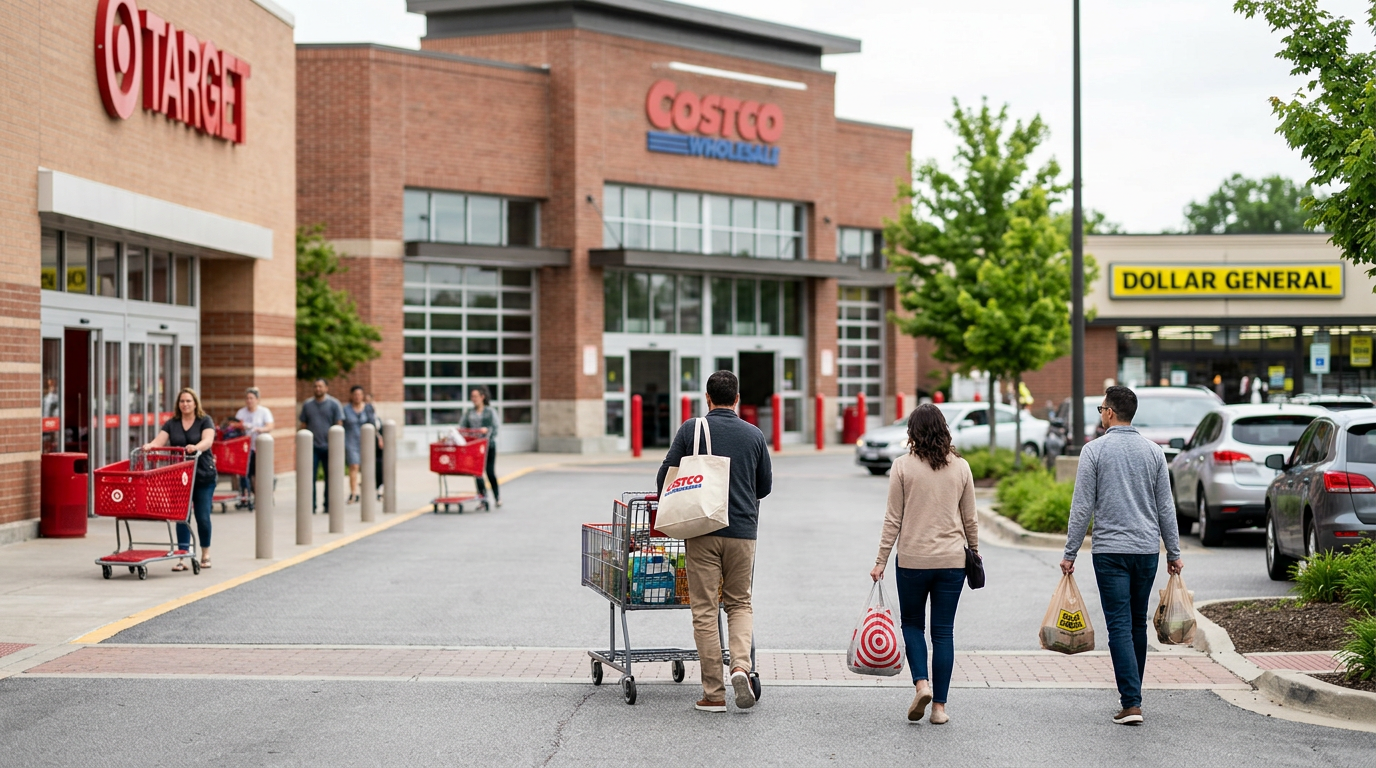
This is where the divergence shows up in a practical way. Warehouse clubs and better-run big box are capturing share. The low-end is still fighting for every trip.
- Costco (COST), fiscal Q2 2026 (ended Feb. 15, 2026): Total revenue $69.6B (vs. $63.7B prior year); diluted EPS $4.58 (vs. $4.02 prior year). Comparable sales +7.4% (or +6.7% adjusted for gas and FX).
- Target (TGT), fiscal Q1 2026 (reported May 20, 2026): Comparable sales +5.6%, the first positive quarter after four straight declines. Digital sales +8.9%.
The Costco numbers in the prior draft were off on both revenue and EPS. The correct quarter was meaningfully stronger.
Why investors care right now
Costco is not just benefitting from “trade down.” It is benefitting from trust. In an inflation hangover, households want fewer mistakes per grocery trip, and Costco’s model leans into that.
Target is different. The signal is not “perfect execution.” The signal is that traffic and baskets can recover when merchandising is less cluttered and fulfillment is faster. If comps stay positive through the tougher comparisons, the market will treat it as a real turn, not a bounce.
One note on the value channel: the earlier Dollar General margin line in this email did not hold up on review. Recent public detail around Dollar General has pointed to gross margin improvement in its latest reported quarter, helped by shrink improvement. Rather than force a number that may be quarter-mismatched, this version keeps the focus on the broader consumer split without citing an unreliable margin contraction figure.
Why Didn’t Your Bank Tell You This?
For decades, America’s biggest banks quietly used a powerful compounding strategy most families never heard about.
The results? $1,000 potentially growing into more than $556,000 since 2000.
It’s simple, legal, and now available to everyday investors.
Macro context that can change the story fast
Inflation is not “done.” BEA’s PCE price index was running +3.5% year over year in March 2026. That keeps rate-cut talk conditional, and it matters for discretionary categories that lean on financing.
Sentiment is the wild card. The University of Michigan’s May 2026 Index of Consumer Sentiment was 49.8. That is weak, and it lines up with the idea that shoppers are still cautious even when they are spending.
Scenarios
Bull case: Wage growth stays steady, gas prices cool, and food inflation keeps easing. Costco holds mid to high single-digit comps longer than expected, and Target builds on positive comps with improving margins as promotions normalize.
Base case: Consumer spending grows, but slowly. Costco remains the steady compounder. Target improves, but the market demands proof for more than one quarter. Value retail stays choppy as the lowest-income shopper remains constrained.
Bear case: Another inflation flare keeps rates higher for longer, and jobless claims trend up. Discretionary categories slow first, then grocery basket mix gets more defensive. In that world, even the winners can see multiple compression.
Technical view
Keep this simple. COST has been acting like a leadership stock for months, and momentum tends to persist until it doesn’t. TGT is more of a prove-it chart, with the next leg depending on whether the next quarter confirms comp strength and margin follow-through. If either name loses support around its 50-day moving average on heavy volume, that is usually the first sign the market is changing its mind.
What I’m watching next
- Retail sales: The next clean checkpoint is the June 2026 U.S. retail sales release in mid-July.
- Target follow-through: Category momentum and fulfillment costs. Positive comps matter, but profitability is what makes it durable.
- Gas and food: If those re-accelerate, value retail will show stress first.
Worth a look: if you’re only tracking “the consumer” as one thing, you’ll miss what’s actually happening under the surface.