
June 1, 2026
AI Bottlenecks Now Steering Money on Wall Street
Featured – Ross Stores: Q1 Strength Raises the Bar
Editor’s Note: For three decades, veteran analyst Eric Fry has built his track record by identifying what Wall Street’s biggest winners need before they need it. Today he’s issuing a rare public warning to every Mag 7 holder – and naming the one “mission-critical” company Nvidia just placed a multibillion-dollar bet on. Watch his full briefing here or read his open letter below.
Dear Reader,
If you own Nvidia, Microsoft, Amazon, Meta, Apple, Alphabet, or Tesla…
I’m urging you to take this warning seriously.
The AI boom is running into a problem that Wall Street has badly underestimated:
Physical reality.
Bottlenecks like power… cooling… land… and raw materials.
These are the unglamorous constraints that can derail even the biggest AI winners.
When they do, they’ll punish investors who think the Mag 7 can keep rising forever.
Because when hyperscalers announce trillion-dollar AI ambitions, too many investors focus on the headline-making promises.
I focus on the reality standing in their way.
And right now, one bottleneck has become so important that Nvidia just opened its checkbook.
The AI giant struck a deal to buy 3 million shares of a “mission critical” hardware supplier.
The stock instantly surged.
But buried in the contract is the part I believe investors cannot afford to ignore…
A clause that could allow Nvidia to buy 15 million more shares.
At today’s prices, that could represent as much as $3.2 billion in potential buying power tied to this one company – an amount that could send this company’s stock soaring.
And that’s exactly why I’ve been telling readers for nearly a year:
Dump Nvidia. Buy this stock instead.
Sincerely,
Eric Fry
Senior Macro-Investment Analyst, InvestorPlace
FEATURED
Ross Stores: Q1 Strength Raises the Bar
Off-price retail does not usually deliver a quarter that forces both buyers and skeptics to update their assumptions in the same afternoon.
Ross Stores just did.
Analyst targets (recent)
- JPMorgan: Overweight, price target to $251 (from $248)
- Citigroup: Buy, price target to $261 (from $240)
- UBS: Neutral, price target to $232 (from $227)
Targets moved quickly after the company reported first quarter fiscal 2026 results on May 21, 2026 for the quarter ended May 2, 2026.
Company profile
Ross Stores is an off-price retailer operating Ross Dress for Less and dd’s DISCOUNTS. The model is straightforward: buy branded goods opportunistically, move inventory quickly, and offer consistent value versus department and specialty stores. When consumers become more price sensitive, off-price tends to gain trips.
The numbers (Q1 fiscal 2026)
- Net sales: $6.01B, +21% year over year
- Comparable store sales: +17% (versus flat in the prior-year quarter)
- Diluted EPS: $2.02, +37% year over year
- Guidance comparison: EPS was above the company’s prior Q1 guide of $1.60 to $1.67
- Operating margin: 13.4%, above the company’s plan of 11.8% to 12.1%
Outlook (as of May 21, 2026)
- Q2 fiscal 2026: comparable sales +6% to +7%, EPS $1.85 to $1.93, operating margin 12.8% to 13.0%
- FY fiscal 2026: EPS $7.50 to $7.74; comparable sales raised to +6% to +7%
- Capital return: repurchased 1.5M shares for $319M in Q1; still targeting $1.275B of buybacks in fiscal 2026 (under a two-year $2.55B authorization)
- Stores: opened 13 Ross and 4 dd’s in Q1; planning about 110 new stores for the year (about 5% unit growth)
Why the stock moved
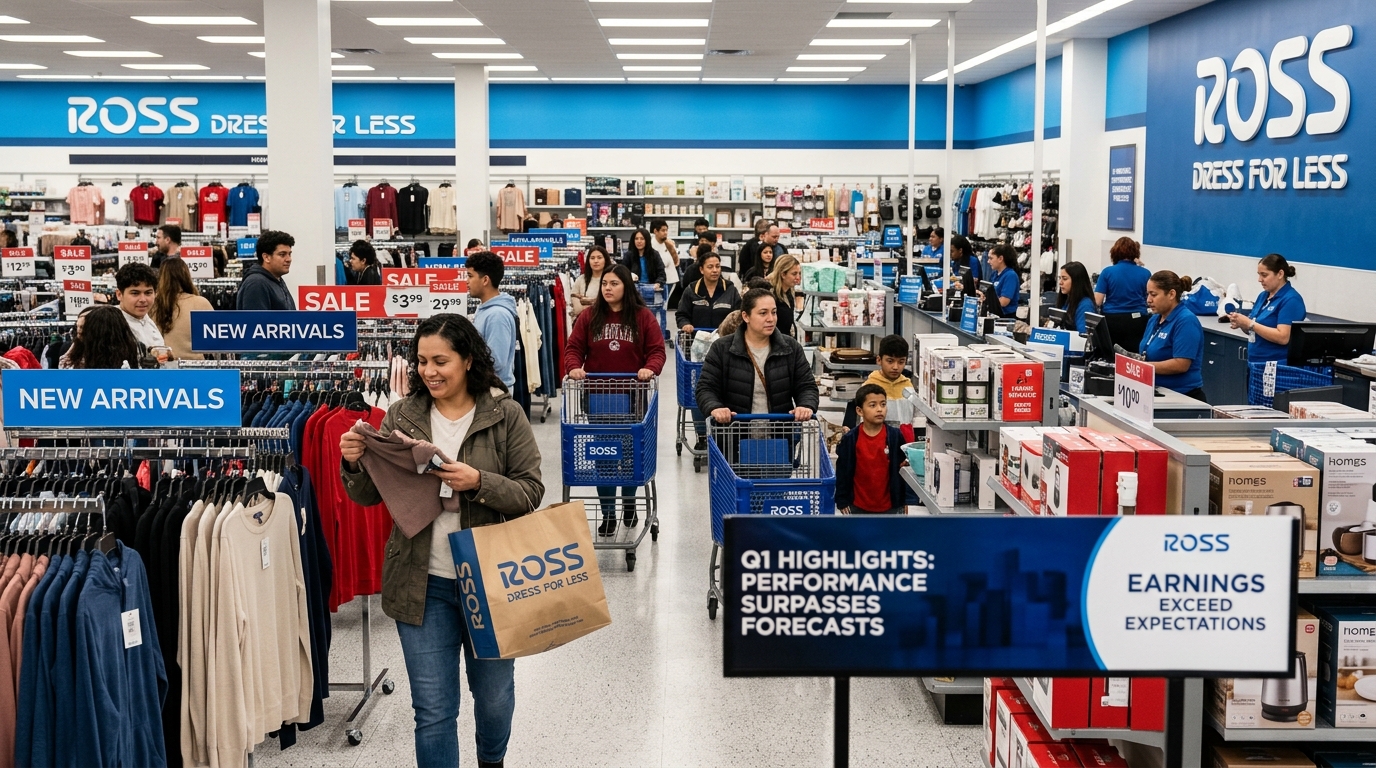
This quarter was not powered by pricing. It was powered by traffic.
Management attributed the comp performance primarily to higher transaction volume and a double-digit increase in customer count across income levels, ethnicities, and age groups. That matters because it suggests Ross was not just harvesting a narrow value cohort. It was pulling trips from a broader set of shoppers.
Slight tangent, but it matters: in retail, there are quarters where you can explain everything with markdown discipline or freight rates. This one reads more like a demand event. Those are rarer, and they tend to reset expectations quickly.
Macro and industry context
Off-price typically benefits when households become more deliberate. In that environment, shoppers stretch budgets by trading down on discretionary apparel and home categories while still shopping in person. Ross does not need exuberance. It needs comparison shopping.
The risk, of course, is that after a quarter like Q1, the market begins to treat 17% comps as a reference point. That is not realistic. The company’s own Q2 guide of 6% to 7% comps is the more practical baseline, and the market will likely focus on whether traffic remains strong enough to keep margins firm as growth normalizes.
Scenarios
Bull case: Demand remains broad based (not just lower income). The 6% to 7% comp guide proves conservative, store productivity holds as openings ramp, and margin strength persists as volumes leverage expenses. In that case, FY estimates drift higher through the summer.
Base case: Comps cool toward guidance as comparisons get tougher and the quarter loses one-off tailwinds. Earnings growth stays solid but becomes less surprising. The stock performance becomes more sensitive to incremental estimate revisions rather than headline beats.
Bear case: The comp slows faster than expected, and investors begin to question how much of Q1 was timing related. If cost pressures return (including trade-policy related uncertainty that the company has cited as a risk), the margin cushion shrinks and the multiple compresses.
Technical overlay (high level)
After a sharp post-earnings move, the key question is whether the stock can hold the post-report gains while forward estimates catch up. If it churns sideways for a few weeks, that often signals the market is waiting for revisions and follow-through data rather than fading the quarter outright.
What to watch next
- Traffic vs. ticket: does transaction growth remain the main driver, or does it lean more on higher basket size?
- Merchandise availability: off-price wins when it can consistently source branded product at attractive costs
- Margins: whether operating margin stays near the low teens as growth normalizes
- Buybacks: pacing toward the $1.275B fiscal 2026 target
Bottom line
Ross delivered a Q1 that was objectively stronger than expected: 21% sales growth, 17% comps, and EPS far above its own guidance, with an outlook increase to match.
Now the bar is higher. If the company can keep traffic healthy while stepping down from an extraordinary comp, the story stays intact. If not, Q1 becomes the high watermark that makes every subsequent quarter feel smaller than it actually is.