
June 18, 2026
Bloom Energy Hits a New 52-Week High
Record revenue, a deal wave, and one uncomfortable wildcard investors can’t ignore.
Bloom Energy is up more than 15% today. The stock just hit a fresh 52-week high. And if you’ve been watching this name for a while, you already know the ride has been anything but boring.
The 52-week range tells the story: $20.93 to $322.83. That’s not a typo. This is a stock that has essentially revalued itself from a speculative clean energy play into something institutional desks are now underwriting as core AI infrastructure. Whether that re-rating holds is the central question. But first, the facts.
Analyst Targets
- Morgan Stanley: Overweight – $310 target
- RBC Capital Markets: Outperform – $335 target
- Daiwa: Outperform – $324 target
- UBS: Raised target, clustering in the high-$260s to low-$320s range
- Bernstein: Market Perform – $276 target
- Consensus average: ~$260, with the stock now trading well above it
The stock is well above Street consensus. That’s either a sign analysts are still catching up to a fundamentally different growth trajectory, or the market is pricing in execution that hasn’t been fully de-risked yet. Probably some of both.
Run This 7-Point Check Before Your Next Move
Ever been right about a stock’s direction and still lost money on the trade?
It happens to almost every beginner. And it’s almost never bad luck – it’s a checkpoint you skipped before you placed the trade.
I put the 7 that matter most on one page.
It’s called the Smart Trade Options Checklist. Normally $29.97. Free today.
Run it before any options trade. About 30 seconds. You’ll catch the bad ones before they cost you.
What Bloom Actually Does
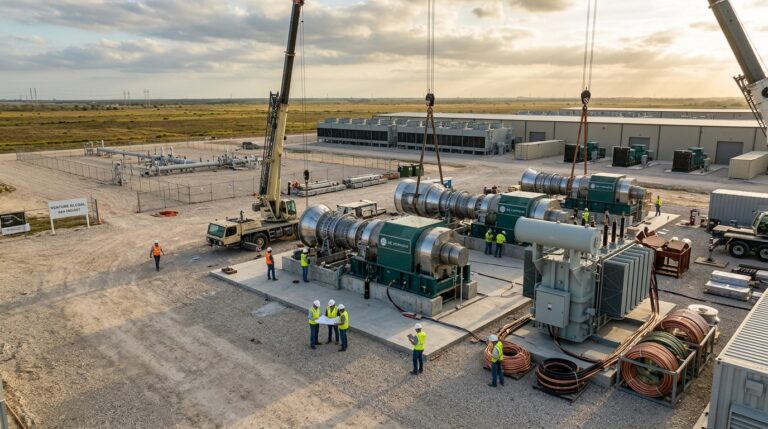
Bloom Energy designs and manufactures solid oxide fuel cells (SOFCs) that generate electricity on-site through a non-combustion electrochemical process. The fuel source can be natural gas, biogas, hydrogen, or a blend. No grid connection required. No combustion. Power goes directly to the facility consuming it.
That last part is the whole trade right now.
AI data centers consume staggering amounts of power. Grid interconnection queues in the U.S. stretch five to ten years in many regions. Bloom’s behind-the-meter solution sidesteps all of that. You don’t wait for the utility. You put the power source on your property and turn it on. For hyperscalers trying to scale GPU capacity this year, not in 2031, that’s not a nice-to-have. It’s a prerequisite.
The company also offers the Bloom Electrolyzer for hydrogen production and holds more than 1,000 patents globally. The customer base spans data centers, utilities, retail, healthcare, telecom, and manufacturing. Service contracts carry a 100% attach rate to product sales and typically span a decade or longer, building a long-dated annuity stream behind the headline revenue.
The Numbers
Q1 2026 was, by any reasonable standard, a blowout. Not in a headline-chasing way. In a way that forces you to recalibrate the model entirely.
- Revenue: $751.1M vs. $326.0M a year ago – up 130.4% year-over-year
- Revenue vs. Estimates: Beat by approximately 41.6% – the Street was looking for roughly $530M
- Product Revenue: $653.3M – up 208.4% year-over-year
- Non-GAAP EPS: $0.44 vs. consensus of $0.13 – a 238% beat
- GAAP EPS: $0.23 (vs. a $0.10 loss in Q1 2025)
- Non-GAAP Gross Margin: 31.5% – up 280 basis points year-over-year
- Non-GAAP Operating Income: $129.7M vs. $13.2M a year ago – roughly 10x
- Adjusted EBITDA: $143.0M vs. $25.2M in Q1 2025 – roughly 6x
- Operating Cash Flow: $73.6M – positive, versus a cash outflow in Q1 2025
- Cash on Hand: $2.49B | Recourse Debt: $2.60B
The guidance raise was equally aggressive. Full-year 2026 revenue guidance moved to $3.4B–$3.8B, implying roughly 80% growth at the midpoint. Non-GAAP operating income guidance set at $600M–$750M. Non-GAAP EPS range: $1.85–$2.25. Management also said Q2 revenue is expected to be at least as strong as Q1.
This is a company that printed $326M in revenue a year ago. It’s now guiding to $3.6B for the full year. That’s not incremental growth. That’s a category shift.
Is the OpenAI IPO a Trap?
Millions of investors are getting ready to buy OpenAI the moment it goes public. But that could be too late. Instead, there’s a way anyone can claim a pre-IPO ownership stake NOW starting with just a few hundred dollars.
Why the Stock Is Moving
Three things are layering on top of each other here, and it’s worth separating them because they carry different risk profiles.
1. Oracle. In April, Oracle expanded its capacity partnership with Bloom, committing to purchase up to 2.8 gigawatts of fuel cell systems. The initial 1.2 GW tranche is already contracted and deployment has started. Oracle also received a warrant to purchase roughly $400M of Bloom’s stock – a signal of long-term alignment, not just a purchase order. That deal alone changes the revenue visibility picture materially, and it pushed shares up 22% on the announcement day.
2. Nebius. On May 20, Bloom struck a master fuel cell capacity agreement with Nebius, the AI infrastructure provider. The deal covers approximately 328 MW of installed capacity, starting with U.S. data centers and carrying the potential for global expansion. Total value: up to $2.6B in service fees over the contract term. This isn’t hardware sales – Bloom installs, operates, and maintains the systems, which means recurring revenue and stickier customer relationships. Shares jumped more than 12% on the day of the announcement.
3. The backlog. Between Oracle, Nebius, and existing contracts, the company’s total backlog across products and long-term service now sits at roughly $20 billion. That’s not a pipeline number. That’s contracted and framework revenue with a real delivery schedule behind it.
The Wildcard: Crusoe and Project Jade
Here’s where it gets uncomfortable. On June 10, AI infrastructure company Crusoe announced it had paused development of Project Jade – a planned 1.8 GW data center campus in Cheyenne, Wyoming – at the request of an unnamed customer. The facility had been designed to eventually scale to 10 GW, which would have made it the largest single AI campus in the U.S.
Bloom was selected to supply fuel cell systems for the first phase. The project was connected to a conditional power purchase agreement involving AEP Energy and Bloom’s SOFC supply. When the pause hit, Bloom’s stock dropped more than 9% in a single session. The math on the exposure: roughly $2.65B in potential revenue clouds over.
A slight tangent worth noting: Crusoe’s own CEO was publicly bullish in the same announcement, pointing to 4.9 GW of contracted data center infrastructure for Crusoe Cloud and a total development pipeline exceeding 40 GW. The company didn’t exit the project permanently. It paused at a customer’s request. Black Hills Energy, a separate utility, confirmed its own Wyoming data center project continues as planned with an in-service date tracking for early 2028.
Morgan Stanley and RBC both stood by Bloom after the drop – MS reiterated Overweight at $310, RBC reiterated Outperform at $335 – pointing to contractual protections with AEP. The stock has since recovered. But the episode crystallized the core risk: Bloom’s growth is heavily concentrated in a small number of very large, capital-intensive AI infrastructure projects. When one moves, the stock moves.
Macro Context
The structural backdrop for Bloom’s business has arguably never been stronger. AI compute demand is accelerating, and power is now the binding constraint – not chips, not capital, not permitting in some cases. Power is the bottleneck.
Bloom’s own mid-year Data Center Power Report, released June 15, flagged something worth watching: intensifying public and legislative scrutiny over grid reliability, electricity costs, and water usage has triggered at least 18 proposed state bills and 86 local moratoriums across the U.S. These aren’t abstract regulatory headwinds. They represent localized resistance to data center construction that could slow deployment timelines for any behind-the-meter solution, Bloom’s included.
The Fed held rates unchanged at the June meeting but the dot plot shifted hawkish, with further rate increases on the table. That matters for a capital-intensive infrastructure company still carrying $2.6B in recourse debt. Cost of capital is not irrelevant here.
On the positive side: Bloom’s addressable market is global, and the European AI buildout is accelerating. The Nebius deal – with its potential for international expansion – hints at a geography that’s equally power-constrained and, arguably, more willing to embrace distributed generation solutions.
The way you’ve been building your wealth is working against you
In 2022, the last time the Fed made a major shift, the 60/40 portfolio had one of its worst years on record.
Bonds collapsed, stocks fell… there was nowhere to hide.
Larry Benedict saw it coming. He went 11-for-11 while most investors had no idea what hit them.
He says the same pattern is setting up now – on a much bigger scale.
Click here to hear his warning and find out the one move he’s making instead.
Bull / Base / Bear
Bull Case. Oracle and Nebius ramp without disruption. The 2.8 GW Oracle framework converts to full delivery. Nebius expands internationally and adds capacity. Crusoe’s Project Jade either resumes or is replaced by another hyperscaler. Full-year 2026 revenue comes in at the top end of guidance ($3.8B) or above. Margins continue to expand toward the 34% non-GAAP gross margin target. The stock – currently trading at over 32x sales – sustains its premium on the thesis that Bloom is a multi-decade infrastructure platform, not just a fuel cell vendor. New contracts from other hyperscalers materialize in H2.
Base Case. Execution stays largely on track. Oracle 1.2 GW ships on schedule. Nebius builds out its 328 MW. Crusoe remains a question mark but doesn’t become a direct revenue loss. Revenue lands in the $3.4B–$3.6B range. Margins expand modestly but fall short of the 34% target due to investment spending. The stock consolidates between $260 and $310, re-testing prior resistance levels as the Street gradually closes the gap between consensus targets and market price. Q2 results (expected July 30) become the next key catalyst.
Bear Case. Project Jade doesn’t resume and AEP’s conditional power purchase agreement becomes complicated. One or more additional hyperscaler projects face delays. The regulatory environment tightens further, slowing data center buildouts. Revenue misses the low end of guidance. Net profit margins – currently razor-thin at roughly 0.24% on a GAAP basis – provide no cushion against cost overruns. The stock, trading at a substantial premium to any reasonable discounted cash flow estimate, compresses sharply. A valuation reset from 32x sales toward 15–18x becomes the scenario.
Technical Overlay
The all-time closing high was $307.88, set on May 21. The intraday 52-week high is $322.83. Today’s move is pushing the stock back toward that ceiling after the Crusoe-driven pullback took it from the low $300s into the mid-$260s over roughly two weeks.
RSI sits at approximately 55, neutral territory. MACD is showing a slightly negative reading, which means momentum is recovering but not yet confirmed. Williams %R is in buy territory. The stock is essentially caught between two forces: a strong fundamental re-rating pushing it toward and through the May highs, and the weight of a valuation that has outrun even the most optimistic analyst targets on the Street.
Key levels to watch: $285 as near-term support (recent closing base), $307 as first resistance (May 21 closing high), and $322–$325 as the intraday ceiling that has rejected twice. A clean close above $322 on volume would be the technical confirmation bulls are looking for. A break below $260 puts the Crusoe narrative back in focus.
Investors are watching this fast-growing tech company
No, it’s not Nvidia… It’s Mode Mobile, 2023’s fastest-growing software company according to Deloitte.
Their EarnPhone has helped users earn and save over $1B, driving $115M+ in revenue and an eye-popping 32,481% revenue growth. And having secured partnerships with Walmart and Best Buy, Mode’s not stopping there…
Like Uber turned vehicles into income-generating assets, Mode is turning smartphones into an easy passive income source. The difference is, investors like you still have a chance to invest in Mode’s pre-IPO offering at $0.52/share.
They’ve just been granted the stock ticker $MODE by the Nasdaq and over 59,000 investors participated in their previous rounds.
$71M+ already invested – claim your stake at $0.52/share and earn up to a 20% bonus
Please read the offering circular at invest.modemobile.com. This is a paid advertisement for Mode Mobile’s Regulation A Offering.
What to Watch
- Q2 Earnings (July 30): Management guided for revenue at least as strong as Q1’s $751M. Any miss here resets the entire thesis.
- Oracle delivery cadence: The 1.2 GW contracted tranche is in deployment. Watch for any update on the additional 1.6 GW framework conversion.
- Project Jade resolution: Whether the unnamed hyperscaler engages directly or the project stalls permanently matters enormously for the pipeline narrative.
- Analyst target revisions: With the stock well above the $260 consensus average, expect continued target raises if execution holds. The gap needs to close – either through price coming down or targets going up.
- Insider activity: Insiders have sold significantly more than they’ve bought over the past 12 months. Worth monitoring, though options-related sales are a common feature of high-growth tech-adjacent names.
- Regulatory landscape: The 18 proposed state bills and 86 local moratoriums flagged in Bloom’s own report represent a slow-moving but real constraint on deployment velocity.
Bottom Line
Bloom Energy is no longer a clean energy story. It’s a power infrastructure story, and right now, power infrastructure for AI is about as in-demand as anything in the market. The Q1 numbers weren’t just good – they were the kind of numbers that force institutional models to be rebuilt from scratch. A 130% revenue jump, a 238% EPS beat, and a guidance raise to $3.4B–$3.8B for the full year – that’s a category-level revaluation event, not a beat-and-raise quarter.
The Oracle and Nebius deals are real, contracted, and backed by serious counterparties with massive deployment incentives. The $20B backlog is not speculation.
What isn’t resolved: whether the stock has priced in everything good and nothing bad. A valuation above 32x forward sales on GAAP-thin margins leaves almost no room for execution slippage. The Crusoe episode showed how quickly the market punishes pipeline uncertainty. It also showed how quickly it recovers when the fundamental case reasserts itself.
The real debate isn’t whether Bloom’s technology works. It does. The debate is whether a $50B-plus market cap company can actually convert a $20B backlog into revenue without a single major project stumbling – and do it at the pace the market is currently pricing. That answer won’t be known until Q2 results land on July 30.
For informational purposes only.