
July 15, 2026
GE Aerospace’s Quiet Dominance
Two massive tailwinds. One overlooked industrial giant.

If the House Flips, Don’t Let Your 401(k) Take the Hit
Move your hard-earned savings out of paper risk before ballots are cast.
If you are 5 to 10 years from retirement, this election season is not background noise. It is a reminder to take a serious look at the retirement savings you’ve accumulated and put some protective measures in place.
If the Democrats manage to flip the House and/or Senate, it breaks the current legislative balance.
The mainstream media may call it a victory for oversight, but history shows what this shift could mean for your savings…
Election fueled volatility that could leave soon-to-be retirees with losses in their 401(k)’s.
Prolonged budget battles that can rattle consumer confidence and corporate earnings.
A Democratic pushback against President Trump’s economic growth plan.
For those closing in on your retirement date, it doesn’t take a major market crash to threaten everything you’ve worked for.
A sudden shift in power and the volatility of an election cycle is just enough to shave years worth of comfort from the retirement budget you’re planning for.
Many market insiders and global financial “whales” see this trap coming… and there’s a major wealth protection play they’re making that’s stood the test of time.
They’re not buying more paper assets, they’re transferring their wealth into the stability that comes with the ownership of physical gold.
Do not let one election cycle break your nest egg when you’re so close to the finish line.
Download our 2026 Wealth Preservation Guide Now!
Inside you’ll learn the legal IRS loophole to legally transfer your vulnerable retirement savings account into physical gold and silver, without taxes or additional penalties.
>>Get Your Free 2026 WEALTH PRESERVATION GUIDE<<

GE Aerospace’s Quiet Dominance
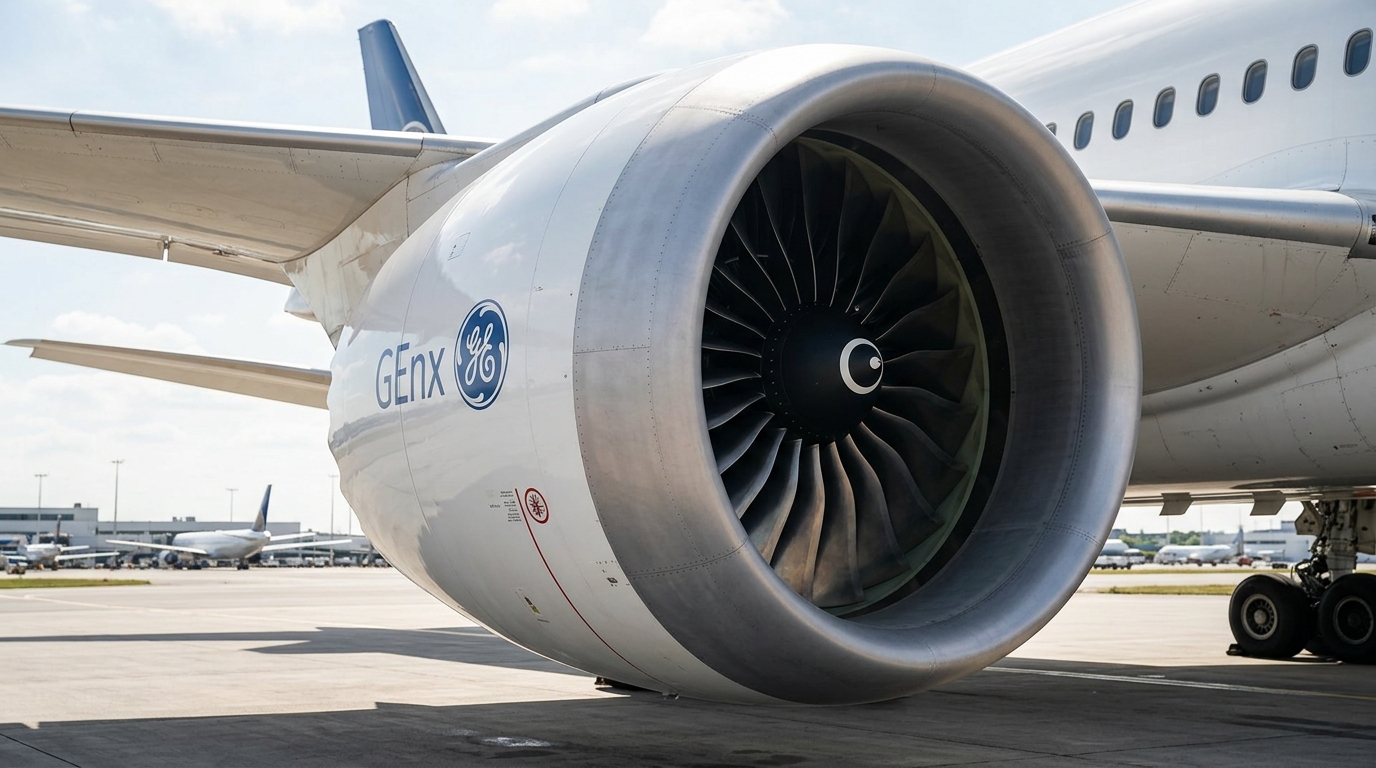
There is a company that makes the engines powering nearly every major commercial aircraft flying today, holds a $170 billion services backlog, just posted its strongest defense order intake in a decade, and is trading near all-time highs while most investors are still focused on semiconductors. That company is not a tech stock. It does not make GPUs. It does not have a chatbot.
GE Aerospace reported Q2 2026 earnings before the open this morning. Wall Street was looking for $1.86 per share on revenue of roughly $11.9 billion. The company has beaten consensus estimates in each of its five most recent quarters, with an average positive surprise of approximately 13.6%. The pattern is consistent enough that the question going into today was less about whether GE would beat and more about what management would say about the second half of the year.
Here is the actual investment thesis: the global aviation industry is structurally short of engines and parts, and GE Aerospace is the single largest supplier. That imbalance does not resolve in one quarter. It plays out over years.
Analyst Targets
- Consensus analyst rating: 19 Buy, 1 Hold, 2 Sell (as of pre-earnings)
- Consensus price target: $370.14
- Full-year 2026 adjusted EPS guidance: $7.10 to $7.40
- GE all-time high: $382.97, set earlier in July 2026
The Market Opportunity
Commercial air travel has fully recovered and, in many markets, exceeded pre-2020 levels. But the supply side of the aviation industry never fully recovered. Engine production is constrained. Shop visit capacity is constrained. Spare parts lead times are long. Airlines are flying older aircraft harder because new deliveries from Boeing and Airbus are running behind schedule by years, not months. Every extra hour those older engines fly generates aftermarket service revenue for whoever manufactured them.
GE Aerospace manufactured a significant portion of them.
At the same time, global defense budgets are expanding at a rate not seen in decades. The Iran-U.S. military confrontation that escalated through the spring of 2026 accelerated procurement timelines across NATO and allied nations. GE’s defense and propulsion business posted a 67% surge in orders during Q1 2026, which management described as the strongest defense order intake of the decade. That kind of demand does not evaporate in a quarter.
The Numbers
Q1 2026 actuals (most recent confirmed quarter):
- Revenue: $12.39 billion, up approximately 25% year over year
- Adjusted EPS: $1.86, vs. $1.60 consensus, a 16.25% beat
- Total orders: $23.0 billion, up 87% year over year
- Commercial Engines and Services (CES) orders: nearly doubled year over year
- Defense and Propulsion Technologies (DPT) orders: up 67%, strongest defense intake of the decade
- Free cash flow: $1.66 billion, up approximately 27% year over year
- Commercial services backlog: $170 billion
Q2 2026 consensus estimates heading into today’s report:
- Revenue: approximately $11.87 billion, up roughly 17% year over year
- Adjusted EPS: $1.86 per share, up 12.1% from a year ago
- Full-year 2026 guidance range: adjusted EPS $7.10 to $7.40
GE has beaten EPS consensus in each of the past five quarters. The average beat was around 13.6%. The Q2 revenue estimate reflects year-over-year growth of approximately 17%, a step down from Q1’s 25%, mostly due to timing differences in large defense deliveries rather than any demand slowdown.
Why GE Aerospace
A slight tangent, but it matters: most investors who follow industrial stocks think of GE Aerospace primarily as an engine manufacturer. That framing is too narrow. The real business model is closer to a recurring-revenue services platform built around an enormous installed base.
Here is how it works. GE sells engines to airlines and governments. Those engines fly for decades. Every time an engine comes off a wing for a shop visit, GE performs the overhaul. Every spare part that gets replaced generates revenue. The CFO confirmed entering Q2 that 95% of spare parts revenue was already in backlog and all scheduled shop visits for the quarter were accounted for. That is not a business with meaningful demand uncertainty. That is an annuity with an engine attached to it.
Commercial wins in Q1 alone included more than 300 LEAP-1A engines for American Airlines, 300 GEnx engines for United Airlines, and 60 GEnx engines for Delta. Those deals feed the services backlog for the next 20 to 30 years. The $170 billion backlog number is not a snapshot. It is a forward revenue guarantee.
Competitive Advantage
GE Aerospace designs and manufactures aircraft engines while generating recurring, high-margin revenue through long-term maintenance and service agreements. Its massive installed engine base creates a durable aftermarket business that delivers consistent cash flow throughout the engine’s operating life.
The LEAP engine, which powers the Boeing 737 MAX and Airbus A320neo family, is the most widely ordered narrowbody engine in history. GE shares the LEAP program with Safran through CFM International. That partnership gives GE exposure to the largest segment of global commercial aviation without carrying the full development cost alone.
On the defense side, GE’s engines power the F/A-18, the KC-46 tanker, the T901 upgrade for the Black Hawk, and a broad range of military platforms. As defense procurement accelerates globally, GE is not chasing new contracts from scratch. It is fulfilling an existing order book that grew 87% in a single quarter.
What’s interesting is that GE Aerospace is benefiting from the same geopolitical tension that is creating uncertainty elsewhere. Defense spending going up is unambiguously good for the order backlog. That is an asymmetric positive in the current environment.
Macro Context
The macro backdrop has two very different implications for GE, depending on which part of the business you are looking at.
On the commercial side, consumer spending on travel has been remarkably resilient despite elevated interest rates and a federal deficit running near $1.4 trillion. Airlines are reporting strong bookings and load factors. The supply constraint in the engine market means demand for GE’s aftermarket services remains elevated regardless of where the economy is headed in the near term. You cannot ground a plane to wait for a better macro environment.
On the defense side, U.S. military activity in the Strait of Hormuz, escalating European defense spending, and allied nations accelerating procurement timelines all point in the same direction: more orders, more urgency, and faster revenue recognition. Crude oil topped $80 per barrel following the latest round of U.S.-Iran military exchanges. That is a tailwind for defense budgets, not a headwind.
GE guided for mid-teens revenue growth in the Commercial Engines and Services segment for the full year. Spare parts orders in that segment surged 40% year over year between early March and mid-May 2026. The demand signal has not weakened.
Forward Scenarios
Bull Case
GE raises full-year 2026 EPS guidance toward the top of its $7.10 to $7.40 range or above it. Defense orders continue accelerating through year end. The supply-constrained aviation market keeps aftermarket pricing power intact. Free cash flow expands above $7 billion for the year, supporting further capital returns. Shares recover from recent levels and establish a new trading range above $380, with the longer-term bull case pointing toward $420 to $440 as earnings revisions move higher.
Base Case
GE delivers Q2 in line with or slightly above consensus. Full-year guidance holds. The commercial services business continues compounding at mid-teens growth. Defense orders moderate slightly but remain elevated relative to historical norms. The stock trades in the $340 to $380 range as investors digest the valuation premium and await confirmation that H2 2026 matches the momentum of H1.
Bear Case
A rapid de-escalation in global military tensions reduces defense procurement urgency. An economic slowdown cuts into airline capacity and shop visit demand. Supply chain disruptions — which have plagued the aviation industry for three years — return in a more severe form. The stock is not cheap on a traditional P/E basis, trading at roughly 50x trailing GAAP earnings, and a guidance cut or margin compression would pressure the multiple meaningfully. Downside support is around $300 to $310, which represents the pre-rally base from early 2026.
Technical Overlay
GE Aerospace hit an all-time high of $382.97 earlier in July 2026, following a run that has taken the stock up more than 43% over the past year and approximately 12% year to date. The stock has built a series of higher lows since the April 2026 lows, a constructive structure that reflects institutional accumulation rather than momentum chasing.
Near-term support sits in the $340 to $345 range, which corresponds to the breakout level from June. A strong Q2 report with raised guidance could push the stock toward $390 to $400 in the weeks following the earnings call. A failure to hold $340 on a closing basis would suggest the post-earnings reaction was insufficient to sustain the prior momentum.
What Investors Should Watch
- Full-year 2026 EPS guidance revision: Any move above the current $7.10 to $7.40 range changes the earnings model for the year and triggers analyst estimate upgrades.
- Commercial services backlog growth: The $170 billion figure already sets a high bar. Watch for language on new engine order conversions and long-term service agreement signings.
- Defense order trajectory: Q1 was the strongest defense intake in a decade. Q2 commentary on pipeline and awarded programs determines whether that was a spike or a trend.
- Free cash flow conversion: GE’s capital return story depends on sustained FCF. Watch Q2 FCF against the $1.66 billion Q1 figure.
- LEAP engine production rates: CFM International has been working to expand output. Any update on production targets directly impacts revenue visibility for the next 12 to 18 months.
The Real Debate
The pushback on GE Aerospace is straightforward: the stock is expensive. At current levels, it trades at a meaningful premium to both its own historical average and the broader industrial sector. The GAAP P/E looks elevated because reported earnings include significant non-cash charges tied to prior restructuring. Adjusted earnings tell a cleaner story, but sophisticated investors will rightly ask how much of the adjusted EPS improvement represents genuine cash generation versus accounting choices.
The answer lies in free cash flow. GE produced $1.66 billion in free cash flow in Q1 alone. The company is guiding for a substantial full-year FCF figure. That is real money, not adjusted away. And it is being returned to shareholders through buybacks and dividends while simultaneously funding manufacturing capacity investments to meet the demand the backlog is telling them is coming.
Here is where I land on the valuation concern: the $170 billion services backlog is not reflected anywhere in the traditional P/E analysis. That backlog represents revenue that is essentially pre-sold, tied to service agreements on engines already flying. It is the kind of visibility that most industrial companies cannot claim at any valuation. When you price GE on a free cash flow basis against the durability of that backlog, the premium shrinks considerably.
The market still has not fully priced in what happens when the defense cycle extends, the commercial aviation supply constraint persists for another two to three years, and GE’s earnings keep compounding above the $7 EPS threshold. That is where the opportunity is.
Watch the guidance language this morning. That is the signal.
For informational purposes only.