
July 20, 2026
AMD’s Quiet Bet Is Starting to Pay Off
Agentic AI is rewriting the data center compute equation, and AMD’s EPYC business sits at the center of it.
Here is the thing about AMD right now. The stock has had a remarkable run, analysts keep lifting their targets, and the Helios platform is generating genuine enterprise excitement. But ask most investors what is actually driving it, and the answer you get back is GPUs. Instinct accelerators. The Nvidia alternative trade.
That framing is not wrong. It is just incomplete.
The numbers from Q1 first. AMD reported Q1 2026 non-GAAP EPS of $1.37, while revenue came in at $10.3 billion, up 38% year over year. Free cash flow rose to $2.566 billion for the quarter. The stock surged on the results. Most coverage moved on quickly.
What got less attention was a single line in CEO Lisa Su’s commentary about CPUs.
Bigger than Nvidia? Louis Navellier thinks so.
In 2016, Louis Navellier recommended Nvidia at $2.51 – split-adjusted. It went up 44,000%. He also called Apple before a 36,000% rise and Microsoft before a 60,800% climb. Now he says a new AI device coming online in Tennessee is the setup for the biggest call of his career.
He’s agreed to reveal the stock at the center of it – down to the ticker – for free.
The Forecast That Doubled Overnight
During the Q1 earnings call, Su said AMD now expects the server CPU total addressable market to grow at greater than 35% annually, reaching over $120 billion by 2030—up sharply from its prior roughly 18% CAGR outlook shared in November 2025 (which implied about $60 billion by 2030).
The reason is agentic AI. Not the chatbot kind. The kind where multiple AI models act autonomously, call tools, execute workflows, and hand off tasks to each other in real time. Instead of the previous 1:4-8 CPU-to-GPU ratio with chatbot AI, agentic AI is moving toward a higher CPU requirement, with more CPU compute needed for orchestration and infrastructure support. That is a structural shift in how data centers get built and how compute budgets get allocated.
As AMD CFO Jean Hu has emphasized in public remarks around earnings, agentic AI workloads increase demand for CPU compute for orchestration and broader infrastructure needs.
Slight tangent, but it matters: on the Q1 call, AMD said server CPU sales grew by over 50% year over year, with both cloud and enterprise customers up more than 50%.
What Is Launching This Week
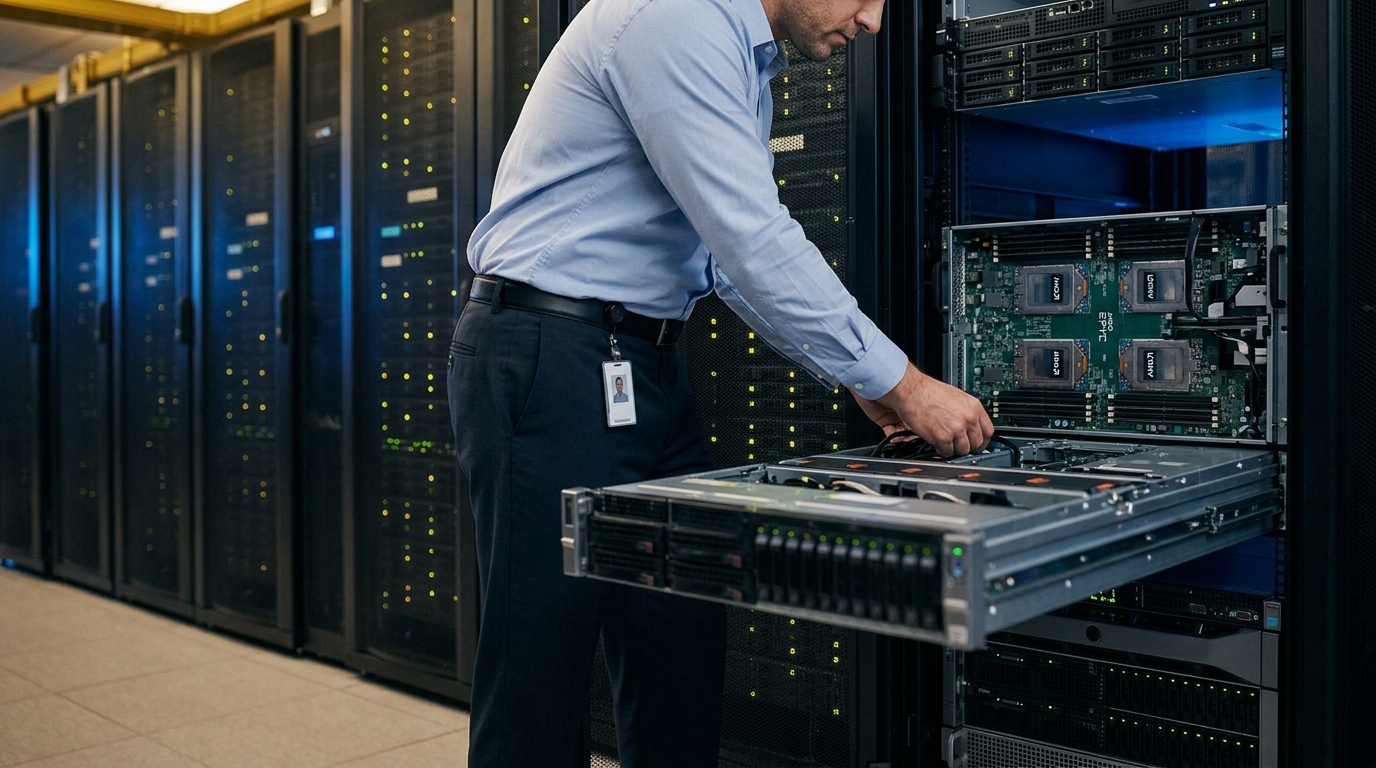
AMD CTO Mark Papermaster has said EPYC Venice, the company’s next-generation (Zen 6) server CPU, will be officially introduced at AMD’s Advancing AI event on July 22 and 23.
EPYC Venice is tied to TSMC’s 2nm process: AMD has said Venice is ramping production in Taiwan on TSMC’s advanced 2nm process technology, with future plans to ramp production at TSMC’s Arizona fabrication facility.
Reporting ahead of the event indicates the flagship configuration goes up to 256 Zen 6 cores, with a new SP7 socket and 16-channel memory support delivering up to 1.6 TB/s of bandwidth, and PCIe Gen 6 support.
Venice is the host CPU inside the Helios rack-scale platform. Helios integrates 72 MI455X accelerators at rack scale, and AMD markets the rack at up to 2.9 exaflops of FP4 compute performance and 31 TB of HBM4 memory. AMD also specs MI455X at up to 432 GB of HBM4 memory and 19.6 TB/s of memory bandwidth per GPU.
Microsoft has announced it will deploy AMD’s Helios rackscale platform on Azure for production-scale AI inference, and has also described two new Azure VM series built on AMD’s upcoming EPYC Venice CPUs.
You’re Being LIED To About The Iran War
Forget EVERYTHING you’ve heard about the Iran war.
Especially the reasons why we’re bombing the country.
The Business Behind It
Data Center segment revenue climbed 57% to $5.8 billion in Q1, driven by AMD EPYC processors and Instinct GPUs, while Client and Gaming revenue rose 23% to $3.6 billion and Embedded grew 6% to $873 million.
Non-GAAP gross margin was 55%, up 170 basis points year over year. AMD’s Q2 2026 outlook points to revenue of about $11.2 billion (plus or minus $300 million) with non-GAAP gross margin around 56%. Q2 earnings are confirmed for August 4.
What Wall Street Is Saying
The analyst community has spent the past several weeks catching up to the CPU story. Goldman Sachs raised its price target to $640 in early July. Wells Fargo raised its target to $615 on June 30. Cantor Fitzgerald raised its target to $700, and UBS raised its target to $670 in late June.
Wells Fargo increased its server CPU revenue estimates for AMD, now modeling $16.0 billion for 2026.
Where the Risk Lives
Nvidia’s CUDA software ecosystem remains a real competitive advantage. AMD’s ROCm stack, while improving, does not yet match the breadth and depth of Nvidia’s CUDA ecosystem for the full range of AI and HPC workloads. Developer inertia is slow to reverse.
A meaningful caveat on supply: specific claims about HBM4 being
Editor’s Note: Our colleague, the former $900 million hedge fund manager Larry Benedict, has discovered a way to make money from gold… WITHOUT buying a single ounce. Read on to learn more…
Dear Reader,
The war in Iran is creating huge opportunities in the gold market right now.
$361 billion is flowing through the gold markets every single day.
That’s four times the New York Stock Exchange.
And thanks to this flood of money, my followers have had the chance to skim huge profits.
Including $5,145 in a single day.
That wasn’t a fluke. We’ve found 19 opportunities with an average payout of $2,259.
How? It’s called “Gold Skimming.”
I don’t know how long this environment lasts. But while it does, I want to help as many people as possible take advantage of it.
That’s why I’ve just released a free presentation explaining my full Gold Skimming strategy – including the three-step method my followers can use to go for these payouts.
I’ll show you exactly how to get started, even if you’ve never done anything like this before.
Larry Benedict
Founder, The Opportunistic Trader