July 23, 2026
Intel Crushes Q2 Estimates
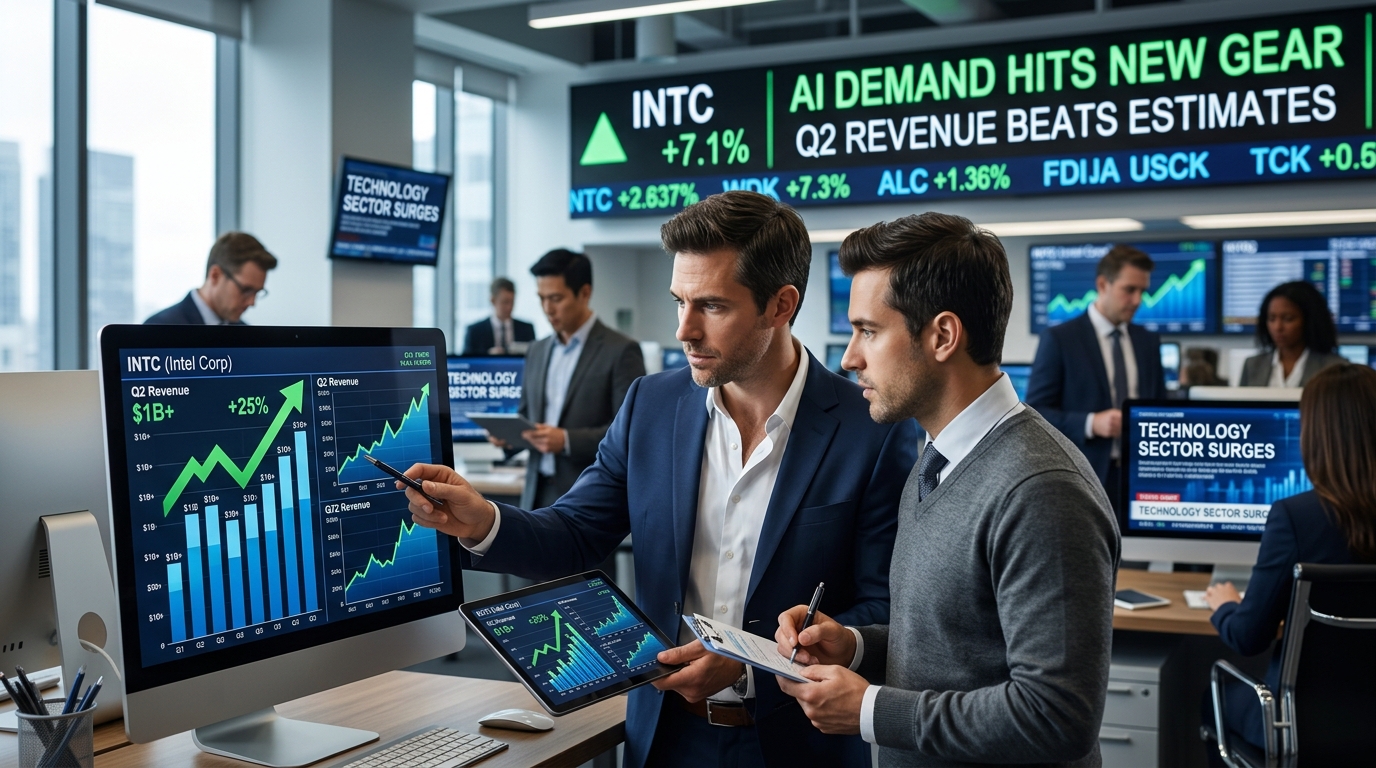
Revenue surged 25% as AI demand hit a new gear.
Analyst Targets
- KeyBanc | Overweight | Price Target: $155 (raised from $110 on July 14)
- Citi | Buy | Price Target: $130
- Susquehanna | Neutral | Price Target: $115 (raised from $80 on July 16)
- UBS | Neutral | Price Target: $121 (raised from $83 on July 13)
- Morgan Stanley | Equal-Weight | Price Target: $75 (raised from $73 on July 20)
- HSBC | Buy | Price Target: $200
- Rosenblatt | Sell | Price Target: $65
Consensus rating: Hold. Average 12-month price target: approximately $113.72, per TipRanks data compiled ahead of earnings.
Nobody was expecting this. Or at least, not this clean.
Intel reported Q2 2026 results Thursday after the bell, and the numbers weren’t just good — they were the kind of quarter that forces a reassessment. Revenue of $16.13 billion came in nearly 12% above the $14.45 billion Wall Street consensus, while non-GAAP EPS of $0.42 nearly doubled the $0.22 estimate. The stock jumped roughly 9% in after-hours trading, touching the $109 area from a closing price near $100.
The growth rate matters here. Intel’s 25% year-over-year revenue expansion was, by management’s own description, the fastest for any period in almost 15 years. That’s not a rounding error. That’s a different company than the one most investors had written off two years ago.
Elon Musk Just Called the Dollar “Hopeless” – Then Reinvented It
What’s going on with Elon Musk? Last year, he launched a full-blown attack on the U.S. dollar, calling it “hopeless.” And within months, he hatched a plan to reinvent the world reserve currency. Now, with the blessing of President Trump and the U.S. Treasury, it’s coming to life. And investors who grasp what’s going on could make a fortune.
Company Profile
Intel Corporation (NASDAQ: INTC) is one of the world’s largest semiconductor companies, designing and manufacturing CPUs, server processors, networking chips, and foundry services. Its business divides across three primary segments: Client Computing Group (CCG), Data Center and AI (DCAI), and Intel Foundry. The company is in the middle of a multi-year turnaround under CEO Lip-Bu Tan, who took the helm in March 2025 with a mandate to rebuild execution, restore product competitiveness, and turn Intel Foundry into a genuine external revenue engine.
The Numbers
- Revenue: $16.13B vs. $14.45B estimated — beat by 11.6% year over year, up 25% from $12.86B in Q2 2025
- Non-GAAP EPS: $0.42 vs. $0.22 estimated — beat by 93%
- Non-GAAP Net Income: $2.2 billion
- GAAP Net Loss: $(2.16) per share, driven by a $12.53B non-cash charge tied to the CHIPS Act escrow arrangement
- Data Center and AI (DCAI) Revenue: $6.26B, up 59% year over year
- Client Computing Group (CCG) Revenue: $8.88B, up 13% year over year
- Intel Foundry Revenue: $5.76B, up 31% year over year
- Q3 2026 Revenue Guidance: $15.8B to $16.8B (midpoint $16.3B vs. $15.1B consensus)
- Q3 2026 Non-GAAP EPS Guidance: $0.38 vs. $0.27 consensus
- 2026 CapEx Plan: raised to $20B from $18B; CFO signals 2027 CapEx will increase further
One note on the GAAP loss: the $12.53 billion non-cash charge is tied to the CHIPS Act escrow structure, not core operations. Non-GAAP net income of $2.2 billion tells the cleaner operating story here.
Why the Stock Is Moving
The DCAI segment is the story. A 59% year-over-year jump to $6.26 billion is a sharp acceleration from Q1’s 22% growth and a world away from where that segment was sitting just a few quarters ago. AI-driven demand for Intel’s Xeon server processors is doing real work here. This isn’t a cyclical bounce. It looks like structural demand.
Slight tangent, but it matters: Intel shares were already up 8.4% on Tuesday, July 22, following three separate announcements — a memory speed upgrade for select Xeon 6700P processors (offering plus 20% bandwidth and plus 25% speed), an expanded AI collaboration with Google Cloud, and confirmation that Intel’s 18A production node had secured its first manufacturing deal with an external cloud service provider. Thursday’s earnings essentially validated all three of those moves at once.
Intel Foundry posted $5.76 billion in revenue, up 31% year over year, with Intel 18A yields reportedly improving to roughly 85% from 65% the prior quarter. The 18A-P node has entered risk production. These aren’t milestones most investors expected to see confirmed this quarter.
The Q3 guidance is what sealed the after-hours move. The midpoint of $16.3 billion crushed the $15.1 billion consensus, and EPS guidance of $0.38 was well ahead of the $0.27 estimate. That combination — a clean beat plus forward guidance that holds the line — is exactly what a stock trading off a 28% July pullback needed.
From The Wall Street Legend Who Bought Apple $1 in 1996: The #1 Retirement Warning for 2026
He Predicted the Dot-Com crash. The 2008 Financial Crisis. And the 2020 collapse…
He also bought Apple at $1…
Netflix at $1.62…
Amazon at $1.77…
And recommended Nvidia at $1.10 (split adjusted).
Now – while the markets are rattled and most investors are frozen…
He’s issuing his #1 Retirement Warning for 2026.
P.S. He’s also revealing the #1 stock pick for 2026 – 100% FREE.
Macro and Industry Context
The AI infrastructure build-out remains the dominant theme across semis. Intel is now positioned at multiple points in that value chain: Xeon CPUs for AI inference workloads, custom ASICs through Foundry partnerships, and advanced packaging for AI accelerator systems. Apple and Microsoft have joined Intel Foundry’s 18A process as early design partners. If either places a commercial order at scale, the foundry math changes significantly — from cost center to profit contributor.
Worth noting: the U.S. government holds a roughly 10% stake in Intel, acquired in 2025 as part of domestic chip manufacturing support. Reports suggest that position carries an unrealized gain of approximately $26.5 billion following Intel’s strong run. That’s not a small detail — it aligns government incentives with Intel’s execution success in a way that has few historical precedents in the semiconductor industry.
The competitive picture is still complicated. AMD’s data center revenue overtook Intel’s for the first time in Q1 2026, at $5.8 billion versus Intel’s $5.1 billion at the time. That gap may narrow or reverse with Q2’s 59% DCAI acceleration, but Intel can’t afford to take its foot off the gas in server CPUs. Nvidia remains in a different lane with GPU dominance, but Intel’s strategy around inference and agentic AI workloads — leveraging its x86 franchise alongside foundry capabilities — is a real differentiation attempt, not just a talking point.
Forward Scenarios
Bull Case
DCAI sustains elevated growth through H2 2026. Intel Foundry transitions from a cost center to a credible external revenue stream as Apple or Microsoft place commercial 18A orders. Gross margin expands meaningfully above the 42% Q3 target as yields improve and factory utilization rises. CapEx discipline holds even as investment scales. The stock reclaims its June highs near $140 and pushes toward HSBC’s $200 target as the foundry turnaround gets priced in more aggressively.
Base Case
Growth moderates in Q3 and Q4 as the AI capex cycle digests its current wave. Intel hits revenue guidance of $16.3 billion at the midpoint, EPS of $0.38. Foundry external revenue ticks up gradually. PC demand stays subseasonal in H2 as the CFO suggested, keeping CCG revenue range-bound. The stock consolidates in the $105 to $125 range while the market waits for 18A commercial proof points.
Bear Case
18A profitable yields get delayed into late 2026 or 2027. Gross margin disappoints in Q3. PC consumption turns out worse than subseasonal guidance suggested. AMD continues to gain ground in data center CPUs. The stock breaks below the $89 to $90 support zone and retraces toward $82, with Rosenblatt’s $65 target becoming a live conversation rather than a contrarian outlier.
Technical Overlay
INTC closed Thursday at $100.23, down 2.33% on the session, before jumping to roughly $109 in after-hours trading. The stock has been in a 28% drawdown through July from its all-time closing high of $140.94 on June 22. That pullback set up a technical overhang at the 50-day EMA near $106 and the 200-day EMA near $108, a cluster that the after-hours move has now punched through cleanly. Prior to earnings, the 20-day SMA had been acting as resistance. The gap-fill toward $110 to $116 is the next zone of interest. Support on any pullback sits around $98 to $100, a level the stock had been defending heading into the report.
Don’t sell your shares to him on Friday afternoon…
Every Friday afternoon like clockwork, a legendary trader scoops up shares knowing after-hours breaking news will have traders desperate on Monday morning to buy back from him for 5X… 10X… or even 100X what they sold for.
All the while he gets to collect as much as $9,518 OR MORE just for holding shares over the weekend.
What Investors Should Watch
- 18A external foundry revenue recognition: Is it growing quarter over quarter, and are named customers confirmed?
- Gross margin trajectory: Q3 guidance calls for approximately 42% non-GAAP. Any miss here will raise questions about factory cost absorption.
- PC demand signals: CFO flagged subseasonal H2 consumption — watch CCG for softness.
- CapEx execution: 2026 raised to $20B, 2027 expected to increase further. Free cash flow profile matters as investment scales.
- Analyst revisions: Expect a wave of price target increases following this beat. Consensus was at roughly $113 heading into earnings; that figure is likely to shift higher.
- DCAI growth rate in Q3: A deceleration from 59% back to the low 20s would be the first real signal that the AI server demand surge is plateauing.
Bottom Line
Intel just posted its strongest revenue growth in nearly 15 years. The DCAI segment grew 59%. The foundry is showing real yield progress. Guidance blew past expectations on both the top and bottom line. By almost every near-term measure, this was a clean quarter.
But the real debate hasn’t changed.
What Intel needs to prove isn’t that it can post one strong quarter on AI demand. It needs to prove that Intel Foundry can generate profitable external revenue at scale — and that the 18A process node can compete with TSMC for the kinds of customers (Apple, Microsoft, cloud CSPs) that matter most to the long-term foundry thesis. Right now, those proof points are emerging, not confirmed. Yields are up. A CSP deal is in place. Apple and Microsoft are design partners. That’s progress. It’s just not the same as commercial volume.
The stock’s 170%-plus gain in 2026 already prices in a lot of optimism. Thursday’s blowout adds credibility to that move. Whether the stock can hold the $109 to $116 range into Q3 comes down to one thing: whether 18A external revenue starts showing up in the numbers in a meaningful way. Until then, this is a turnaround that’s working — with the hardest part still ahead.
For informational purposes only.