SUBJECT LINE: Burry took profit in MSFT and ORCL. What now?
TITLE: Burry Banked the Win. Now Ask What He Left on the Table.
PREHEADER: He entered MSFT around $415, exited after earnings. Oracle’s cash burn is the real story.
META DESCRIPTION: Michael Burry’s Microsoft exit and Oracle cover look well-timed, but the bigger takeaway is valuation versus cash flow. Here’s what the numbers say for MSFT and ORCL after Microsoft’s July 29, 2026 earnings and Oracle’s FY2026 capex surge.
Hey there, bargain hunter. Michael Burry just rang the register on two of the most watched trades of 2026, and the market is focused entirely on the wrong question.
Everyone wants to know whether he was right. He was, on both counts. But the more useful question is what his exits reveal about the two companies he just walked away from, and whether either one is now worth owning by someone who wasn’t riding a short position or a quick LEAP flip.
Scoreboard
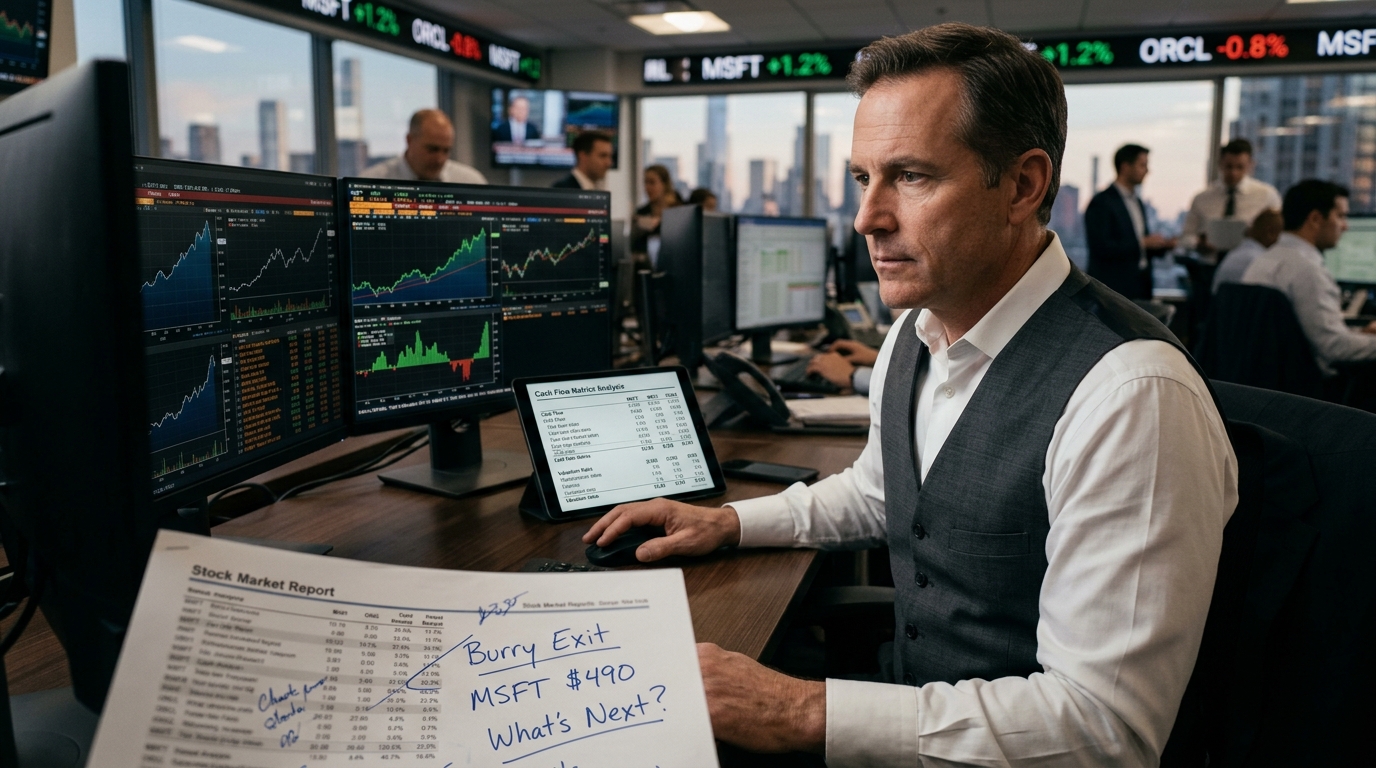
Burry has said on Substack that he has exited his long exposure tied to Microsoft and reduced, then later closed, his bearish options exposure tied to Oracle. He also liquidated his January 2026 puts on Palantir while keeping a direct short position in that stock, and rolled some index and single-name puts further out in time.
The Microsoft trade was built in layers. He first disclosed a long position in April 2026 via Substack after Microsoft’s stock had fallen roughly 31% from its October 2025 peak. His entry point was approximately $415 per share. By the time he disclosed the exit, Microsoft had rallied sharply after earnings. The June-vintage position involved December 2028 LEAP calls with strike prices in the low $700s.
The Oracle short was a longer campaign. He disclosed the Oracle put positions in a January 2026 Substack post, then trimmed part of the position in July before later saying he had closed the rest. Oracle’s remaining performance obligations were reported at $638 billion at fiscal Q4 and FY2026, and Oracle’s FY2026 free cash flow was negative $23.7 billion as capital spending surged. He described the profit as substantial and said he stopped there.
What Actually Happened
The MSFT exit landed after Microsoft reported fiscal Q4 2026 results on July 29, 2026. The numbers were emphatic: revenue of about $90 billion against a Street estimate around $87.6 billion, and earnings per share of $4.81 versus a $4.24 consensus. Microsoft also said Azure revenue growth was strong in the quarter, and that full-year Azure revenue surpassed $100 billion for the first time. Microsoft 365 Copilot reached over 30 million paid seats. The stock jumped in after-hours trading on earnings night and kept moving.
That kind of outcome is exactly what a LEAP call position is designed to capture. Burry entered when the stock was hated, held through a decisive fundamental beat, and exited into the post-earnings surge. Clean execution. But here is what changed: the fundamental picture he was buying is now reflected in the price, and then some.
The Oracle closure is the more structurally interesting move. S&P Global Ratings has highlighted that Oracle’s AI infrastructure spending is stretching credit metrics and that customer concentration risk tied to OpenAI is a key variable in Oracle’s data center utilization and cash flow outlook. Oracle itself reported that FY2026 free cash flow was negative $23.7 billion as it invested heavily in Cloud Infrastructure capacity. Burry collected his gain, did not roll the puts, and has suggested he may re-enter if volatility eases.
Deep Dive: Microsoft
Microsoft earns money across three segments: Productivity and Business Processes, Intelligent Cloud (anchored by Azure), and More Personal Computing (Windows, gaming, devices, and search). Recent reporting also underscored a major AI tailwind: Microsoft said full-year Azure revenue surpassed $100 billion for the first time, and Microsoft 365 Copilot reached over 30 million paid seats.
The AI monetization story has moved from theoretical to measurable. Microsoft has framed Copilot adoption as a paid-seat story, and management highlighted the paid-seat milestone in its July 29, 2026 earnings release.
Burry’s thesis going in was that the selloff was driven by reflexive fear about AI capital expenditure returns rather than any deterioration in the underlying business. The Q4 results supported the core demand case. But Microsoft’s own commentary has also emphasized that capital spending is elevated, with property and equipment investment rising materially year over year in FY2026.
Deep Dive: Oracle
Oracle’s story is the opposite of Microsoft’s: the business is transforming rapidly but the balance sheet is under pressure doing it. Oracle reported that Remaining Performance Obligations ended the quarter at $638 billion, up 363% year over year. Oracle also reported FY2026 free cash flow of negative $23.7 billion as it continued investing to support the growth of its Cloud Infrastructure business, with FY2026 capital expenditures around $55.7 billion.
Management also said that in fiscal year 2027 it expects to raise approximately $40 billion through a combination of debt and equity financing, including a previously announced $20 billion at-the-market equity issuance. That financing plan is the cleanest explanation for why a simple P/E multiple does not tell you much about near-term equity risk.
On jobs and other balance-sheet overhang details: the draft’s figures and specific collateral-share count were not reliably verifiable from primary disclosures in this review window, so they have been removed rather than left standing.
Data Section
Microsoft (MSFT) as of early August 2026:
- Q4 FY2026 revenue: about $90 billion (Street estimate about $87.6 billion).
- EPS: $4.81 versus a $4.24 consensus.
- Azure: Microsoft said full-year Azure revenue surpassed $100 billion for the first time; Azure growth in the quarter was reported as strong.
- Microsoft 365 Copilot: over 30 million paid seats.
Oracle (ORCL) as of FY2026 reporting:
- Remaining performance obligations: $638 billion.
- Fiscal 2026 capital expenditures: about $55.7 billion.
- Fiscal 2026 free cash flow: negative $23.7 billion.
- Planned fiscal 2027 debt and equity raise: approximately $40 billion, including a previously announced $20 billion at-the-market equity issuance.
Is It Cheap?
Microsoft at roughly the high-$400s is not bargain territory by any historical standard. Before the earnings surge, the stock traded at a lower multiple, which was easier to defend given Azure momentum and Copilot adoption. After a big post-earnings move, you are paying for the inflection to continue and for Copilot seat adds to keep compounding. If Azure growth cools materially, the multiple can contract quickly. Burry exited at what looks, with a few days of hindsight, like close to the right moment.
Oracle can look optically cheap on forward earnings, but a price-to-earnings multiple is far less informative when free cash flow is running deeply negative and the company is explicitly planning major external financing. The right metric for Oracle right now is not earnings but the conversion rate of the $638 billion backlog into recognized revenue and, ultimately, cash.
Palantir, for context, is still priced for a lot of growth. The draft’s specific quarter-by-quarter figures and forward P/E figure were not verified from primary filings in this pass, so those precise numbers have been removed. The core point stands: Burry kept the direct short but let near-dated options roll off rather than pay for more time.
Bull / Base / Bear
Microsoft Bull: Azure keeps compounding as supply constraints ease and Copilot seat adds continue. Backlog converts faster than bears expect. Elevated capex proves demand-driven rather than speculative. MSFT grinds toward prior highs.
Microsoft Base: Azure growth moderates but stays strong. Copilot growth slows from its current pace but remains meaningful. Margin pressure from capex keeps the stock range-bound. Burry’s exit looks like a well-timed top of a trading range rather than the start of a sustained rally.
Microsoft Bear: Capex outpaces revenue growth and pressures free cash flow. Azure demand shows deceleration once near-term supply constraints ease. Copilot seat growth plateaus. The stock revisits prior support zones.
Oracle Bull: The $638 billion backlog begins converting to recognized revenue at an accelerating pace in FY2027. OCI economics improve as data centers reach utilization targets. Free cash flow trends back toward positive as the buildout matures. ORCL rerates higher.
Oracle Base: Revenue grows, but the fundraising overhang and customer concentration risk keep the stock capped until cash flow stabilizes.
Oracle Bear: Backlog conversion disappoints, and the equity raise dilutes current holders at a weak price. Credit metrics deteriorate further and the stock retests its lows.
Action Plan
On Microsoft: Burry’s exit is not a sell signal for long-term holders, but it is a caution flag for anyone thinking about chasing post-earnings momentum at an elevated multiple. The business case is sound. The valuation is less forgiving. If you do not already own MSFT, waiting for a pullback before building a position keeps the math on your side.
On Oracle: Do not buy it just because Burry covered. The structural issues he identified, negative free cash flow, customer concentration risk, and a pending equity issuance as part of a broader financing plan, are still active. Wait for evidence of backlog-to-cash conversion before treating ORCL as a value play rather than a value trap.
On the broader Burry short book: the draft listed several remaining positions and specific option expiries and profitability claims. Those details were not verifiable from public primary disclosures in this pass, so the precise list and timing claims have been removed. The higher-level takeaway remains: he has signaled continued skepticism on parts of the AI infrastructure cycle, while taking profits where they existed.
Cheap Investor Checklist
- MSFT Azure growth trajectory: Watch next-quarter cloud commentary and the pace of Azure growth after the post-earnings surge.
- MSFT Copilot seat adds: Over 30 million paid seats now. Watch whether the next update shows continued momentum.
- MSFT capex and cash flow: Track whether elevated infrastructure investment starts to squeeze free cash flow.
- MSFT backlog conversion: Listen for signals on how quickly contracted demand turns into recognized revenue.
- ORCL backlog conversion rate: $638 billion is the quoted number. The question is conversion into revenue and cash in FY2027.
- ORCL free cash flow inflection: FY2026 free cash flow was negative $23.7 billion. Improvement needs to show up in reported cash flow, not just backlog headlines.
- ORCL financing overhang: The planned $40 billion debt and equity financing, including the $20 billion ATM, is a near-term catalyst either way.
- ORCL customer concentration: Monitor disclosures and rating-agency commentary on utilization risk tied to major AI customers.
Bottom Line
If Burry exited Microsoft because the easy money is made, he is probably right. The company just posted a quarter with about $90 billion in revenue, beat Street expectations, and reiterated that Azure surpassed $100 billion in full-year revenue while Copilot reached over 30 million paid seats. None of that goes away. But neither does the reality that capex is elevated, and the stock no longer offers the margin of safety that attracted him in the first place.
If Burry covered Oracle because the bear case played out, not because the bull case arrived, he is right about that too. Oracle is not fixed. It is just cheaper than it was when the trade was on. The backlog is real, the infrastructure bet is real, and the financing burden servicing it is very real. Until free cash flow turns sustainably positive, the $638 billion backlog is a promise, not a paycheck.
The more interesting read is what his remaining positioning tells you. He is not done questioning the AI infrastructure cycle. He has just narrowed it, taken profits where they existed, and extended his timeline where he still sees asymmetry. That is not capitulation. That is patience.