
August 5, 2026
Circle’s CEO Says Billions of Agents Are Coming.
Q2 earnings landed this morning with an EPS beat and a revenue miss. T
Analyst Targets
- Morgan Stanley, Underweight, $38 price target (downgraded August 3, from $106)
- TD Cowen, Buy, $82 price target (initiated August 3)
- Bernstein, Outperform, $190 price target
- Consensus (28 analysts), Buy, $113.72 average price target
The Vision vs. the Quarter
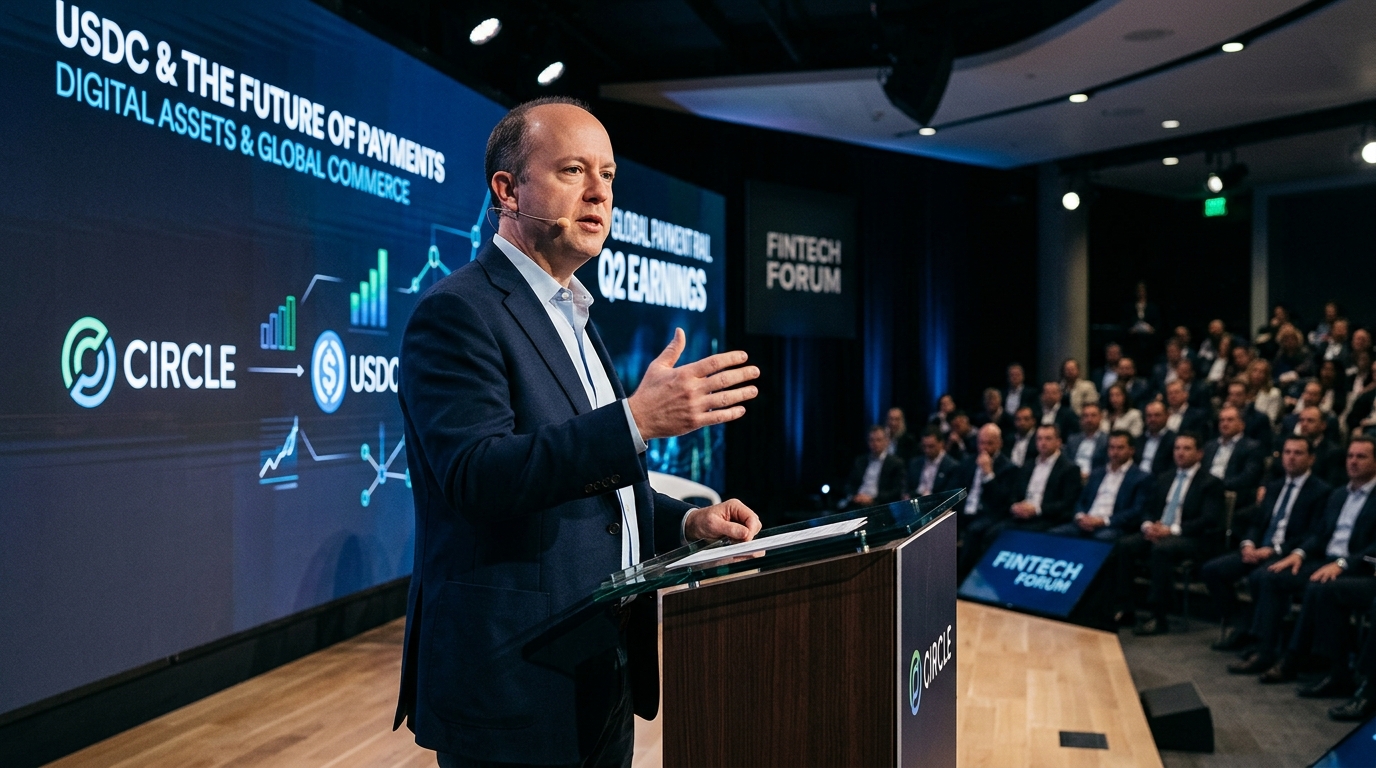
Jeremy Allaire gave the broadest version of his argument on Yahoo Finance’s Opening Bid this morning, the same day Circle reported Q2 results. “We think that there will eventually be billions of agents providing work and labor, and they’ll be able to be orchestrated and integrated within a firm and across firm boundaries,” Allaire said. The timing was intentional. Circle wants investors reading its quarterly numbers through the lens of what the agentic economy makes possible, not what a slowing crypto market and rate pressure delivered in the past 90 days.
The problem is that the numbers and the vision are not yet on the same timeline. Circle reported revenue and reserve income of $701 million for Q2, up 7% year-over-year but slightly below Wall Street’s $717 million expectation, while earnings per share came in at $0.18, beating the $0.17 consensus estimate. The stock is down modestly on the release. The gap between Allaire’s macro call and Circle’s current financial architecture is the only question that matters.
“Frontier AI” is a point of no return when AI surpasses human intelligence and gains free will.
Elon Musk warns this moment could hit by the end of 2026. According to 60-year Wall Street legend, Marc Chaikin, Frontier AI could soon become the only thing that determines which companies make money and which grind to a halt. That’s why he’s giving away a list of stocks to buy and sell absolutely FREE to help you position your money for a world driven by Frontier AI technology.
Company Profile
Circle is a global financial technology firm that enables businesses of all sizes to harness the power of digital currencies and public blockchains for payments, commerce, and financial applications worldwide. Circle is building the world’s largest stablecoin network, issuing USDC and EURC through its regulated affiliates.
Circle’s business model, driven by interest income from short-term U.S. Treasuries backing its USDC stablecoin, remains heavily concentrated in reserve income. That concentration is both the strength and the vulnerability. When rates fall, margins compress. When competition encroaches on USDC’s share, distribution costs can rise against a shrinking reserve base.
Circle’s platform includes a stablecoin network anchored by USDC, the Circle Payments Network for global money movement, and Arc, an enterprise-focused blockchain project the company has positioned as infrastructure for internet-native finance.
The Numbers
- Q2 Revenue and Reserve Income: $701 million, +7% year-over-year; below the $717 million Street estimate
- EPS: $0.18, beat $0.17 consensus
- USDC in Circulation: $73.3 billion, +19% year-over-year
Three months earlier, that same 7% growth rate was 20%. The sequential deceleration is the number Mizuho flagged immediately after the release. Circle has also highlighted the tension between reserve income and distribution costs, a structure that can look less attractive if short-term rates fall.
Why the Stock Is Moving
The initial premarket pop was real. Traders were not buying the income statement. Traders bought the Arc blockchain timeline and Circle’s improving regulatory posture rather than the shortfall.
Circle has been leaning into product positioning for agentic payments. Circle’s Agent Stack marketing page says USDC is already emerging as the default money for agents, powering 99.8% of x402 transaction value. That is directionally supportive of the machine-economy thesis, even if it is still early in revenue terms.
The sell-side is not unified. Morgan Stanley downgraded Circle to Underweight and lowered its price target to $38 from $106, citing concerns tied to USDC growth and the reserve-income model under a lower-rate path. TD Cowen initiated at Buy around the same time. The wide spread between those two targets captures the entire investment debate in a single data point.
Apple Price Hikes Reveal Mode’s Big Opportunity
Apple will potentially raise prices on Macs and iPads by $200 or more, another reminder that the devices we rely on keep getting more expensive.
Mode Mobile, is building the countertrend: technology that turns everyday smartphones into income-generating assets.
Its EarnOS platform has already helped users earn and save $1B+, reached 490M+ users, and powered 32,481% three-year revenue growth, earning Deloitte’s #1 fastest-growing software company ranking.
Now, Mode has secured the Nasdaq ticker $MODE, and its pre-IPO investment offering is open at $0.52/share with up to 20% bonus shares. But that window is closing fast.
Please read the offering circular at invest.modemobile.com. This is a paid advertisement for Mode Mobile’s Regulation A Offering.
Macro Context
Allaire’s agent economy thesis is not speculative fiction. A Keyrock report, as covered by CoinDesk in May 2026, said AI agents settled more than $73 million across 176 million blockchain transactions over the prior year, with 98.6% of machine payments settling in USDC. The infrastructure is live. The economics are micro.
AI agents need stablecoin payments because card rails were built for human-scale economics: percentage-plus-fixed interchange, delayed settlement, and static card-rule programmability. Agents break each of those assumptions in turn. That structural argument is strong. It also describes a market that Stripe, Google, Coinbase, and Visa are all building into simultaneously.
On the regulatory side, Circle has moved closer to bank-grade status. The OCC granted conditional approval for Circle’s national trust bank charter application in December 2025, and Circle announced on July 10, 2026 that it received final OCC approval to establish First National Digital Currency Bank, N.A., a national trust bank. In a world where stablecoin rules are tightening, being the most regulated name in the room can be a structural advantage.
The competitive pressure from within the regulated space is sharper. Rival stablecoin Open USD was unveiled on June 30, 2026, with more than 140 companies reported as backers, including Visa, Mastercard, Stripe, BlackRock, and Coinbase. Open USD has been positioned to share more of the reserve economics with partners, an approach that directly targets the economics that currently accrue to Circle.
Forward Scenarios
Bull Case
Arc launches on the company’s stated timeline with the institutional validator set intact. USDC’s dominance in early agent payment flows holds as agentic commerce scales. The trust bank charter becomes a moat: competitors struggle to match Circle’s regulatory posture, and Open USD fragments the market without dislodging the incumbent. Rate cuts compress reserve income but are offset by subscription and transaction revenue growth. CRCL re-rates toward Bernstein’s $190 target.
Base Case
Revenue growth stabilizes in the high single digits through year-end as the rate environment and crypto market conditions described by Allaire persist. Arc attracts builders but transaction volume remains modest in 2026. The agentic payments business grows but does not yet reshape the income statement. The stock trades in a band roughly consistent with TD Cowen’s $82 target, with a valuation premium sustained by the regulatory moat but capped by the margin structure.
Bear Case
Open USD’s consortium erodes USDC’s share more aggressively than expected. Rate cuts arrive before transaction revenue can offset the decline in reserve income. Weaker reserve income and lower-margin revenue pressure earnings, while competition from tokenized cash products and new stablecoin models compounds the pressure. Morgan Stanley’s $38 target is not impossible in this scenario: it implies Circle trades at a low multiple of a significantly compressed earnings base.
Technical Overlay
CRCL is still down 20.2% in 2026 while the S&P 500 has gained 13%. The stock entered today’s earnings at a level roughly 60% below its IPO-week high of nearly $299. The premarket pop toward $69 represents a test of the mid-60s resistance zone that capped the stock through July after the Morgan Stanley downgrade. A sustained close above $70 would be constructive. Failure to hold the premarket gain and a close below $63 reopens the path toward the prior post-downgrade low.
The options market had implied roughly a 10 to 12 percent move around today’s release. The premarket move came in toward the lower end of that range. Implied volatility will compress after the open, meaning the near-term directional bet has to be made on the thesis, not on premium decay.
What Investors Should Watch
- Arc Launch Timing: Validator participation and early transaction volume are the first proof points for the chain-as-Economic-OS argument.
- USDC Circulation Trend: Q2 ended at $73.3 billion, down sequentially from Q1’s $77.0 billion. A reversal in Q3 is essential for the bull case.
- Open USD Market Share: Watch whether a yield-sharing model changes distribution economics across the stablecoin stack.
- Reserve Income vs. Distribution Costs: In a falling-rate environment, the operating leverage can work in reverse unless non-reserve revenue scales faster.
- Agent Stack Commercial Traction: The key question is monetization, not just transaction count.
- Fed Rate Path: Circle’s reserve income is a direct function of short-term Treasury yields. Any September cut, regardless of magnitude, tightens the margin without a compensating revenue offset in the near term.
Wall Street May Be Chasing Yesterday’s AI Winners
While everyone watches the biggest AI names stumble, a new group of companies could be emerging as tomorrow’s biggest winners.
Bottom Line
Allaire is describing a real structural shift. Traditional companies could become smaller and more modular as specialized AI agents take over tasks across engineering, marketing, finance, legal, and customer support. Stablecoins could become the preferred money for machine-to-machine commerce, offering programmable, always-on transfers with rapid settlement. If that is correct, Circle’s position as a compliance-first issuer with an OCC-approved national trust bank charter is worth a lot more than today’s price implies.
The problem is timing. The income statement today reflects a business where the bulk of revenue depends on Treasury yield on a stablecoin balance that is declining sequentially, facing a new well-funded competitor, and operating under margin economics that can be pressured in a lower-rate world. The agent economy thesis is a 2028 to 2030 story. The earnings model is a 2026 reality.
The stock deserves a position in any framework for the agentic payment infrastructure cycle. Size it to the timeline you believe in, not the one Allaire is selling this morning.
For informational purposes only.