
August 9, 2026
Chevron Is No Longer Just an Oil Company
Featured: Chevron Is No Longer Just an Oil Company
Dear Reader,
Five years from now, there will be two kinds of investors…
The ones who built generational wealth in the right stocks.
And the ones who stayed in the wrong ones.
I’ve spent nearly two decades running a hedge fund firm in Manhattan. I recommended Netflix before it soared 11,000%… Amazon before it gained 9,000%… Apple before it climbed 80,000%.
CNBC called me “The Prophet” after I publicly predicted the Global Financial Crisis before almost anyone else saw it coming.
But I want to be direct with you today.
Because what I’m watching unfold in America right now – a collision of the AI boom, the energy crisis, and the biggest commodity supercycle in 100 years – is unlike anything I’ve seen in my career.
And one little-known company sits right at the center of all three.
It controls critical assets so scarce and so strategically vital, the White House invoked emergency powers to protect them.
One of the most decorated fund managers of the past 50 years put HALF his $9 billion into it.
Google’s former CEO just partnered with it.
And I believe a $10,000 investment in this company today could grow to $220,000 over the long term.
I’ve recorded a free presentation. The full name, ticker, and complete story.
The window won’t be open forever.
>>> Watch My Free Presentation: America’s Greatest Retirement Stock Right Now
I didn’t just read about it.
I flew to West Texas with one of our most trusted boots-on-the-ground sources… A man who called the largest oilfield in American history before Wall Street even knew the name.

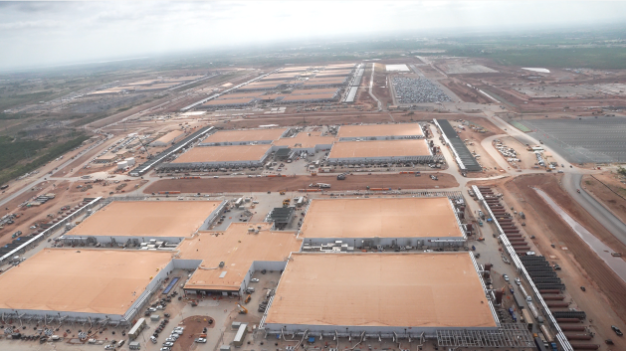
We took a helicopter over the Stargate construction site together…
What I saw below us removed any doubt.
Regards,
Whitney Tilson
Senior Analyst, Stansberry Research
P.S. Here’s my prediction about that window closing… On February 2nd, Trump signed “Project Vault” – a plan to set hard government price floors on the exact critical commodities sitting at the heart of the biggest supercycle I’ve ever seen. July 13th is when Washington makes that call.
If those price floors get the greenlight, every fund and every trading desk rushes in at once.
A company already sitting at the center of the AI boom, the energy crisis, AND a 100-year commodity supercycle – with Wall Street flooding in behind a government mandate – doesn’t stay at these prices for long.
Five years from now, the investors who were already in are going to look very different from the ones who waited.
>>> Watch the free presentation.
Chevron Is No Longer Just an Oil Company
Analyst Targets
- Morgan Stanley – Overweight, $214 price target (raised May 22, 2026)
- Barclays – Equal Weight, $213 price target (raised May 26, 2026)
- Wall Street consensus – Average price target and Buy percentage vary by data provider and date. Treat any single-point consensus snapshot as time-sensitive.
Two Companies in One Ticker
When Chevron reported Q2 2026 results on July 31, the headline numbers were clean: $12.1 billion in earnings, $6.06 adjusted EPS against a $5.27 consensus estimate, a 15% beat. Revenue came in at $70.06 billion, clearing forecasts by about $7.7 billion. Return on capital employed hit 21.4%. Worldwide production was 20% above year-ago levels, driven by the contribution from legacy Hess assets and growth in the Permian Basin and Gulf of America.
Analysts congratulated management on execution and moved on. They should have stayed longer on slides twelve through fifteen.
Buried inside the Q2 earnings cycle, Chevron management confirmed that Project Kilby, the company’s approximately 2.67-gigawatt co-located power facility in West Texas, had signed a 20-year power purchase agreement with Microsoft. The deal was struck through Energy Forge One LLC, a wholly owned subsidiary. Final investment decision is targeted by the end of 2026. First power delivery is scheduled for 2028. When analysts pressed on whether this was a one-off, management indicated Chevron is already in discussions on additional opportunities with Microsoft and other potential customers.
That answer changes the investment thesis in ways the quarterly income statement does not capture.
Company Profile
Chevron is one of the world’s largest integrated energy companies, with operations spanning crude oil and natural gas production, refining, transportation fuels, lubricants, petrochemicals, and lower-carbon technologies. The Hess acquisition closed on July 18, 2025, adding significant Guyana deepwater exposure and additional U.S. onshore position. Chevron New Energies, an internal business unit, now manages the company’s power and data center infrastructure ambitions alongside lower-carbon investments. The stock trades near $190, and is widely described by market commentary as being up about 36% year-to-date in 2026, supported in part by higher crude prices earlier in the year and integration progress. Chevron also reported achieving $1.5 billion of Hess-related annual run-rate synergies ahead of schedule, exceeding the initial target by 50%.
The Numbers That Matter
- Q2 2026 adjusted EPS: $6.06 vs. $5.27 consensus – beat of 15%
- Q2 revenue: $70.06B vs. about $62.36B forecast – beat of about 12.4%
- Q2 net earnings: $12.1B ($6.11/share diluted)
- ROCE: 21.4% for the quarter
- Adjusted free cash flow: $15.4B generated in Q2
- Hess synergies: $1.5B annual run-rate, 50% above the initial target and ahead of schedule
- Structural cost reductions: Chevron has guided to $2B-$3B of targeted structural cost reductions by the end of 2026; progress details and timing should be treated as company guidance unless restated as achieved in filings
- Production growth YoY: 20% increase, driven by legacy Hess assets, the Permian Basin, and Gulf of America
- Project Kilby PPA: ~2.67 GW over 20 years with Microsoft; FID targeted by end of 2026; first power targeted for 2028
- Guidance headwinds: Specific quarterly downtime and turnaround impacts should be treated as period-specific company guidance; confirm figures against Chevron’s latest outlook materials
Why the Stock Is Moving – and Why the Real Move Hasn’t Happened Yet
The Q2 beat is real, but it is largely explained by elevated commodity prices earlier in the quarter and the contribution from legacy Hess assets. Those are cyclical tailwinds. The market is pricing them as such.
What the market is not yet pricing is a structural change in Chevron’s revenue architecture.
Project Kilby is not a utility project. It is a behind-the-meter, co-located power facility designed to supply dedicated electricity to a specific data center rather than serve the broader grid. Chevron has framed the concept publicly as co-locating reliable generation with compute demand. The facility leverages Permian Basin natural gas as the direct fuel source, with a majority of generation planned to come from large GE Vernova turbines and associated electrical infrastructure, and additional capacity provided by Solar Turbines, a wholly owned subsidiary of Caterpillar. Chevron has also used the framing of converting energy into intelligence in its broader communications around powering data centers.
The 20-year contract duration is the critical variable. Unlike a commodity sale priced to a benchmark that changes monthly, Project Kilby cash flows are designed to be anchored by a long-duration contract. That is a different business, attached to the same balance sheet, funded by the same Permian gas reserves Chevron already owns.
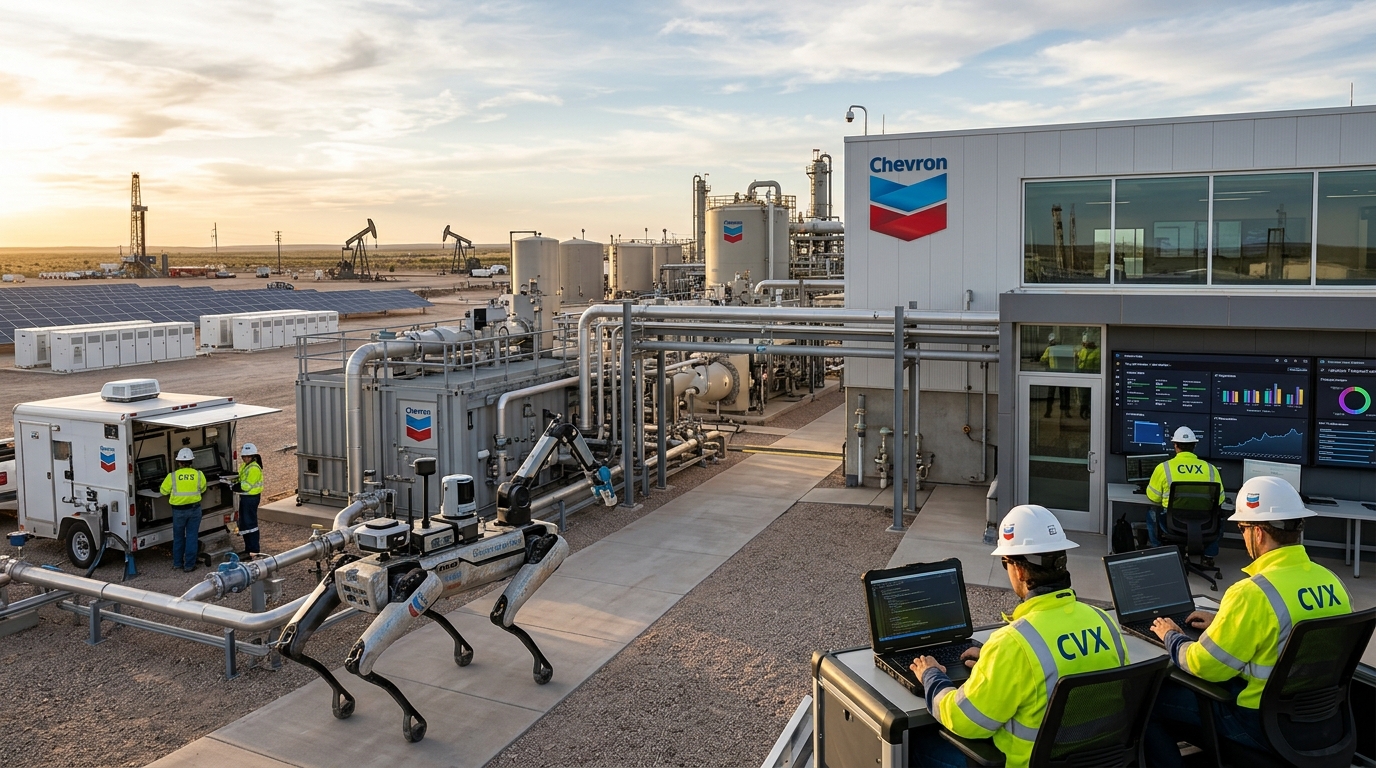
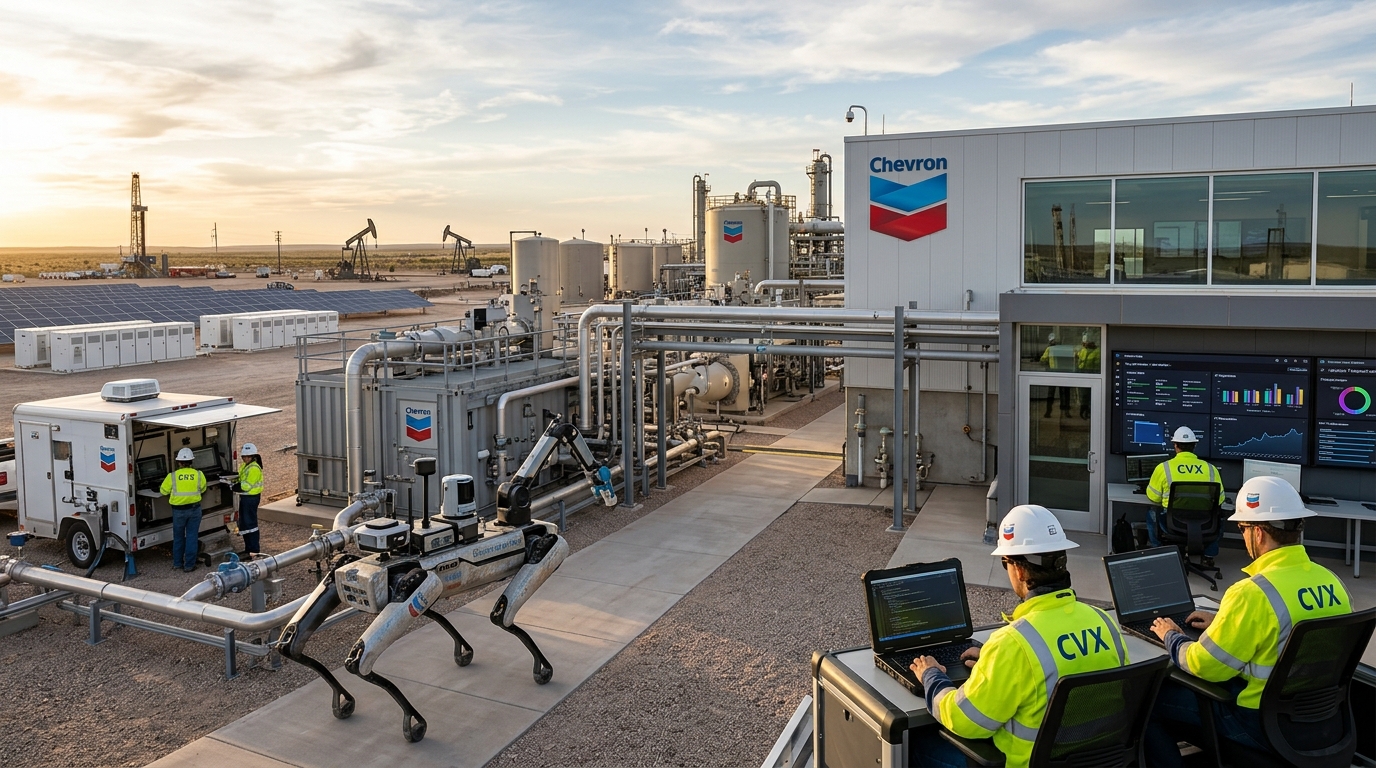
At the same time, inside Chevron’s own operations, the company is deploying agentic AI at the edge. On June 2, 2026, DataRobot announced it is collaborating with Chevron to apply AI agents to autonomous inspection operations across its facilities, leveraging NVIDIA software and compute within Chevron’s digital and operational systems. The stated focus is improving how robotic missions are planned, assessed, and executed within established operational standards. Chevron has positioned this work inside its Facilities and Operations of the Future initiative.
Macro Context
The structural tension driving Chevron’s pivot is straightforward: data center operators cannot get power from the grid fast enough. Goldman Sachs research projects that U.S. data center power demand will more than double to 66 GW in 2027 from 31 GW in 2025. Grid connection timelines can run years. Chevron can move faster in co-located power because it already controls fuel and has large-scale project execution capabilities, and it has secured turbine capacity through GE Vernova as part of its data-center power buildout efforts.
The competitor benchmark matters here. ExxonMobil has discussed plans to generate low-carbon electricity for data centers using natural gas paired with carbon capture and storage, and NextEra Energy has presented a partnership concept with ExxonMobil that includes an initial 1.2-GW carbon-abated, gas-fired plant. Relative project sizes and counterparties are still evolving, and power purchase agreement status should be treated as time-sensitive.
Forward Scenarios
Bull
Final investment decision on Project Kilby clears by year-end 2026. Chevron announces one or two additional power contracts with different customers before the October 30 earnings call, demonstrating that Kilby is a template rather than a one-off. Chevron’s targeted structural cost reductions progress toward the high end of the $2B-$3B goal by end-2026. Oil holds above $85 through Q3. The market begins assigning a utility-style multiple to the contracted power revenue stream, compressing CVX’s effective cost of capital and pushing the stock toward the $220-$236 range that currently represents the upper end of some published analyst targets.
Base
Kilby reaches FID on schedule. No additional power contracts are announced before year-end. Chevron’s next-quarter downtime impacts play out broadly in line with management’s outlook, keeping the stock range-bound near $190-$210. The AI power thesis becomes a 2028 story as first power delivery approaches. Hess synergies continue to compound quietly. The stock delivers mid-teens total return over 12 months, broadly in line with many sell-side target frameworks.
Bear
Oil retreats toward $70 as Middle East risk premium fades. Downstream downtime hits the high end of management’s guided impact. Kilby misses its FID deadline due to permitting or environmental approvals, raising questions about execution. The AI power thesis gets reclassified as speculative capex rather than contracted revenue, and the stock gives back a portion of its 2026 gains. Note that Chevron’s Q2 cash generation and ongoing shareholder returns can still provide a meaningful floor, though the exact buyback range is board- and period-dependent.
Technical Overlay
CVX ran from a 52-week low near $132 to a 2026 high of approximately $215 before settling near $190. The Q2 earnings gap brought volume confirmation of the move. Near-term support sits in the $183-$187 zone, where the 50-day moving average has converged with the prior breakout level from the April spike. Resistance at $210 aligns with the prior consolidation range. A Kilby FID announcement or an additional power contract would be the catalyst needed to clear that level on volume. Absent a new catalyst, the stock is consolidating within a well-defined range.
What Investors Should Watch
- Kilby FID announcement: Chevron has targeted FID by end-2026. Any slip in timing will be interpreted as permitting, execution, or counterparty risk.
- Additional power contracts: Chevron has signaled further discussions with Microsoft and other potential customers. A second agreement before the October 30 earnings call would materially shift the AI power revenue multiple the market assigns to CVX.
- Analyst target revisions post-Q2: The EPS beat gives cover for revisions. Watch whether sell-side models begin assigning explicit value to contracted power cash flows separate from upstream.
- GE Vernova turbine capacity: Chevron has said a majority of Kilby’s generation will come from large GE Vernova turbines. Delivery timing and supply chain remain key variables.
- Production trajectory: Chevron’s quarterly volumes are sensitive to planned maintenance and turnarounds; confirm any quarter-specific MBOED guidance in the latest company outlook.
- Oil price trajectory: Brent at or above $85 keeps the upstream earnings engine running at rates that can fund infrastructure buildout without requiring incremental debt.
Bottom Line
The debate about Chevron has been framed as a commodity stock with a side project in AI power. That framing is now incomplete. Project Kilby is a roughly 2.67-gigawatt, 20-year contract to supply dedicated power to a Microsoft-operated data center, with first power targeted for 2028 and FID targeted by end-2026. The agentic AI deployment inside Chevron’s own operations, using DataRobot’s platform with NVIDIA software and compute to support autonomous inspection workflows, represents a second lever: operational efficiency that can compound as it scales. The Q2 beat proves the base business is executing. The Kilby signing proves the new business is real. What determines the next move in CVX is not whether the AI power thesis is credible. It is whether the market decides to price it before or after first power delivery in 2028.
For informational purposes only.