
September 2, 2026
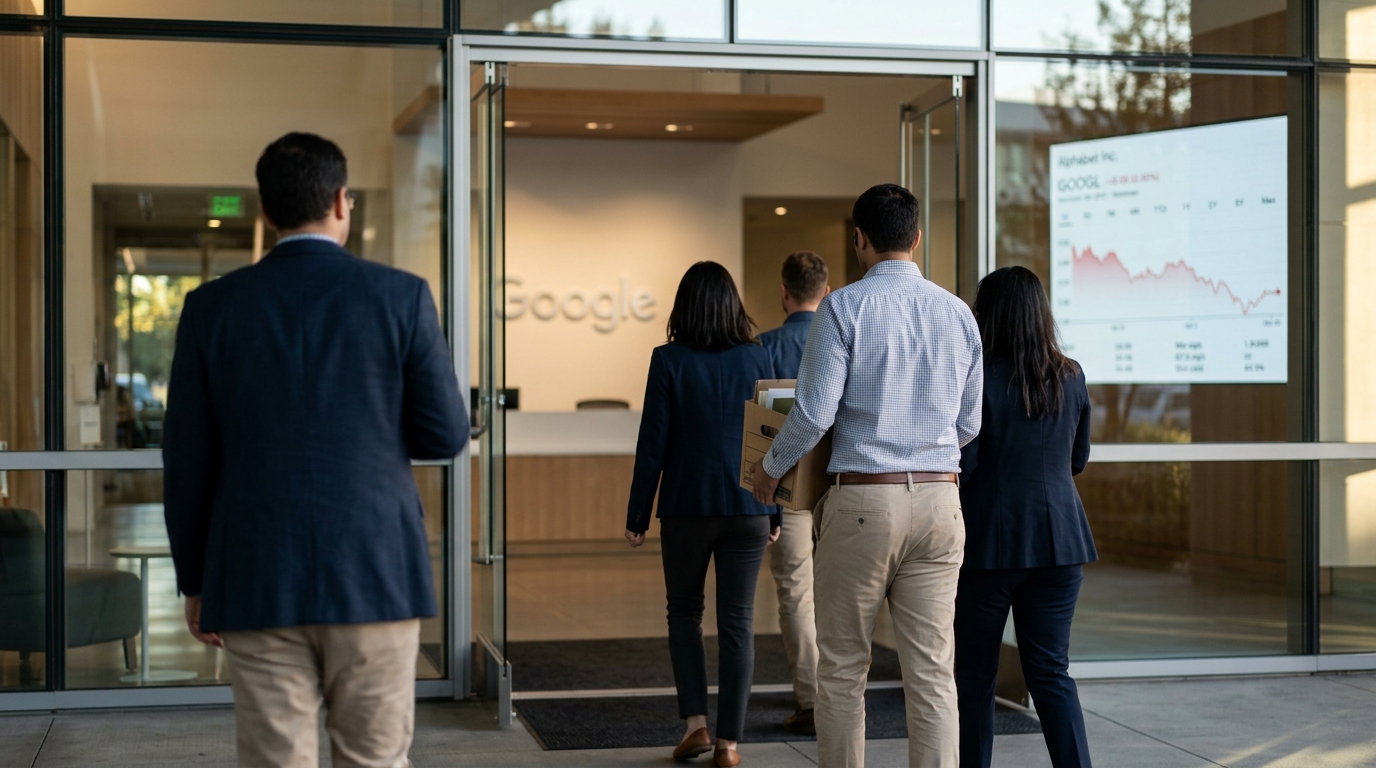
Bonus Content: Google Lost Four Top AI Researchers. Now the Stock Reflects It.
The download link for my Simple Options Trading For Beginners book is about to expire.
Once it goes, the book goes back to $29.97 on the website – same book, same content, just no longer free.
This is one of those things where the people who grab it in the next sixty seconds will have it on their computer forever. The people who don’t will be staring at an order page tomorrow, wishing they’d taken the twenty seconds.
It’s a quick read that finally explains options in plain English. No Greeks. No textbook charts. Just the actual mechanics with step-by-step trade examples.
Grab the free copy before the link expires.
Good Trading,
Bill Poulos
p.s. This link will expire without warning.
Google Lost Four Top AI Researchers. Now the Stock Reflects It.
Alphabet ended August as a notable Dow laggard, and the stock fell again on September 1 to close around the mid-$330s. The broader point stands: the stock has been under pressure even as the market has held up better. The gap is not noise. It is the market doing arithmetic on an AI talent exodus that has no recent parallel at any major technology company.
Analyst Targets
- Goldman Sachs: Buy, $450
- TD Cowen: Buy, $450
- Bank of America: Buy, $430
- Morgan Stanley: Overweight, $400
- UBS: $379
- DA Davidson: Neutral, $350
- Consensus (70 analysts): ~$430, roughly 26% upside from current levels
The Numbers
Q2 2026 revenue came in at $119.8 billion, up 24% year over year, the 12th consecutive quarter of double-digit growth. EPS of $9.11 topped the $3.04 consensus. Google Cloud surged 82% to $24.8 billion with about $514 billion of remaining performance obligations attributed to Cloud. Operating margin was 34%.
One blemish: search revenue of $63.3 billion landed slightly below the $63.4 billion estimate, and search faces tougher year-over-year comparisons starting this quarter. Full-year capex guidance rose to $195-$205 billion. Free cash flow turned negative in Q2 as spending accelerated.
Why the Stock Is Moving
On August 5, Jeff Dean, Google employee No. 30 and chief scientist, left alongside Sanjay Ghemawat, Oriol Vinyals, and Quoc Le. Their names are on foundational Google infrastructure and modern AI work. Vinyals co-led Gemini development. Le co-founded Google Brain.
Their destination is Discovery Loop, a startup using AI to automate scientific experimentation. Alphabet became a founding investor and cloud partner, blurring the line between departure and alliance. Markets remain unimpressed.
Two anxieties compound each other. Search growth slowed in Q2 and harder comparisons begin now. Gemini 3.5 Pro was delayed. With the architects of Gemini gone, who delivers Gemini 4?
Alphabet has not publicly confirmed the leadership changes described here, including Koray Kavukcuoglu taking a unified SVP mandate over Gemini model development, or Demis Hassabis transitioning to chairman and Alphabet’s chief scientist. Alphabet also has not publicly confirmed that Gemini 4 is in pre-training.
Forward Scenarios
Bull: A clean execution handoff keeps Gemini on schedule, Gemini 4 ships in H1 2027, and Cloud sustains above-70% growth through its backlog. Search holds mid-teens. Stock re-rates toward $430-$450.
Base: Search decelerates into the high-single digits in Q3 on tough comps. Cloud holds but Gemini 4 slips to late 2027. Stock stabilizes in the $330-$360 range heading into October earnings.
Bear: Gemini 4 underdelivers relative to OpenAI’s next flagship. Search drops below 10% growth, raising structural questions about AI-driven query displacement. Elevated capex with slow monetization pushes the stock toward $290-$310.
Technical Overlay
GOOG trades in the low-to-mid $330s, about 15% below its May high of $404.47, making lower highs at every rally since. No established floor exists between here and $274. A sustained close above $360 would be the first credible reversal signal.
Bottom Line
The talent loss is real, but the full picture is more complicated. Alphabet invested in Discovery Loop. What determines the next move is not the roster debate. It is whether search growth holds above 12% when Q3 numbers land in late October, and whether Gemini 4 ships before a competitor’s next release makes the timeline irrelevant. Until then, this is a known set of risks at a known price.