Robotics stocks are having a pivotal moment. And one of those stocks is changing on 9/17.
A recent robotics IPO was oversubscribed 8,000X, and nuts and bolts flew in celebration.
Experts say the frenzy could reprice robotics stocks everywhere.
Meanwhile, everyday investors like you didn’t miss an opportunity to get in on this boom: a private-stage company named Miso Robotics.
Miso’s Flippy robot works the fry station and was already boosting profits up to 4x for restaurant brands like White Castle. That led industry powerhouse Ecolab to invest in Miso’s growth.
Now, after Miso made two major asset acquisitions in 2026, Flippy is the star of Miso’s expanding ecosystem. Customers think of it as the new operating system for modern restaurants.
This year alone, Miso added big-name customers like Jersey Mike’s and Cinnabon, and grew their patent portfolio by ~10X to over 300. Their robots have even expanded beyond restaurants, entering college campuses and NBA arenas.
Everyday people like you have already made 44k+ investments into Miso so far. Now’s your chance to claim your own stake in the robot boom.
But hurry. Invest in Miso at $5.48/share before the price changes on September 17.
Skyworks Just Had Its Best Week in 17 Years. Two Regulators Stand Between Here and a $22 Billion Deal.
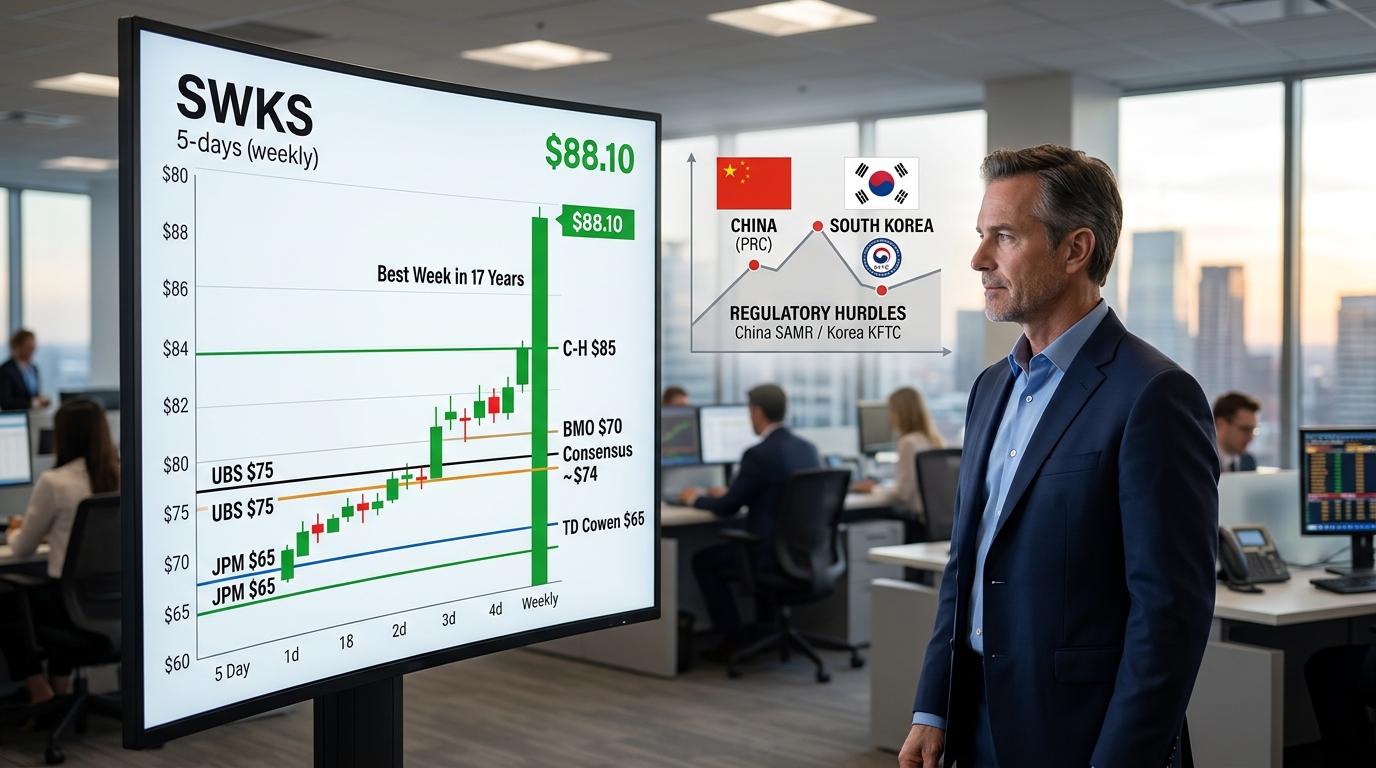
Analyst Targets
- UBS: Neutral, $75 price target (raised from $63)
- J.P. Morgan: Neutral, $65 price target
- TD Cowen: Hold, $65 price target
- Craig-Hallum: Buy, $85 price target
- BMO Capital: Market Perform, $70 price target
- Consensus (25 analysts): Hold, ~$74 mean target, roughly 16% below Friday’s close near $88
What Just Happened
Skyworks surged 9.79% on Thursday to close at $84.03 after CEO Phil Brace told attendees at the Goldman Sachs Communacopia + Technology Conference that the company’s merger with Qorvo is in its final stages and that he remains confident it will close within the 2026 calendar year.
The stock then rose about 5% on Friday, extending what has become a sustained multi-session upswing. The two-day run put SWKS on pace for its best weekly performance since 2009.
Skyworks is up sharply over the past month, with risk now procedural rather than existential as the fixed exchange ratio keeps Qorvo tracking it closely. Including the week’s gains, the stock is up more than 50% versus its low in mid-July.
Company Profile
Skyworks is a firm engaged in analog and mixed-signal semiconductors, while Qorvo is a global provider of connectivity and power solutions. The two companies are major RF front-end suppliers, alongside larger peers with significant RF capability such as Broadcom and Qualcomm. Mobile remains Skyworks’ largest end market, with Apple the dominant customer in that segment.
The Regulatory Picture
The U.S. Hart-Scott-Rodino waiting period expired and the FTC’s timing agreement lapsed in early August 2026 without further action, while Skyworks has said required foreign investment approvals have been obtained where filings were made. China’s State Administration for Market Regulation and the Korea Fair Trade Commission are the only competition authorities still reviewing the transaction.
SWKS and QRVO both rallied as Brace said the companies are waiting on remaining approvals and reiterated a year-end closing timeline. No formal SAMR decision has been calendared publicly, so the next confirmed data points come through SEC filings and any exchange-offer amendments tied to Qorvo’s senior notes. That gap between what management says and what can actually be confirmed is the central risk in owning SWKS at current levels.
The Combined Business: Scale and the Apple Problem
Skyworks has said the merger is in its final stages, with U.S. waiting periods expired and financing completed, and management has described a combined revenue base of roughly $8.0 to $8.1 billion with a $500 million synergy target. Brace has framed the pro forma mix as roughly a $5.5 billion mobile business and a $2.5 to $2.6 billion non-mobile business.
The concentration question does not disappear at close. Apple is a major customer for both Skyworks and Qorvo mobile RF content, which tethers the combined company’s revenue to iPhone unit volumes and dollar content per device. The merger targets $500 million in annual cost savings and management has guided to an Apple exposure that should come down meaningfully, though it would still remain a large portion of revenue. That is a meaningful improvement from today, but it still leaves a majority of the business linked to a single customer’s product cycle.
Forward Scenarios
Bull: China’s SAMR and Korea’s KFTC both clear before year-end. The Qorvo merger brings synergy benefits, cost reductions of $500 million or more, and a more diversified business across defense, IoT, AI data centers, and automotive. Revenue approaches $8 billion on the combined base, and the stock pushes toward the Street-high target of $106.
Base: One jurisdiction approves by end of 2026; the other slips into Q1 2027. Skyworks remains hopeful of closing the deal before the end of 2026, subject to remaining regulatory approvals and customary closing conditions. Integration execution occupies management through mid-2027, and SWKS consolidates in the $80 to $90 range.
Bear: SAMR imposes divestiture conditions or delays stretch into H2 2027. Merger arb unwinds sharply. If the deal stalls, gets restructured with divestitures, or is blocked, the story reverts to a standalone RF supplier still working through an Apple-concentration and earnings-trough problem. Shares retest the low $60s.
Technical Overlay
Skyworks closed near $88 on Friday after trading as high as about $92 intraday. On the daily chart, price sits well above key moving averages, and momentum indicators are stretched with RSI in overbought territory and price above the upper Bollinger Band. The gap between spot and the moving average stack is not normal accumulation behavior; it reflects event-driven repricing that can reverse just as quickly. The put-to-call ratio cited for September 16 expiries could not be verified from primary exchange data in this review, so it should be treated cautiously.
Bottom Line
Wall Street analysts broadly believe the recent SWKS rally has gone too far near-term, with the consensus rating sitting at “Hold” and a mean price target around the mid-$70s, implying potential downside from current levels. That disconnect is the whole debate. Brace’s Goldman Sachs comments shifted the question from whether this deal closes to when, and the market adjusted accordingly. What happens next depends almost entirely on the timing of SAMR’s decision and whether Beijing attaches conditions. Those are not variables technical analysis or earnings models can resolve. The synergy case is credible; the Apple concentration risk shrinks but persists; and the balance sheet takes on meaningful debt at close. Investors buying SWKS above $90 are making a regulatory timing bet dressed up as a fundamental thesis.