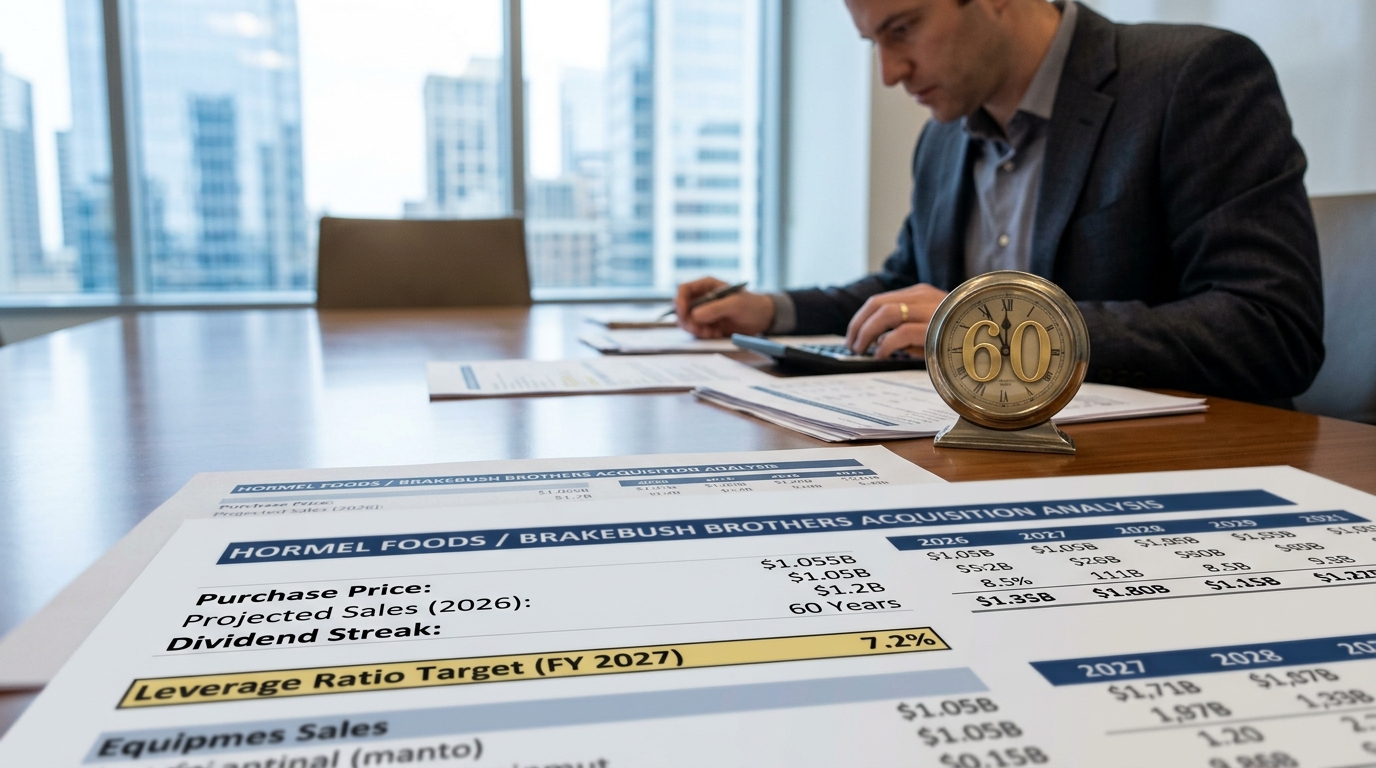
Hormel Foods has spent 60 consecutive years raising its dividend. On September 29, 2026, it agreed to write a $1.055 billion check for Brakebush Brothers, a Wisconsin chicken processor that management said is expected to generate approximately $1.2 billion in net sales in calendar 2026. Those two facts belong in the same sentence, because the second one complicates the first.
What Brakebush Actually Buys
The deal expands Hormel’s chicken exposure from below 5% to roughly 13% of its protein portfolio in one transaction. Brakebush is a leading value-added, non-vertically integrated chicken provider to national and regional foodservice operators, with five production facilities. For Hormel, whose foodservice segment has been the bright spot in an otherwise sluggish earnings picture, that customer network is the real asset. Management has said it expects approximately $20 million in annual cost synergies by fiscal 2028, with additional potential from broader distribution and product innovation.
Synergies are expected to boost earnings from fiscal 2028 onward, which is the honest part of the timeline. Fiscal 2027 is the transition year, and that is where income investors need to focus.
The Leverage Question
This is where the dividend conversation gets serious. Hormel has said it will fund the purchase with cash and new debt, temporarily pushing leverage above its 1.5 to 2.0 times target range before returning within that range during fiscal 2027. Before the deal, Hormel’s quarterly filing for the period ended July 26, 2026, said its outstanding debt included an aggregate of $2.9 billion of fixed-rate unsecured senior notes, and its balance sheet showed $840 million in cash and cash equivalents. Layering $1.055 billion of acquisition spending on top of that existing debt load, while a $500 million tranche matures in fiscal 2027, means Hormel’s treasury team faces a crowded calendar.
Hormel boosted its dividend at the beginning of fiscal 2026, marking its 60th consecutive year of dividend increases. The quarterly rate sits at $0.2925 per share. At that level, dividend payments have increased over the last 10 years, but recent earnings pressure has pushed the payout ratio uncomfortably high in some periods. Free cash flow covers the payout more comfortably than reported earnings do, but the margin for error narrows when you add a billion-dollar debt service obligation.
The Test Income Investors Should Apply
A Dividend King buying growth is not automatically bad news for the dividend. The question is whether the acquired business generates enough cash, fast enough, to keep the streak alive without squeezing the balance sheet beyond recovery. Brakebush’s roughly $1.2 billion of net sales and its foodservice positioning suggest it can. Hormel has said it expects the acquisition to be solidly accretive to adjusted earnings per share beginning in fiscal 2028. If that holds, the 61st consecutive increase is defensible.
The risk is the gap between now and fiscal 2028. Leverage above target, a maturing note, capital spending estimated at $260 to $290 million for fiscal 2026 alone, and a payout ratio already stretched: each of these is manageable individually. Together, they leave Hormel with less cushion than it has carried for most of the past decade.
Where This Fits in a Portfolio
Competitors like Tyson Foods and Pilgrim’s Pride operate at far greater chicken scale. Hormel is not trying to out-commodity them. It is buying a value-added, foodservice-focused platform that commands better margins than commodity chicken and fits the direction its Foodservice segment has been heading for years. The strategic logic is clear.
For long-term income investors, the position sizing question matters more than the headline price. Hormel at a roughly 5.9% yield reflects genuine uncertainty about the earnings trajectory, not just a valuation opportunity. Adding to a position today means believing management can close the deal, absorb the debt, retire the maturing note, and generate accretion by fiscal 2028, all without skipping a dividend increase. That is achievable. It is also a tighter path than Hormel’s shareholders have needed to walk in most of the last six decades.
Wealth Takeaway
When a company with a decades-long dividend record makes a large acquisition, the question is never whether the business is strategically sensible. It almost always is. The question is whether the balance sheet can carry the cost of growth without forcing a choice between the dividend and the debt. Monitor Hormel’s leverage ratio through fiscal 2027 closely. That single metric will tell you more about the dividend’s safety than any press release will.