October 10, 2026
Bonus Content: Delta’s $6 Billion Fuel Bill Is Now the Industry’s Problem
Editor’s Note: We’re delighted to bring you the latest stock pick from our colleague, Wall Street legend Marc Chaikin. You may recognize Chaikin’s name from frequent appearances on CNBC, Bloomberg or Fox Business. His client list has included billionaires such as Paul Tudor Jones, Steve Cohen, and George Soros. His Power Gauge system flashed bullish on Nvidia right before it rose 50,001%. And it just flashed bullish on another off-the-radar AI stock poised to trigger a $248 trillion “White Swan” event as soon as October 20. See below for Marc’s research and free recommendation.
Dear Reader,
I’ve uncovered the single best AI stock in the world.
And it could explode in value on or before October 20.
That’s the date I anticipate a major announcement.
It relates to a brand-new technology this company just launched.
A technology so powerful…
It could speed up AI breakthroughs 360 times over.
Breakthroughs in medicine, energy, quantum computing and AI itself…
Breakthroughs that were five years away…
Could come in just FIVE DAYS once this technology launches.
I’m talking about something I call AI “micro clusters.”
These are clusters of AI compute that will soon replace the massive data centers blotting the American landscape right now.
Micro cluster technology uses 99% less energy than data centers.
It takes up 99% less real estate.
Yet it’s more than 1 trillion times more powerful than today’s data centers.
Micro clusters are about to trigger this $248 trillion AI “White Swan” event.
Those who understand what’s coming could get very rich.
Those who ignore what’s coming could see their AI portfolios wiped out.
The good news?
One company has engineered the special chips that will power this breakthrough.
The U.S. government is pouring billions into this company’s account ahead of the launch.
And when this story breaks into the mainstream…
I believe billions, even trillions more dollars will flow into this stock.
→ It’s not Nvidia.
→ It’s not Apple.
→ It’s not SpaceX.
It’s an off-the-radar AI play that could explode on or before October 20.
The time to get in is right now.
So, I created this urgent presentation detailing the whole opportunity.
I explain the technology.
I take you “inside” the secretive lab where it’s being finalized.
And I even give you the name and ticker of the company behind the coming technology revolution.
Fair warning: This presentation contains time-sensitive information.
I may have to take it offline as soon as 12 midnight, tonight.
Good investing,
Marc Chaikin
Founder, Chaikin Analytics
P.S. The company I name in this presentation represents the future of AI. Its new technology is about to replace AI data centers when it comes to major AI breakthroughs. And it will, I predict, trigger a $248 TRILLION reboot of the AI markets… and one of the biggest moneymaking opportunities we’ll ever see… about 50 times bigger than the whole AI boom to date, in fact.
Go here for full details, including the company’s name and ticker. And if interested, I urge you to get in on or before October 20, when this company presents its latest findings at a major tech conference in Europe.
Delta’s $6 Billion Fuel Bill Is Now the Industry’s Problem
Analyst Targets
- TD Cowen: Buy, PT $101 (cut from $105, Oct. 2)
- Bernstein: Outperform, PT $100 (cut from $106, Oct. 7)
- Susquehanna: Positive, PT $100 (cut from $105, Oct. 7)
- Wells Fargo: Overweight, PT $100 (cut from $105, Oct. 6)
Every one of those cuts arrived before Friday’s report. The question now is how far they move post-earnings, with DAL sliding roughly 4% to around $79 in early trading.
What the Quarter Actually Said
Delta reported Q3 adjusted revenue of $17.585 billion, up 20.4% year over year, and adjusted EPS of $1.72 against a consensus of roughly $1.82, with adjusted net income of $1.134 billion. It was Delta’s first earnings miss in two years.
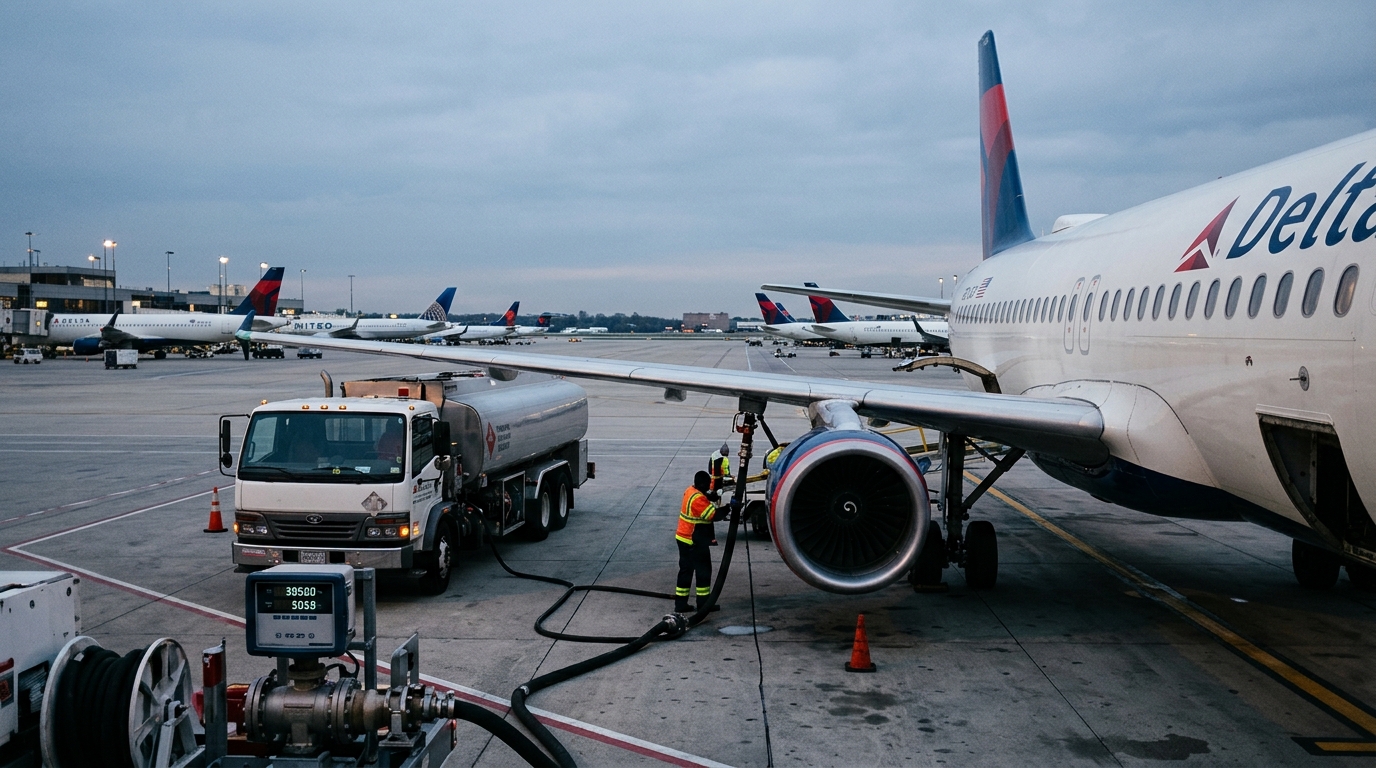
The fuel bill for the quarter alone hit $4.1 billion, up 62% from a year ago, as the U.S.-Israeli war with Iran drove jet fuel prices sharply higher worldwide. CFO Erik Snell said the quarter absorbed more than $500 million in additional fuel costs compared with the company’s early July forecast. That single line explains almost everything.
The Guidance Cut
Delta cut its adjusted EPS forecast to $5.10–$5.60 from $6.50–$7.50, with free cash flow guidance coming down to approximately $2.5 billion from a prior range of $3 billion to $4 billion. The midpoint of the new range is 23.6% below the midpoint of Delta’s own July range.
CEO Ed Bastian framed it plainly in the company’s results release: Delta expects to generate a pre-tax profit of roughly $4.5 billion for the full year while absorbing a $6 billion increase in fuel costs.
The carrier expects fuel to cost about $4.25 a gallon in the December quarter, including a benefit from its refinery business, compared with $3.61 a gallon in the September quarter.
Why This Extends Beyond Delta
Bastian put it directly on the earnings call: “In a high-cost environment you cannot grow your way out of it.” He also said the market has accepted higher price points this year with limited resistance from travelers.
The problem is that fares can only travel so far. Adding too many flights to capture more demand could intensify competition for passengers, making it harder to sustain higher fares and protect profits. The challenge becomes more acute as industry capacity growth is scheduled to accelerate in Q4.
The industry has already taken steps to restrain capacity, but Bastian said more will be needed next year to improve profitability.
Deutsche Bank analysts expect the industry to recover a smaller share of higher fuel costs through revenue measures in Q4, with full recovery not expected until early 2027.
Forward Scenarios
Bull: Oil pulls back materially from here. Delta has pushed pricing meaningfully higher this year with limited traveler pushback and expressed confidence those price points can hold. If that holds, every dollar of fuel relief drops almost directly to the bottom line.
Base: Fuel stays near $4.25 a gallon through Q4. With more than 60% of Q4 already booked and the company guiding to about 20% year-over-year revenue growth, Delta earns toward the top of its $5.10–$5.60 full-year range but margin recovery remains shallow.
Bear: Capacity discipline cracks across the industry. If carriers add flights to capture demand, competition intensifies and sustained higher fares become impossible to maintain. In that scenario Delta’s $4.5 billion pretax profit estimate looks optimistic.
Technical Overlay
DAL fell roughly 4% to around $79 in early Friday trading on the earnings release, breaching its pre-earnings base. The stock had traded above $83 just days earlier; the gap down opens space toward the mid-$70s before the next meaningful support zone. Consensus targets cluster near $100–$101, which implies the Street still sees value, but those targets will face downward pressure when post-earnings revisions arrive.
What Investors Should Watch
- Oil price direction: Every move relative to the $4.25 Q4 fuel assumption changes the earnings math directly.
- Industry capacity decisions: Whether UAL, AAL, and LUV follow Delta’s restraint signal or add seats determines whether the fare increases hold.
- Analyst revisions: Melius Research noted Delta’s fare increases are keeping second-half earnings broadly flat despite soaring fuel costs, but cautioned that profit margins have struggled to improve for years. “Holding or improving fares in 2027 is the linchpin for higher margins,” they wrote.
- AAL’s next earnings report: American faces the same fuel shock with a weaker balance sheet, making its earnings call the next pressure test for the sector.
Bottom Line
Delta’s demand is fine. Revenue up about 20%, premium cabin up 18%, Q4 already more than 60% booked. None of that is the problem. CFO Snell said in Delta’s release that the quarter absorbed more than $500 million of higher fuel costs versus the company’s early July forecast. That is what makes Friday’s report consequential beyond Delta alone: the company with the strongest brand, the highest margins, and a functioning refinery still could not offset what a 62% jump in its quarterly fuel bill did to earnings. The entire industry is watching the same math. If Bastian is serious about curbing 2027 growth and others follow, fares stay elevated but capacity contracts. If discipline breaks down, fares fall and the sector’s profit recovery gets pushed well past 2027.