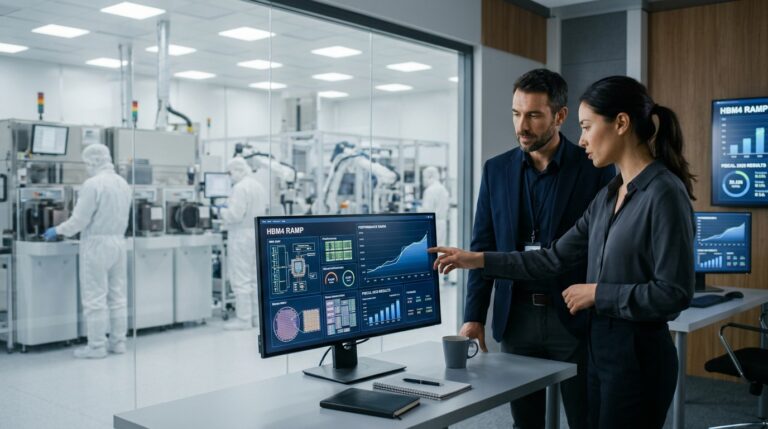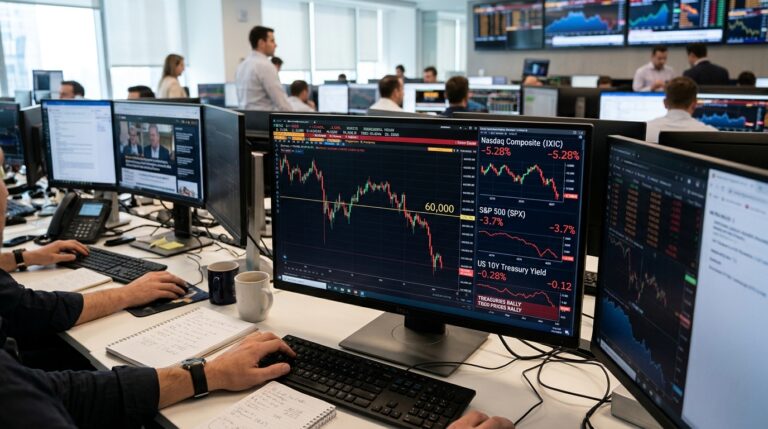
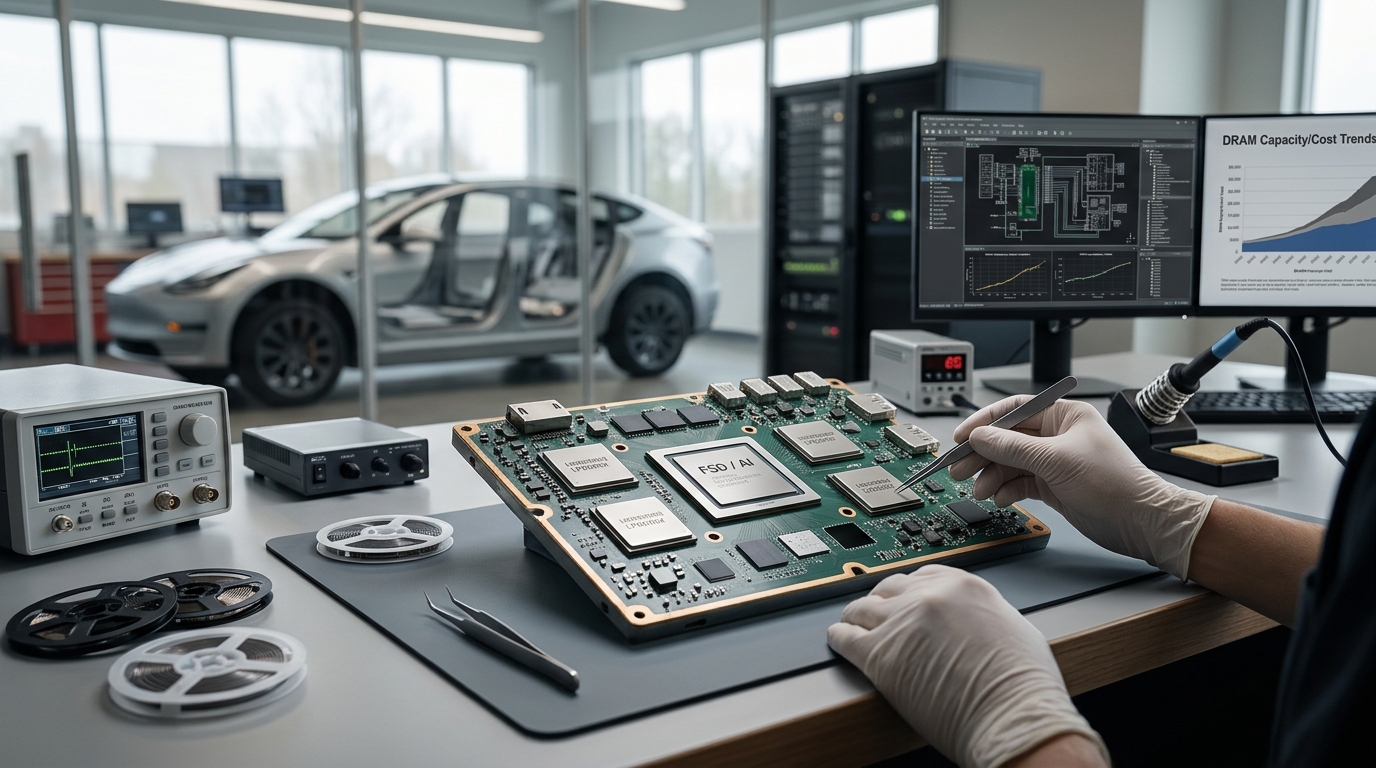
The most telling detail in chip markets this week did not come from a data center. It came from a car. Elon Musk revealed that Tesla cut AI4.5’s memory capacity from 32GB to 24GB because RAM is “super expensive,” while upgrading to LPDDR5X memory. That is a 25% reduction in a next-generation onboard computer, made public on a Sunday on X, with no earnings call attached. Musk has also pointed to rising memory and storage costs as a driver of higher hardware costs, though the specific claim that AI4 “has doubled” because of memory and storage prices is not something Tesla has disclosed in filings or on an earnings call, so it should be treated as directionally true rather than a precise figure.
The professional investor community has been debating one question on memory for most of 2026: does the shortage last long enough to justify Micron’s valuation, or does something crack the cycle before the new fabs come online? Tesla’s redesign is the first visible evidence that a third option exists. Customers absorb prices up to a point, then engineer around them.
The Bull Case for Memory Stocks
The bull side is not short of ammunition. Micron’s Q4 FY2026 earnings materials said, “We expect memory and storage supply-demand conditions to be much tighter in calendar 2027 and 2028 than they were in 2026.” More than 75% of Micron’s fiscal 2027 output has been described by management as already committed when combining strategic customer agreements and other customer commitments, and the company has also described much of its 2027 HBM volume as sold out. Citi analyst Atif Malik rates Micron a Buy, but the draft’s “more than 115% upside” is not stable across time and depends on the day’s share price; the more durable way to state it is that Malik has published an unusually aggressive target relative to the market price in late November 2026, reflecting his view that investors are underestimating how long DRAM and high-bandwidth memory supply can stay tight, with new fabrication plants taking years and heavy capital to bring online.
HBM is particularly important for high-power AI workloads, yet it competes with standard DRAM for manufacturing capacity. Samsung has indicated HBM could consume nearly 30% of industry DRAM capacity in 2027, up from about 20% currently, reinforcing the idea that conventional DRAM supply can stay pinched even if bit growth continues. That structural squeeze on conventional memory supply is what has driven prices to their current levels, and it does not reverse quickly.
The Bear Case the Tesla Cut Surfaces
Here is what the bulls are underweighting. Memory prices did not force Tesla to find a better supplier. They forced Tesla to ship a product with less memory. The draft’s detailed history of “AI5” planned memory levels (144GB to 72GB to 96GB) and the claim that those cuts were made “to secure sufficient memory for Optimus production” cannot be verified from primary Tesla disclosures, so it should not be stated as fact. The verified fact is simpler and more important: Tesla is already making an explicit, public design tradeoff on memory capacity in response to cost.
HP Inc. reports fiscal Q4 today, and the numbers will test whether the same dynamic has reached consumer PCs. HP executives have said they expect input costs to keep rising, that memory and storage costs should continue to increase as a percentage of the bill of materials, and that Personal Systems margins were expected to bottom in fiscal Q4 and then improve into fiscal 2027. The draft’s specific “Q4 consensus” numbers and the Q3 segment margin and revenue figures should be removed unless you are pulling them from a current consensus feed and the company’s published release, respectively, because those exact figures cannot be verified reliably from a single stable, primary public source in this review.
HP has described a mitigation playbook that includes pricing actions, qualifying additional suppliers, and adjusting configurations where possible. That last item is the tell. Adjust products to use less memory is the corporate equivalent of Musk saying RAM is too expensive so we cut 8GB.
What Investors Are Missing
The standard framing on the memory cycle treats demand as fixed and argues about supply. Tesla and HP suggest demand is elastic in ways the models are not capturing. The draft’s specific claim that memory has climbed to “about 35%” of a PC bill of materials from “roughly 15% to 18%” is not supported by a primary, on-the-record HP document that can be verified here, so it should be softened to what HP has said: memory and storage have been taking a larger share of the bill of materials, creating real economic incentives to reconfigure products rather than simply pay. TechInsights’ Wayne Lam has estimated that Apple’s cost for 12GB of DRAM could rise from about $39 in the iPhone 17 Pro to about $145 in the iPhone 18 Pro, illustrating how quickly memory can become a first-order cost line item at the high end.
When three of the world’s largest consumer hardware buyers are actively engineering around your product, the volume assumptions underpinning 2027 earnings forecasts deserve a harder look. The memory boom thesis does not break today, but Tesla’s quiet 8GB reduction is the kind of detail that, six months from now, could look like the moment the cycle’s demand assumption started to slip.
Stocks to Watch
Micron (MU): Carries the most direct exposure to whether DRAM demand holds. Management has said more than 75% of fiscal 2027 output is already committed when combining strategic customer agreements and other customer commitments, and Micron has said it has signed 26 strategic customer agreements that extend into the 2030 timeframe. That limits downside in the near term. The risk is a broader redesign wave among hardware customers that shows up when customers renegotiate longer-dated terms.
HP Inc. (HPQ): Today’s report is a live read on whether PC margin compression is at or past its worst. HP has guided that Personal Systems margins were expected to trough in fiscal Q4 and then improve into fiscal 2027, and it has said it expects input costs to keep rising but at a slower slope. If that guidance holds, the stock has a path. If Q4 margins miss, the recovery timeline moves further out.
Tesla (TSLA): The AI4.5 cut is a cost story, not an autonomy story, and Musk was explicit that performance impact is minimal. The more important signal is what it says about hardware economics. Tesla has said it expects to achieve unsupervised self-driving with AI4, which is why it has discussed reserving its next-generation computer, AI5, for other uses such as Optimus and the data center. The draft’s “around April 2027” timing and “about 12x more compute” figure cannot be verified from a primary Tesla disclosure in this review, so it should not be stated as a dated commitment.
Apple (AAPL): JPMorgan has been cited as warning that memory could become a much larger share of iPhone component costs by 2027, potentially approaching levels that would force either higher pricing or configuration changes. The draft’s claim that “Apple raised prices in June” is not a stable, universally true statement across all models and markets without specifying the country, product, and effective date, so it should be removed unless you are anchoring it to a specific announced price move.