April 29, 2026
META Q1 2026: The Quarter Was Fine. The Bill Wasn’t.
Revenue up 33%. EPS beat. Guidance solid. And then came the spending number that changed the entire conversation.
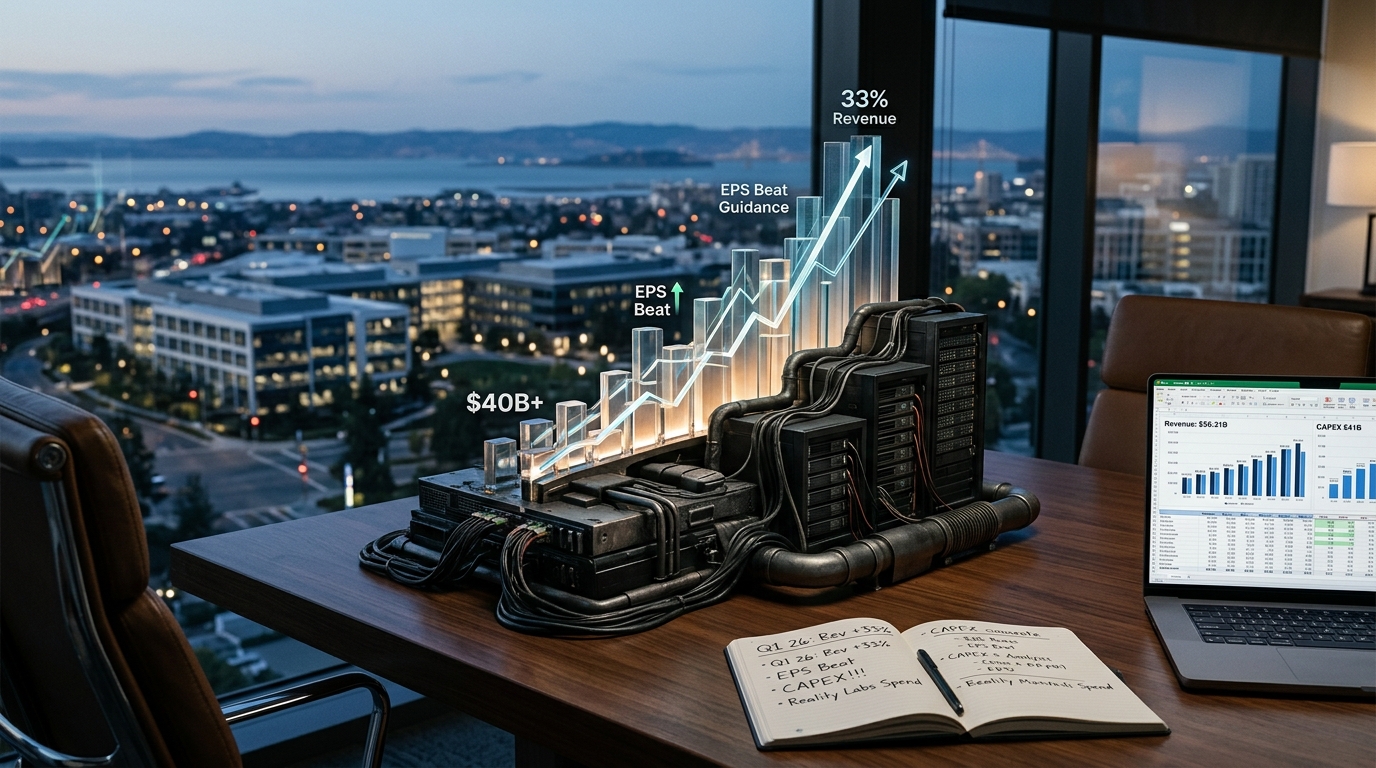
Wednesday night, Meta dropped a Q1 report that most companies would consider a career-defining quarter. Revenue of $56.31 billion, up 33% year-over-year. An EPS print that nearly doubled analyst estimates at first glance. Operating margin steady at 41%. Q2 guidance that came in right on top of consensus — $59.5 billion at the midpoint, range of $58 to $61 billion. No major misses. No guidance cut. Nothing that, in isolation, should send a stock down hard.
And yet the stock dropped more than 6% in after-hours trading.
Not because the business is broken. Because of what it’s going to cost to keep it growing — and the number Meta put on that got a lot bigger Wednesday night.
Your Download Link Will Expire
If you still haven’t downloaded my free “Simple Options Trading For Beginners” guide…
…please take a few seconds and download it right now before your new temporary download link expires.
I eventually plan to charge money for this training, so do yourself a favor and download it now…
That way, no matter what it costs in the future, you’ll have a free copy on your computer.
Make sense?
Before Anything Else — That EPS Number
The $10.44 headline EPS figure is real, but it needs context immediately. Embedded in that number is an $8.03 billion income tax benefit tied to recent federal tax legislation. Pull that out, and diluted EPS lands at $7.31 — still a beat against the $7.11 analyst consensus, still a solid result, but a very different story than the headline implies. The market saw through it quickly, which is part of why the after-hours reaction was so focused on the spending side rather than celebrating the profit beat.
Free cash flow came in at $12.39 billion, down from $14.1 billion the previous quarter. That’s not a crisis level, but the trajectory is worth noting. When capex goes up, free cash flow tends to follow in the wrong direction — and Meta just raised its capex guide by $10 billion at both ends of the range.
The operating margin of 41% is genuinely impressive for a company at this scale, and it matched the same quarter a year ago. But here’s the part people aren’t talking enough about: holding margin flat while revenue grows 33% means costs are scaling at roughly the same rate as the business. That’s a different dynamic than expanding margin. It’s controlled, not accelerating.
The Number That Broke the Mood
Meta’s original 2026 capex guidance was already aggressive — $115 to $135 billion, up from $69.69 billion spent in 2025. A near-doubling in a single year. CFO Susan Li explained that the revised figure of $125 to $145 billion reflects higher component pricing and additional data center capacity requirements. The logic is straightforward. The scale is not.
To put that in perspective: Meta is now guiding for more capital expenditure in a single calendar year than the entire company earned in revenue just three years ago. That’s not a criticism — it reflects how large the business has become and how seriously leadership is treating the AI infrastructure cycle. But it is the kind of number that makes even supportive investors do the math twice.
What makes this harder to dismiss is that Meta isn’t financing this vaguely. They’ve already locked in a $6 billion multi-year fiber-optic supply deal with Corning and a 20-year nuclear power purchase agreement with Vistra. These are operational commitments, not aspirational spending slides. The money is being spent. The question investors are now asking is what it buys — and when.
Worth noting, though not as a comfort: Meta is not alone in this. The four major U.S. tech companies have collectively committed somewhere close to $650 billion in AI-related capital spending for 2026. This is an industry-wide conviction trade. That doesn’t reduce Meta’s specific risk, but it does mean the competitive pressure to keep spending is real on every side.
The SpaceX IPO makes me FURIOUS
Elon has reportedly filed to take SpaceX Public… in an IPO that’s expected to hit a $1.75 trillion valuation.
The biggest in Wall Street history…
And you know who’s going to make all the money? The banks brokering the deal. The hedge fund managers. The billionaire insiders. The same “already rich” 1%’ers.
After the IPO, everyone else will be left fighting over scraps.
That’s why I’m leveling the playing field.
Where the Business Actually Stands
The advertising business — which is still, by a wide margin, what Meta actually is — had a strong quarter. Ad impressions rose 19% year-over-year. Average price per ad increased 12%. Daily Active People across the Family of Apps reached 3.56 billion, up 4% from a year ago. There was a slight sequential dip attributed to internet disruptions in Iran and WhatsApp access restrictions in Russia, two events that have nothing to do with advertiser demand or platform health in core markets.
The Family of Apps segment generated $26.90 billion in operating income in a single quarter. That number is doing a lot of heavy lifting across the entire company — it’s covering AI buildout costs, absorbing Reality Labs losses, and still leaving room for shareholder returns. Whatever else you think about the capex debate, the engine powering all of it remains in very good shape.
Management also reiterated that 2026 operating income will exceed the $83.28 billion posted in 2025 — even accounting for the elevated infrastructure spend. That’s a meaningful commitment. If it holds, the valuation math starts to look more reasonable. If it doesn’t, this after-hours move will look like the beginning of a longer repricing, not a brief overreaction.
One more thing on the advertising side that deserves its own sentence: AI-assisted ad tools are genuinely contributing to impression volume and pricing power right now. That’s the clearest evidence so far that the infrastructure investment is producing measurable returns in the core business. It’s not theoretical. It’s in the Q1 numbers.
Reality Labs — Same Story, Different Quarter
Reality Labs posted a $4.03 billion operating loss in Q1. The division lost $19.2 billion across all of 2025, and 2026 is expected to come in at a similar level before losses peak. Zuckerberg has been consistent about the long-term thesis here — wearables, augmented reality, spatial computing. Consistent enough that the market no longer punishes or rewards the stock much based on Reality Labs results alone.
What’s genuinely interesting is how little the $4 billion quarterly loss came up in post-earnings discussion. A year ago, that number would have dominated the conversation. Now it’s almost background noise. That shift says something — either investors have accepted it as a long-term investment line item, or they’ve simply moved on to worrying about the much larger capex number. Probably some of both.
MAJOR BUY ALERT: Mar-a-Lago/Trump/Elon
I recently visited Mar-a-Lago…
And now I’m prepared to put my reputation on the line.
Since 1998, my proprietary system would’ve returned 13,126% in backtests.
(That’s 13X the S&P and 106X the average investor, according to JP Morgan.)
However, one investment I just uncovered could be my biggest winner of all…
It involves President Trump, Elon Musk, trillions of dollars, China…
And a MAJOR upgrade to the artificial intelligence revolution.
The Workforce Contradiction
Here’s something that doesn’t get framed clearly enough. Meta is in the middle of laying off roughly 10% of its global workforce — about 8,000 employees — while simultaneously committing up to $145 billion in capital spending, largely on AI infrastructure. It has also stopped filling approximately 6,000 open roles.
That’s a very specific thesis being acted on in real time: that AI systems will generate more value per dollar than the human employees being removed. It might be correct. Zuckerberg has made similar bets before and been right. But it’s worth understanding what’s actually being said — this isn’t cost-cutting for the sake of margins. It’s a deliberate reallocation from people to infrastructure, at a scale the industry hasn’t really seen before.
The question isn’t whether that bet is intellectually defensible. It clearly is. The question is timing — how long before the machines actually show up in the productivity numbers in a way that offsets both the layoff costs and the capex drag? That answer almost certainly isn’t this quarter or next.
What Else Is Sitting in the Background
There are a few slower-moving risks that didn’t drive Wednesday’s reaction but deserve to stay on the watch list. Meta has disclosed that multiple youth-safety-related legal cases could ultimately result in a material financial loss. In March, the company lost two separate court trials involving allegations that it misled consumers about product harms. None of this is priced into any model right now. It rarely is — until it suddenly needs to be.
Regulatory exposure more broadly — in the EU especially — hasn’t gone away. It just hasn’t been the loudest thing in the room. Competitive pressure from TikTok’s continued engagement growth and YouTube’s advertising gains remains real. And the macro environment, while favorable right now for tech broadly, is still subject to rate and tariff dynamics that could shift sentiment quickly.
The Nasdaq had its best month since April 2020 heading into Wednesday’s close — up about 14% for April. Meta’s after-hours drop is landing against a genuinely strong backdrop for the sector. That’s an important piece of context. The sell-off isn’t a macro reaction. It’s specific. And specific reactions tend to require specific answers to go away.
Bottom Line
Meta’s Q1 was a strong quarter in every operational sense. The ad business is healthy, engagement is holding, and the company’s core revenue growth rate is accelerating in a way most mega-caps can’t match. None of that is in dispute.
The debate now is entirely about capital allocation at scale. Spending $125 to $145 billion in a single year on AI infrastructure — while cutting thousands of employees and promising operating income above $83 billion — is a bet that requires patience from investors and execution from management simultaneously. Right now, investors are being asked to believe the payoff is coming. The Q1 ad numbers are the best evidence that it might be.
But belief doesn’t hold indefinitely at $145 billion per year. At some point the AI spending needs to show up in margin expansion, accelerating free cash flow, or a meaningful new revenue stream beyond advertising. Q2 margins will tell part of that story. The quarters after that will tell more.
The business hasn’t changed. The expectations placed on it have.
For informational purposes only.