May 24, 2026
IBM’s Best Week in 24 Years
The Quantum Foundry Bet That Moved a Mega-Cap
Analyst Targets
- Wedbush — Outperform | Price Target: $320
- RBC Capital — Hold | Price Target: $300 (lowered from $330)
- HSBC — Hold | Price Target: $231 (upgraded from Reduce)
- Consensus (21 analysts, S&P Global) — Buy | Avg. Target: ~$278–$291
IBM doesn’t usually move like this. The stock is a dividend stalwart, an enterprise institution, the kind of name that drifts in narrow ranges while the rest of the market does something interesting. That changed this week.
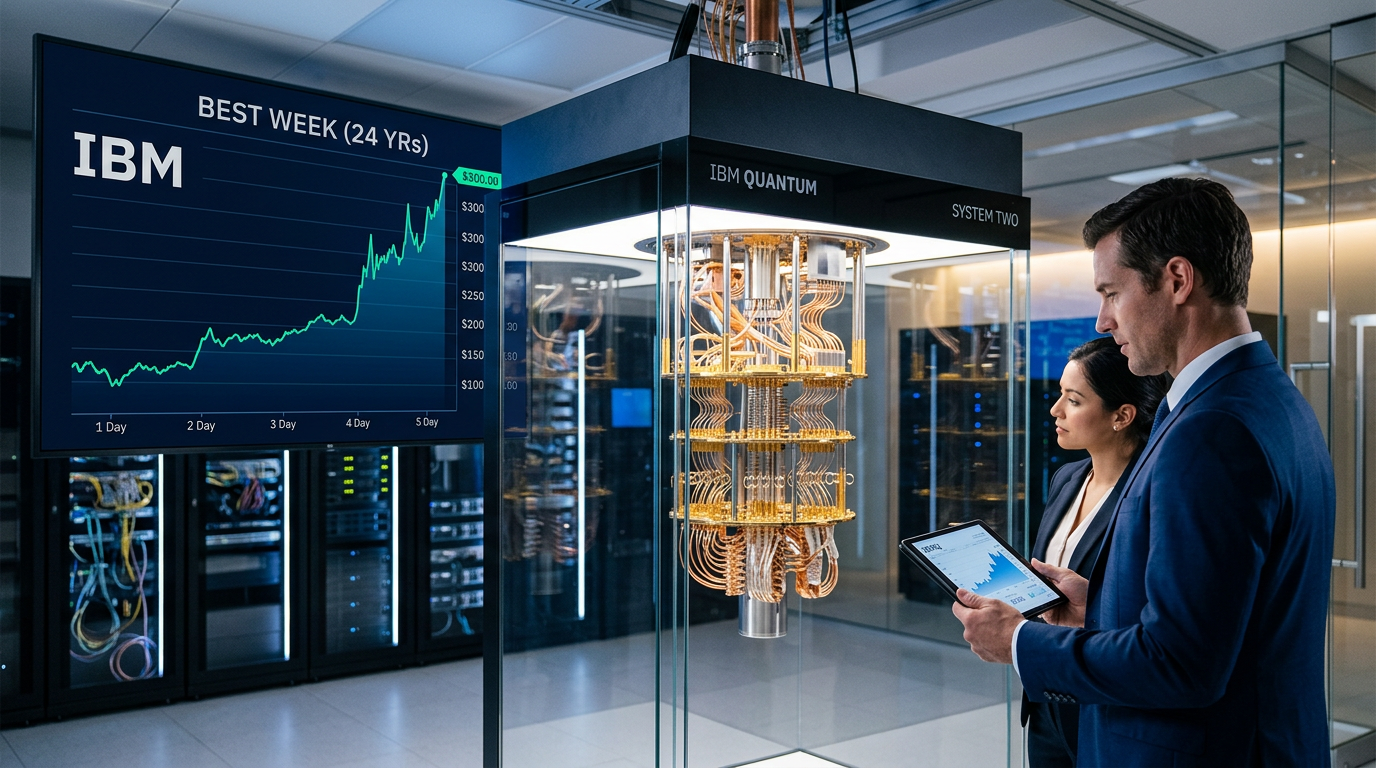
Shares gained nearly 16% on the week — the strongest single-week performance since October 2002, according to Dow Jones Market Data. To put that in context, a weekly advance of 15% or more in IBM has appeared just seven times since the company went public in 1967. The last comparable episode was near the bottom of the dot-com collapse.
This time, it wasn’t a crisis bottom. It was a catalyst.
15X Bigger Than SpaceX: Elon’s New Launch
While the rest of the market goes crazy for “the mother of all IPOs”, a new Elon Musk innovation is quietly being rolled out nationwide. It’s been 27 years in the making, and it could have a radical impact on how millions of people manage their money… and even collect Social Security.
Company Profile
IBM operates across four primary segments: Software, Consulting, Infrastructure, and Financing. The Software business — anchored by Red Hat, watsonx, and HashiCorp (acquired via Confluent for $11.6 billion in Q1 2026) — now drives the majority of growth and margin expansion. Consulting handles enterprise AI integration. Infrastructure, long considered the legacy anchor, has been staging a quiet revival through IBM Z mainframe refresh cycles.
The company serves more than 175 countries and counts 95% of Fortune 500 firms as clients. What’s interesting is that despite a public identity still rooted in hardware, roughly 75% of IBM’s business today is software and services.
The Numbers (Q1 2026)
- Revenue: $15.92B vs. $15.61B consensus — up 9.5% YoY
- Non-GAAP EPS: $1.91 vs. $1.81 consensus — beat by 5.5%, up 19% YoY
- GAAP Diluted EPS: $1.28 (up from $1.12 in Q1 2025)
- Software: $7.05B — up 11%; Red Hat +13%, Data +19%
- Infrastructure: $3.33B — up 15%; IBM Z mainframe revenue +51% YoY
- Free Cash Flow: $2.22B — highest in a decade, up 13% YoY
- Adjusted EBITDA Margin: 25.0%
- Full-Year Guidance: Reiterated — 5%+ constant-currency revenue growth; ~$1B FCF increase YoY
Four consecutive quarters of beating EPS estimates. The guidance reaffirmation — rather than an outright raise — triggered some early profit-taking after the April earnings release, but that concern quickly faded when this week’s catalyst hit.
Millionaire Who Bought Apple at $1: “This Is the LAST Tech Boom You’ll Ever Need”
He bought Apple at $1… Netflix at $1.62… Amazon at $1.77 (split adjusted)…
A $1,000 in those picks could have become $1.7 million.
Now he says three unstoppable economic forces are about to collide – triggering what could be the FINAL and most explosive phase of this Tech Boom.
The same setup that’s already minted a recent 600,000 NEW millionaires.
Only this time, his research shows the final phase could be 2X bigger.
And 20 billionaires are moving their money to get positioned…
P.S. He’s revealing the #1 stock pick for 2026 – 100% FREE.
Why the Stock Moved
On May 21, 2026, the U.S. Department of Commerce announced $2.013 billion in CHIPS Act funding distributed across nine quantum computing companies. IBM was the headline recipient — pulling in $1 billion in proposed incentives, the largest single allocation of the group. IBM is matching that dollar-for-dollar, contributing an additional $1 billion of its own cash to launch Anderon, a new standalone subsidiary the company describes as America’s first pure-play quantum foundry.
Anderon will be headquartered in Albany, New York, operating as a state-of-the-art 300-millimeter quantum wafer foundry — the same wafer format used in leading classical semiconductor fabrication. The initiative carries a Letter of Intent (not yet finalized agreements), a detail worth watching. But the market didn’t wait for the paperwork.
Slight tangent, but it matters: the quantum sector reaction was broad. Rigetti finished up 30.6% on the day, D-Wave surged 33%, and Infleqtion closed up 31.4%. IBM’s move was more measured — and arguably more durable — given the company’s scale, existing infrastructure, and the direct size of its federal award.
Macro Context
The CHIPS and Science Act has been deploying capital in waves, and quantum is now receiving its first large-scale federal intervention — the largest single commitment to quantum R&D from the U.S. government to date. The broader directive here is competitive positioning against China, with the government explicitly aiming to position the U.S. to manufacture most of the world’s quantum wafers.
For IBM specifically, the Anderon announcement lands on top of an already improving fundamental picture. The generative AI book of business crossed $12.5 billion at year-end 2025 — up from $9.5 billion just one quarter prior. Enterprise AI demand is accelerating through both the Consulting and Software segments, and the Confluent acquisition adds meaningful data-streaming infrastructure to an already deep hybrid cloud stack.
The quantum industry’s projected economic value sits at an estimated $850 billion by 2040. That number comes from IBM’s own planning materials, so take it with appropriate skepticism — but the directional point stands.
Forward Scenarios
- Bull: Anderon agreements are finalized, IBM secures outside investors as the foundry scales, the 2029 fault-tolerant quantum target holds, and Software/AI bookings continue to compound. The stock re-rates toward the $320–$335 range where top-end analyst targets cluster. Dividend growth — now at 31 consecutive annual increases — reinforces the income floor.
- Base: Anderon progresses through definitive agreements without major setbacks, Q2 2026 earnings (expected July 22) confirm continued revenue momentum above 5%, and the stock consolidates in the $255–$280 range as the market weighs execution risk against the valuation multiple. Consensus sits near $278–$291 for a reason.
- Bear: The LOI stalls in negotiations, currency headwinds compress Consulting margins further, and AI bookings growth decelerates. The prior six-month window following historical 15%+ weekly surges has been IBM’s soft spot — the stock won only a third of the time over that horizon, with slightly negative average returns. A reversion toward the $221–$235 support zone isn’t off the table if macro conditions deteriorate.
Technical Overlay
IBM closed at $253.84 on May 22, sitting just below the near-term resistance zone around $258–$265. The 50-day moving average recently crossed above the 200-day, a constructive intermediate signal. Volume surged notably on May 21 — over 25 million shares traded, roughly three times average daily volume — which adds weight to the move. A buy signal from a pivot bottom was issued May 13, and the stock has risen nearly 18% from that point.
On pullbacks, support levels emerge around $234–$248. The 52-week range runs $212.34 to $324.90, and the stock is currently trading in the lower half of that range despite this week’s surge — which is either an opportunity or a reminder of how far the stock fell from its late-2025 highs before this week’s recovery.
Nvidia About to Crash? Predictive AI Tech Issues Forecast That Could Shock Entire Market
The same AI tech used to prevent heart failure and grid blackouts can now “see ahead” in the U.S. stock market in a way that sounds like science fiction.
What Investors Should Watch
- Finalization of definitive agreements between IBM and the Department of Commerce for Anderon
- Q2 2026 earnings (estimated July 22, 2026) — Software growth trajectory and Consulting margin recovery
- GenAI book of business trajectory — the $12.5B year-end figure needs to keep moving
- Confluent integration progress and its contribution to Software ARR
- Analyst revisions following the quantum catalyst — several firms have yet to update targets post-announcement
- Whether the 2029 fault-tolerant quantum computer roadmap holds amid execution demands
Bottom Line
IBM just received the kind of external validation that doesn’t show up in quarterly earnings. A $1 billion federal commitment — matched with $1 billion of the company’s own capital — transforms quantum from a research talking point into a funded infrastructure bet. The market hasn’t seen IBM move like this in 24 years, and the question now is whether the fundamental case can hold up what the catalyst started.
The six-month window historically has been where these surges lose steam. The bull case requires Anderon agreements to close, AI bookings to keep compounding, and the Software engine to keep delivering. All three are plausible. None are guaranteed.
What’s worth watching here isn’t the quantum hype cycle. It’s whether IBM can convert federal backing and enterprise AI momentum into a sustained re-rating — or whether this week ends up being the high-water mark before reality sets back in.
For informational purposes only.