July 1, 2026
CSX Hit an All-Time High. The Railroad Story Is Bigger Than One Stock.
A 46% one-year gain, a $495M tunnel now fully open, and Q2 earnings on July 22.
Analyst Ratings and Price Targets
As of late June 2026, the analyst community is broadly bullish on CSX, with the most recent wave of target increases arriving the week of June 25 ahead of the July 22 earnings release. Below is the current landscape across major firms.
- Barclays (Brandon Oglenski) — Overweight | PT $55 — Raised from $47 on June 25, 2026. Highest target on the Street from a major firm. Reflects confidence in continued margin expansion and volume acceleration in Q2.
- Bank of America (Ken Hoexter) — Buy | PT $53 — Raised from $51 on June 17, 2026 after Q2-to-date carload growth came in at 6.0% year over year versus BofA’s prior estimate of 2.7%. Firm also raised Q2, 2026, and 2027 EPS estimates by 2-3%.
- RBC Capital (Walter Spracklin) — Outperform | PT $51 — Raised from $47 on June 24, 2026. Cited stronger operational execution and CSX’s positioning across multiple merger resolution outcomes.
- Wolfe Research — Outperform | PT $50 — Raised from $46 post-Q1 results. Noted improved earnings outlook with 2026 and 2027 estimates now running above prior Street consensus.
- Susquehanna — Neutral | PT $50 — Raised from $44 earlier in June. Flagged encouraging ISM readings across five consecutive months of expansion and rail volumes running ahead of expectations, but maintained a neutral stance on valuation.
- Wells Fargo — Buy — Issued a Buy rating on June 18, 2026, joining the constructive camp ahead of the Q2 catalyst.
- Baird (Daniel Moore) — Outperform | PT $47 — Raised from $40 following Q1 results. Updated model to reflect improved cost structure and margin trajectory.
- Evercore ISI — In Line (Hold) | PT $47 — Raised from $46 on June 25, 2026. Constructive on Q2 volume trends but maintaining a neutral stance on valuation at current levels.
- BMO Capital — Buy | PT $45 — Reiterated Buy with a higher target, citing operational outperformance and freight growth tailwinds.
- Benchmark — Buy | PT $48 — Raised from $46. Positive on infrastructure pipeline and efficiency gains under the new management team.
- J.P. Morgan (Brian Ossenbeck) — Buy — Maintains a constructive Buy rating on the name.
- Bernstein — Hold — Stuck to its Hold rating on June 25, 2026. No target change announced at this time.
- Morgan Stanley (Ravi Shanker) — Underweight | PT $30 — The lone bearish outlier. Downgraded to Underweight citing valuation concerns at current price levels. The lowest target on the Street by a significant margin.
Consensus leans heavily toward Buy: 23 Buy ratings, 9 Hold ratings, and 1 Sell rating in the current month per TipRanks. Average 3-month price target sits at $45.61 across all covering analysts, though the most recent and highest-conviction upgrades cluster in the $50 to $55 range.
Revealed: The SpaceX aftershock
The biggest IPO in history just hit the market.
And while the mainstream media is busy feeding the SpaceX hype…
The man whose firm helped bring Facebook public says “Do NOT Buy SpaceX’s stock.”
Because the real fortunes will come from SpaceX’s Aftershock instead.
CSX hit an all-time closing high of $48.01 on June 29. A roughly 46% gain over the past year, Q2 earnings dropping July 22, and analysts still raising targets. The stock isn’t running on fumes. There’s actually something behind it.
The Operating Story
CSX’s operating margin hit 36.0% in Q1 2026, up 560 basis points year over year, driven by a 6% reduction in operating expenses. Revenue rose a modest 2% to $3.48 billion, but operating income jumped 20% to $1.25 billion. EPS came in at $0.43, up 26% from a year earlier, beating the consensus estimate of $0.39 by about 10%. That’s not a revenue story. That’s a cost discipline story.
The new CEO, Steve Angel, came from Linde and Praxair, where he served as CEO for over a decade and built a track record of driving operational efficiency at industrial scale. That influence is showing up at CSX faster than most expected. Train velocity and dwell times each improved 7% in Q1. The FRA train accident rate dropped 31%. And free cash flow before dividends reached $793 million in the quarter, up significantly from the prior year.
Intermodal volumes rose 6% in Q1 2026, and Q2 carload growth has already come in at 6% year over year through mid-quarter, well ahead of BofA’s initial estimate of 2.7%. More businesses are shifting from trucking to rail to cut fuel and logistics costs, a trend that accelerated as energy prices climbed. CSX raised its full-year guidance off the back of that dynamic, now targeting mid-single-digit revenue growth and operating margin expansion of 200 to 300 basis points, trending toward the high end of that range.
EBITDA margin stands at approximately 45.6%. Revenue was $14.09 billion in full-year 2025. The forward P/E sits around 25x on consensus earnings growth expectations in the low double digits. Not a screaming value, but a fair price for a business with genuine pricing power and essentially no competitive threat to its route network.
REVEALED: Trump just green-lit what could be the biggest AI budget in history.
Over $1 trillion aimed at AI-powered defense, surveillance, and autonomous weapons.
But the real money isn’t in fighter jets..
It’s in the small AI company supplying the core tech – the same one rumored to be working with Elon Musk.
It’s tiny compared to Nvidia…
Yet it could be the fastest way to ride Trump’s AI surge + Musk’s next supercycle.
The Tunnel Nobody Is Talking About
Here’s where it gets more interesting.
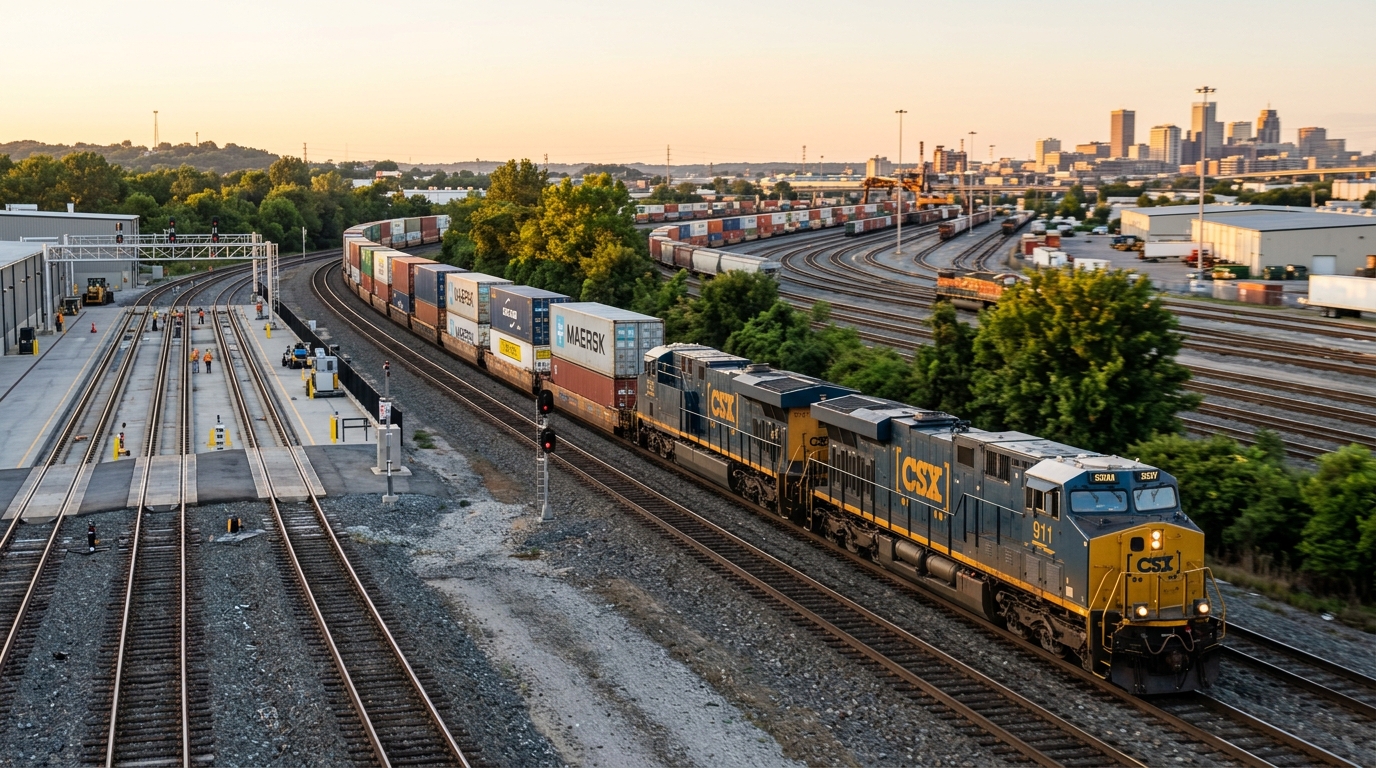
On June 22, 2026, CSX CEO Steve Angel stood at a ribbon-cutting ceremony in Baltimore to officially open double-stack rail service through the Howard Street Tunnel. The $495 million project, a public-private partnership with the State of Maryland and federal partners, expanded the 131-year-old tunnel by 18 inches and improved clearances at 21 other locations across Maryland, Delaware, and Pennsylvania. The tunnel had reopened to initial rail traffic in September 2025, with full double-stack clearance finalized in early 2026.
What this unlocks is significant. Double-stack intermodal trains can now move directly from the Port of Baltimore to Midwest markets without height restrictions, bypassing the I-95 corridor trucking bottleneck that constrained freight for decades. The project is expected to increase Port of Baltimore container capacity by 160,000 units annually and generate more than 13,000 new jobs. For CSX, it removes one of the last major constraints on its East Coast intermodal network.
The Merger Angle Nobody Is Fully Pricing
Union Pacific and Norfolk Southern are attempting the largest railroad merger in modern history. The Surface Transportation Board accepted their revised application on May 28, 2026, but immediately held proceedings in abeyance, ordering the applicants to submit supplemental information by July 27, 2026. The companies expect the transaction to close in early 2027, though the STB review timeline remains uncertain.
If it clears, the resulting transcontinental railroad would be the first single-line railroad linking the Atlantic and Pacific coasts. It would fundamentally reshape the competitive landscape CSX operates in. Opponents, including BNSF and CSX itself, have warned that the deal concentrates a massive share of U.S. rail volume into a single entity.
The dynamic here is unusual. CSX is simultaneously one of the opponents of the merger and one of the potential beneficiaries if regulatory conditions force route access concessions or traffic divestiture in overlapping corridors. RBC specifically cited this positioning as a reason to own the stock regardless of how the merger resolves.
Options traders are paying attention. Call activity in CSX has been running at multiples of its 30-day average, with concentrated positioning in the July and August expiration windows ahead of the Q2 earnings release on July 22.
Forward Scenarios
- Bull: Q2 earnings beat consensus on margin expansion and volume growth, merger clarity forces route concessions that benefit CSX’s intermodal network, and the stock moves toward $60+ as the freight recovery broadens. Q2 consensus EPS sits at $0.49.
- Base: Solid Q2 in line with estimates, steady buyback execution from the $5 billion repurchase program, and the merger review drags into 2027 without resolution. CSX trades in the $48 to $54 range.
- Bear: Intermodal pricing pressure from truckload competition intensifies, housing-related freight weakens, and the merger ultimately passes without meaningful concessions, removing a potential catalyst for CSX.
This IPO Could Make SpaceX Look Small (Read before October 6)
A red-hot AI startup just filed to go public — and it’s already valued at nearly $1 trillion. Wall Street legend Marc Chaikin believes a single announcement on October 6 could send that number far higher. He’s found a backdoor way in before the IPO.
The Bigger Picture
Railroad consolidation is the most consequential structural change happening in American freight infrastructure right now. Most equity investors are fixated on AI infrastructure. The physical infrastructure story, who moves goods across a continent, at what cost, under what regulatory structure, is just as important and far less crowded as a trade.
CSX is the cleanest way to own that story without taking direct merger regulatory risk. July 22 is the first real test of whether the operational improvement is durable or a one-quarter event. The early Q2 volume data suggests it’s durable.
The part people skip: CSX has dividend-raised for 21 consecutive years and the $5 billion buyback covers roughly 6% of outstanding shares. That’s not aggressive hype. That’s a management team signaling confidence in their own cash generation. And the next leg of the compounding hasn’t started yet.
For informational purposes only.