July 5, 2026
AVGO Is Down 27% From Its High
The AI story has not changed. The opportunity might just be starting.
First a note from Stocks to Trade
You won’t believe what I’ve been seeing almost every Monday at 9:30am.
For 20 years, I’ve been watching the markets.
Seen every pattern you can imagine.
But this one still blows my mind.
Almost every Monday morning… Right when the bell rings…
Certain stocks start doing things that shouldn’t be possible.
Little companies nobody’s heard of…
Have suddenly rocketed 100%… 200%… sometimes 500%.
All on the same day.
Past performance doesn’t indicate future results. And all trading carries risk, of course…
But after years of tracking this anomaly…
There are 4 specific things that happen before these Monday explosions.
And when I see all 4 together?
That’s my cue.
I’ve automated the whole process now.
My scanner watches thousands of stocks every Monday…
Hunting for those 4 signals.
When it finds them… you’ll know immediately.
Because Monday mornings could become your favorite time of the week.
See the Monday pattern that’s been hiding in plain sight
Tim Bohen
FEATURED
Analyst Ratings
Wall Street lined up behind Broadcom after the post-earnings drop. Here is where the major firms stand as of early July 2026:
- JPMorgan: Overweight — Price Target $580 (raised from $500 on June 4, 2026; top semiconductor pick)
- Evercore ISI: Outperform — Price Target $582 (issued March 5, 2026; high-end of the Street)
- Jefferies: Buy — Price Target $550 (raised from $500 on June 4, 2026; characterized the selloff as a buying opportunity)
- Mizuho: Outperform — Price Target $530 (raised from $480 on June 4, 2026)
- Goldman Sachs: Buy — Price Target $525 (raised from $500 on June 4, 2026)
- Deutsche Bank: Buy — Price Target $515 (raised from $430 on June 4, 2026)
- Morgan Stanley: Overweight — Price Target $502 (raised post-earnings from $485)
- B of A Securities: Buy — Most recent rating issued June 4, 2026
- UBS: Buy — Price Target $485 (maintained June 4, 2026)
- Argus Research: Hold — Price Target $375 (issued September 8, 2025; low-end of the Street)
- Consensus (48 analysts, S&P Global): Strong Buy — Average 12-month price target $523.73; 44 Buy, 4 Hold, 0 Sell
The quarter was good. Really good, actually. Revenue up 48% year-over-year. EPS of $2.44, beating estimates. AI semiconductor revenue of $10.8 billion, more than doubled on an annual basis. Free cash flow of $10.3 billion. Record operating margin of 67.3%.
And then the stock fell 14% the next day.
That is the Broadcom situation in one sentence. When you walk in as one of the most hyped AI names in the market, good is not enough. Investors wanted great. What they got instead was a guidance hold — Hock Tan did not raise the company’s long-term AI revenue target — and a margin mix story that spooked the crowd.
What the Numbers Actually Said
Broadcom’s Q2 FY2026 results, reported June 3:
- Revenue: $22.19 billion vs. $22.27 billion estimated — a slight miss on the top line
- EPS: $2.44 adjusted, beating the $2.40 estimate
- AI semiconductor revenue: $10.8 billion, up 143% year-over-year
- Gross margin: 77.1%
- Free cash flow: $10.3 billion
- FY2026 AI semiconductor revenue guidance: $56 billion (reaffirmed)
- Q3 guidance: Revenue of approximately $29.4 billion, ahead of the roughly $28.5 billion Wall Street expected; AI semiconductor revenue guide of $16.0 billion, projecting approximately 200% year-over-year growth
The long-term AI revenue guidance stayed at “in excess of $100 billion” for AI semiconductor revenue in fiscal 2027. Tan reiterated it. He did not push it higher. That held-flat posture is what the market punished.
Why the Selloff Happened
Expectations get dangerous when they outrun reality. AVGO had run hard heading into earnings. At those levels, the stock was pricing in a guidance raise that never came. The gross margin and mix debate added to the anxiety — even modest mix shifts can change the blended margin profile, and investors worried about where that trend goes as AI revenue becomes a larger share of total sales.
What is interesting is the reaction may have been overdone. The Q3 AI semiconductor revenue guide of $16.0 billion implies approximately 200% year-over-year growth. The $29.4 billion Q3 total revenue guide beat consensus by close to a billion dollars. And Tan confirmed the company’s AI business is driven by six core customers — hyperscalers and frontier AI labs including Google, Meta, OpenAI, and Anthropic — with total AI bookings exceeding $30 billion as of the Q2 call.
Most $5 Stocks Are Noise. These 5 Are Different
There’s a reason most investors avoid stocks under $5. But not every company at this level fits that stereotype.
These five Nasdaq names are tied to real markets and long-term trends. They are still early, still developing, and not widely followed, which may be exactly why they stand out.
The Custom Silicon Angle
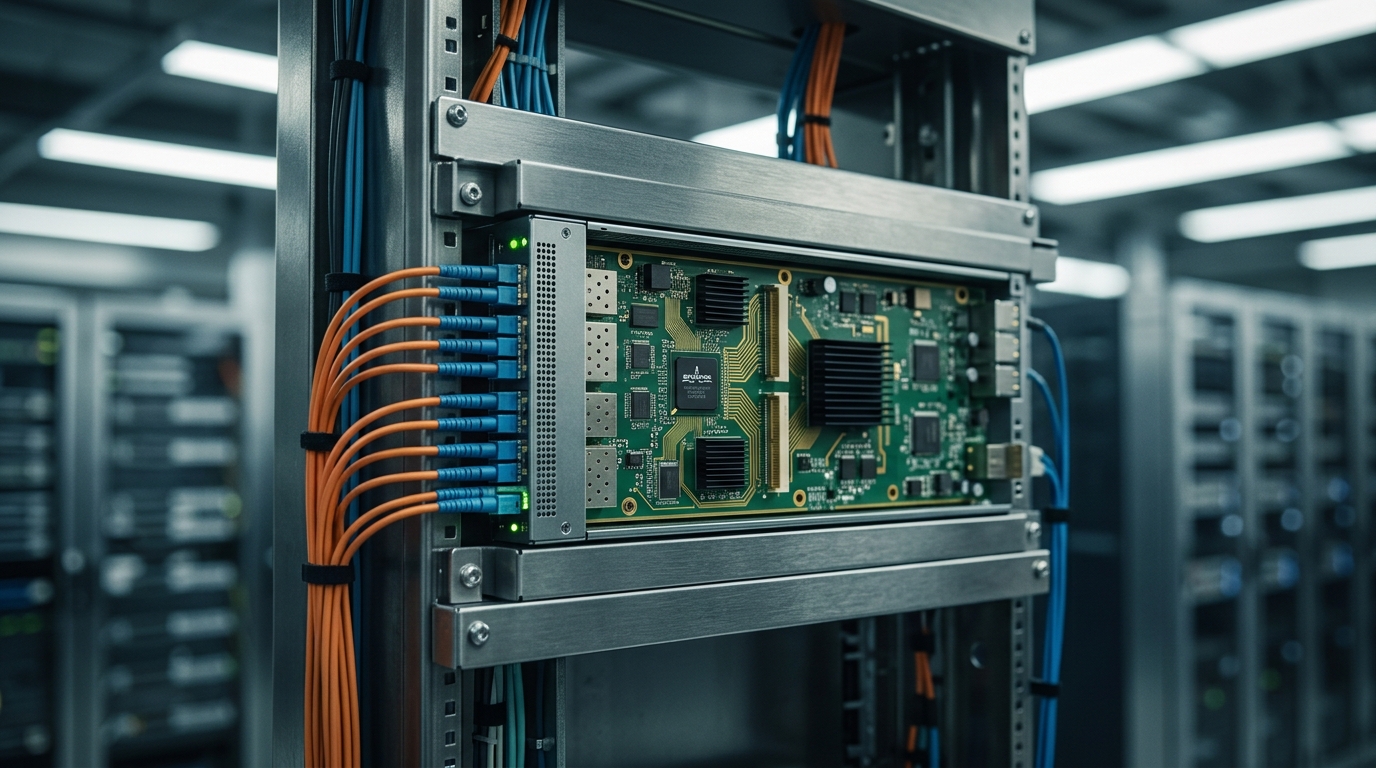
This is what separates Broadcom from the rest of the chip conversation right now. While Nvidia dominates the merchant GPU market, Broadcom is quietly becoming a dominant partner for hyperscalers and AI labs building their own custom accelerators.
The OpenAI Jalapeño chip, co-developed with Broadcom, is a concrete example. An inference-focused processor designed around OpenAI’s large language model serving needs. That is not a vendor relationship. That is a multi-year architectural integration. Switching costs are enormous. And as more players move toward custom silicon to reduce dependency on Nvidia and lower cost-per-inference, Broadcom sits directly in the path of that trend.
Slight tangent, but it matters: Broadcom also has the AI networking side largely locked up. As AI clusters scale from hundreds to thousands of chips, the interconnect between chips becomes a critical bottleneck. Broadcom’s Tomahawk and Jericho product lines address exactly that. Wall Street tends to undercount this revenue stream when modeling AVGO.
Where the Stock Stands
AVGO hit an intraday high of $495.00 on June 3 — the day earnings dropped. The 52-week range runs from $262.73 to $495.00. As of early July 2026, the stock is trading in the $360–$370 range, roughly 25–27% below that post-earnings peak. The support zone between $364 and $374 has been the key area to watch.
According to 48 analysts polled by S&P Global, the consensus is Strong Buy with an average 12-month price target of $523.73 — implying more than 40% upside from recent prices. The high target sits at $650; the low at $215.
Bull / Base / Bear
Bull: Custom AI chip momentum accelerates through FY2027. The $100+ billion AI semiconductor revenue target becomes a floor, not a ceiling. Hyperscaler relationships deepen. Margins stabilize as software revenue scales alongside AI chips. Stock reclaims $450–$500.
Base: Stock range-trades through summer as the market digests margin mix concerns. September 2 earnings become the catalyst. Q3 results either confirm the $29.4 billion guide and reignite the bull case, or margin deterioration deepens the debate. Stock holds $370–$420.
Bear: Google shifts more TPU work to MediaTek (reported in late June 2026, worth watching closely). Custom chip customer concentration risk surfaces. Margin pressure deepens as AI mix rises. Broader tech multiple contraction pulls AVGO toward $300.
Technical Overlay
The post-earnings selloff established a support zone between $364 and $374. AVGO needs to reclaim and hold above $420 to reassert upward momentum toward prior highs. The 50-day moving average has rolled over following the earnings gap-down. Watch September 2 earnings as the next key inflection point — Q3 results will either validate the guide or accelerate the margin debate.
What to Watch
- Google’s next-gen TPU vendor decision — reports that MediaTek is in contention suggest Broadcom may face competitive pressure on a major custom chip relationship
- Gross margin trajectory in Q3 — whether the AI chip mix stabilizes or erodes further
- Any upward revision to the “in excess of $100B” long-term AI semiconductor revenue target on the September 2 call
- OpenAI Jalapeño chip commercialization timeline
- Broader hyperscaler capital spending signals from Amazon, Microsoft, and Meta Q2 earnings
Bottom Line
Broadcom posted a record quarter, guided ahead of expectations, and fell hard. That is not a story about a broken business. That is a story about priced-in perfection meeting a guidance hold. The underlying AI demand is real. The custom silicon moat is real. Eight Wall Street firms raised their price targets the same day the stock dropped 12%. Whether AVGO can work from here depends on one thing: whether Q3 results on September 2 prove that the $100+ billion AI line-of-sight was a floor — or the ceiling investors feared it was.
For informational purposes only.