July 26, 2026
Jensen’s First Post Was a Business Move
Featured: Jensen’s First Post Was a Business Move
Hey Trader,
There’s a very specific moment in the market…
It happens right after the opening bell.
And if you know what to look for, it can reveal moves that only take a day to play out.
Most traders completely miss it.
Not because it’s hidden…
But because they’re focused on the wrong thing.
What’s interesting is where the smart money is placing their bets during this window.
It’s not what you’d expect.
I’ll show you exactly what I mean here.
It could completely change how you look at the market open.
To a surprising trade idea,
Thomas Wood
Lead Trader, Base Camp Trading
When a CEO who has never posted on social media finally does, you stop and pay attention to what he chose to say.
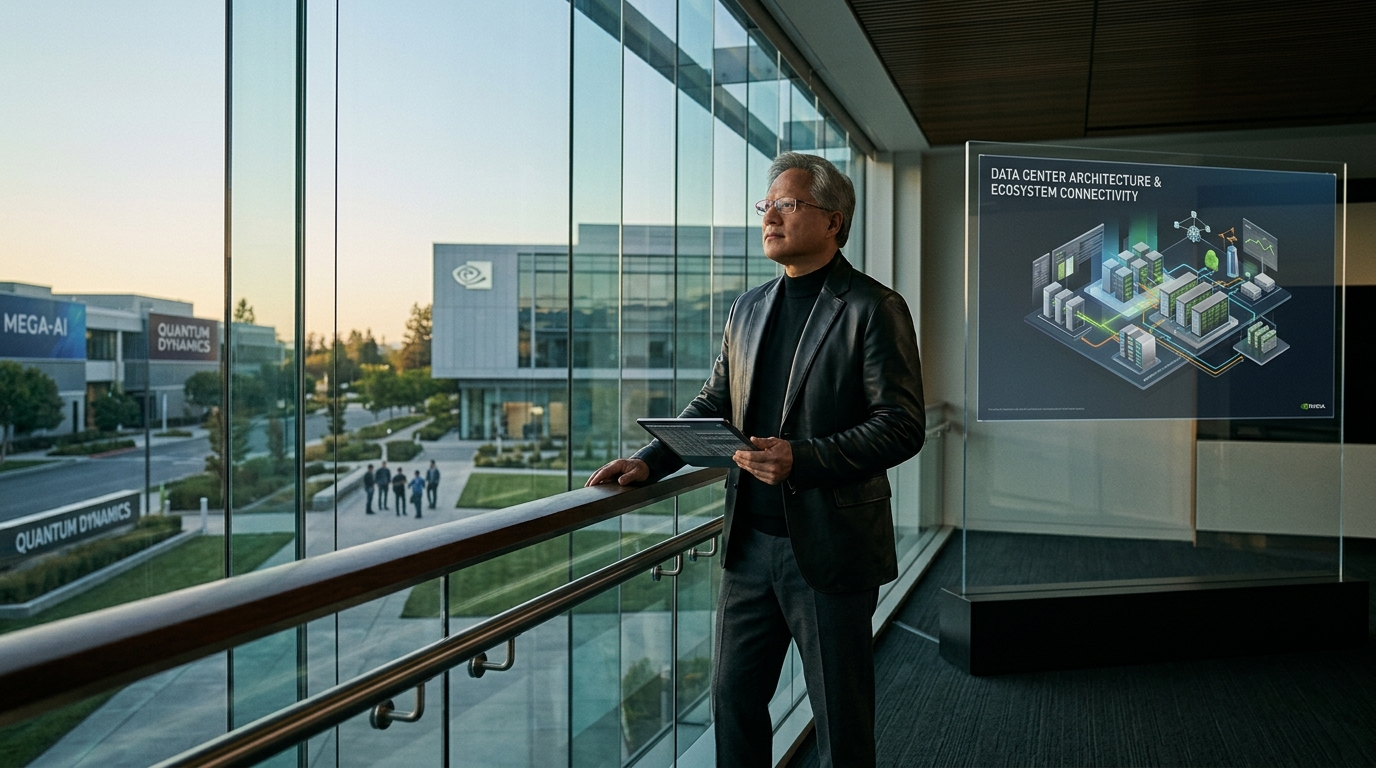
Jensen Huang has run Nvidia for more than three decades. He has given thousands of interviews, hundreds of keynotes, and testified before Congress. But he had never posted on X. Not once. On July 24, 2026, that changed. And what he posted wasn’t a product announcement. It wasn’t a quarterly milestone. It was a policy position.
He shared a letter titled “Open Weights and American AI Leadership,” signed by more than 20 companies including Nvidia, Meta, Microsoft, IBM, Palantir, CrowdStrike, ServiceNow, Hugging Face, Mistral, Mozilla, Andreessen Horowitz, and Y Combinator. The letter urged Washington not to restrict open-weight AI models. It argued that doing so would not protect American leadership in AI. It would hand it away.
That is the kind of move you make when you’re genuinely worried the policy is going in the wrong direction.
The question for long-term investors isn’t whether Huang is right on the policy. The question is what this moment tells us about the business underneath the stock.
What Triggered the Post
On July 16, Beijing-based Moonshot AI unveiled Kimi K3 at the World Artificial Intelligence Conference in Shanghai. The model has 2.8 trillion parameters, making it the largest open-weight release in history. It topped Arena.ai’s coding leaderboard in blind developer testing, ranked fourth on the Artificial Analysis Intelligence Index ahead of Claude Opus 4.8, and introduced architectural mechanisms Moonshot claims deliver up to 6.3 times faster decoding on long-context tasks.
Demand surged immediately. Moonshot paused new subscriptions on July 19 after GPU capacity hit its limit. The comparisons to DeepSeek in January 2025 were immediate and not entirely unfair. That January moment briefly erased nearly $600 billion in Nvidia’s market value in a single session.
Washington’s response this time was sharper. White House OSTP Director Michael Kratsios publicly accused Moonshot of conducting large-scale covert distillation of Anthropic’s Fable model to build K3. He also alleged Moonshot accessed restricted Nvidia GB300 Blackwell chips through servers in Thailand. Treasury Secretary Scott Bessent separately threatened sanctions and possible Entity List designations for Chinese AI companies that improperly distilled American models.
In at 9:35 AM. Out by 10.
I call it the “Opening Bell Breakout.” It’s the same setup I used to catch moves like 113% on GOOGL and 240% on META. I trade one simple 15-minute window each morning – and I’m usually done by 10 AM.
Worth noting: some experts have disputed the distillation claim on timeline grounds alone, pointing out that K3 testing reportedly predated the public release of Fable. No formal enforcement action had been announced as of July 25. But the political temperature had clearly risen.
Into that environment stepped Huang. His letter drew a deliberate historical parallel to the open-source software movement of the 1980s, arguing that just as open-source code became the foundation of the modern internet despite early resistance, open AI models represent a strategic asset for the U.S. rather than a vulnerability. A week before Huang’s post, Chinese President Xi Jinping made his debut at the same Shanghai conference, calling for global AI cooperation and warning against “overstretching the national security concept” in AI. Analysts read it as a direct counter to U.S. export controls.
This is not a simple story. It is a genuine policy disagreement with real money on both sides.
The Fault Line in the AI Industry
Here is what makes this moment particularly interesting from a value investor’s perspective. OpenAI and Anthropic did not sign the letter. Both have been quietly encouraging Washington to take a harder line on Chinese open-weight models, framing them as a national security risk. Critics, including Trump adviser David Sacks, have described this as potential regulatory capture by closed-model labs that benefit financially from reduced competition.
The split is not accidental. Closed labs sell access. Open models commoditize access. Those are structurally opposing business interests dressed up in security language on one side and innovation language on the other.
Huang’s position, stated explicitly in an Axios interview the same day as his post, is that fears about hidden backdoors in Chinese open models are a misconception, and that broader adoption of capable AI models, whether open or closed, ultimately increases demand for Nvidia’s chips. That is not idealism. That is the business model speaking.
The Numbers Behind the Noise
Policy debates are loud. The fundamentals on this company are louder.
Nvidia’s most recent quarter, Q1 fiscal 2027, reported on May 20, 2026, showed revenue of $81.6 billion. That was up 85% year over year and 20% sequentially, beating Wall Street’s estimate of roughly $79 billion. Data center revenue came in at $75.25 billion, up 92% from the prior year. Non-GAAP EPS was $1.87 against a consensus estimate of $1.77. Operating profit was $53.5 billion, up 147% year over year. Gross margin held at 74.9%.
Full-year fiscal 2026 revenue was $215.9 billion, up 65% from the prior year. Net income for that year reached $120 billion.
The next earnings report is scheduled for August 26, 2026. Consensus estimates call for non-GAAP EPS of approximately $2.01. The company has beaten estimates in four consecutive quarters.
The AI Boom’s Most Profitable “Tollbooth” Stock?
A little-known company is quietly building what may be the closest thing to a virtual monopoly the AI era has ever seen.
Whitney Tilson – the man CNBC calls “The Prophet” – calls it the world’s most profitable tollbooth. One billionaire put more than half his $9 billion fund into it.
Right now it’s trading at a rare discount…the same kind that’s previously turned $10,000 into $55,000…in just over 12 months.
There is a detail worth sitting with. Nvidia secured $119 billion in supply-related commitments to meet demand beyond the next several quarters. That is not a company scrambling to fill orders. That is a company with visibility into demand that most businesses would not recognize as real.
The Valuation Case
NVDA closed at $206.84 on July 24, the same day as Huang’s post, down 0.92% on the day. The stock has shed roughly 7% over the past four weeks and sits about 12% below its all-time high. Sixty-one analysts cover the stock with an average rating of Strong Buy and a 12-month average price target of $302.83, implying roughly 46% upside from current levels.
The forward P/E is approximately 21.7x based on current consensus estimates. Goldman Sachs has described that level as “compelling” given the growth rate. The five-year average P/E is above 72x. Even the more conservative three-year average sits around 52x. The current multiple is roughly 40% below where this stock has historically traded during periods of similar growth.
A business growing revenue at 85% year over year, trading at 21x forward earnings. The PEG ratio sits well below 1.0. By almost any standard valuation framework applied to a high-growth compounder, that combination does not scream overvaluation. What it reflects is a market assigning meaningful probability to the risks materializing.
Those risks are real. China export restrictions have already cost Nvidia a $4.5 billion charge in the most recent quarter due to H20 licensing requirements. Policy uncertainty around open-weight AI is live and unresolved. The Kyber NVL144 platform delay scare in early July rattled the stock, though Nvidia denied the delay. Competition from custom silicon at hyperscalers is a long-term structural watch item.
But the business has absorbed every one of these shocks so far and kept growing. That is the central observation a value investor has to reconcile.
What the Market Is Getting Wrong
The market consistently treats Nvidia as a sentiment vehicle rather than a business. When AI enthusiasm cools, the stock gets punished regardless of what the underlying operations are doing. The YTD performance of Nvidia actually lags its semiconductor peer group substantially in 2026 despite posting the best fundamental results in the cohort. That divergence is the signal worth examining.
What the market appears to believe: policy risk is escalating, Chinese competition is closing the gap, and the hyperscaler capex cycle will eventually plateau, leaving Nvidia exposed. All three of those concerns are legitimate. None of them have yet produced a quarter where Nvidia’s results showed deterioration. The disconnect between the perception of increasing risk and the reality of accelerating results is exactly the kind of gap The Cheap Investor looks for.
The open-weight AI debate sharpens this further. Restrictions on open models would concentrate AI infrastructure spending back toward a small number of closed-model hyperscalers. That might sound like good news for Nvidia’s biggest customers. What it actually does is reduce the diversity of Nvidia’s customer base, which the company has been deliberately expanding. Enterprise customers, sovereign AI projects, mid-sized cloud providers, and startups building on open infrastructure are increasingly driving the incremental growth. Anything that closes that aperture carries real cost to the long-term story, even if it isn’t visible in the next quarter.
Three Scenarios From Here
- Bull case: Open-weight AI policy resolves favorably. Nvidia’s customer base continues broadening across enterprise, sovereign AI, and startup markets. The August 26 earnings report extends the beat streak. The valuation gap to historical averages narrows as growth validates. Analyst targets in the $300 to $350 range become the conversation.
- Base case: Policy uncertainty creates noise but no material enforcement against open models. Nvidia keeps winning infrastructure spending on both sides of the open/closed divide. Earnings grow into the current price gradually. The stock trades in a range while fundamentals build underneath it.
- Bear case: Washington imposes meaningful restrictions on open-weight models. Chinese competition accelerates faster than the CUDA moat can respond. Hyperscaler capex disappoints in 2027. The export control situation worsens beyond current estimates. The multiple contracts further before earnings can catch up.
The Cheap Investor Scorecard
- Business Quality: Dominant. No comparable accelerated computing platform exists at scale. CUDA ecosystem moat is deep and takes years to replicate.
- Revenue Growth: 85% year over year last quarter. Third consecutive year of 60%+ annual growth.
- Margins: Gross margin 74.9%, operating margin approaching 66%. Both holding near record levels.
- Free Cash Flow: Cash from operations hit $50.3 billion in Q1 fiscal 2027 alone. Annualized, that is a level few businesses in history have reached.
- Balance Sheet: Supply commitments of $119 billion secured. Company in strong net cash position. $80 billion buyback authorized.
- Valuation vs. History: Forward P/E of 21.7x versus a five-year average above 72x. The discount to history is not subtle.
- Competitive Position: CUDA software ecosystem, NVLink fabric, Blackwell architecture, and now Kyber on the roadmap. Each generation widens the switching cost.
- Catalyst Visibility: Q2 fiscal 2027 results on August 26. Open-weight AI policy resolution. Continued Blackwell ramp. Sovereign AI deal flow.
- Policy Risk: Elevated. The open-weight AI debate is live. No enforcement yet, but the direction of Washington’s attention is clear.
- Overall Assessment: Not a deep discount value opportunity in the traditional sense. But a high-quality compounder trading well below its own historical valuation with fundamentals that have not yet justified the discount the market is applying.
The man CNBC calls “The Prophet” just revealed his biggest AI trade
And it isn’t Nvidia, Microsoft, or any chip stock you’ve seen on CNBC.
It’s a little-known company that controls the rare assets the entire AI boom can’t exist without.
One billionaire already put over half his $9 billion fund into it.
Right now it’s trading at a rare discount – weeks before the next dividend hits.
Wall Street Legend Whitney Tilson reveals the name and ticker, completely free.
Bottom Line
Nvidia is not the kind of stock this publication typically covers. It is widely followed, heavily owned, and constantly in the news. But the valuation picture right now is genuinely unusual. A business of this quality, growing at this rate, at 21x forward earnings and roughly 40% below its historical multiple is not the profile of a stock that has already priced in the upside.
What Jensen Huang’s first X post tells a disciplined investor is this: the CEO of the most important semiconductor company in the world saw a policy risk forming and decided it was important enough to break a decade of social media silence to fight it publicly. That is not routine corporate communications. That is a signal about where the pressure is coming from and how seriously the people running this business are taking it.
The question is not whether the risk is real. It is. The question is whether the market has already overpriced that risk into a stock trading at a 40% discount to its own five-year average multiple while revenue is growing at 85%.
That gap is worth watching closely. August 26 will tell us more.
For informational purposes only.