
July 27, 2026
Shein’s $99M Loss: Tariffs Take Their Toll
The fast-fashion giant’s IPO filing lays bare a business under serious trade pressure.
First a note from The Oxford Club
Dear Reader,
Only 3% of U.S. companies have adopted AI.
Three percent.
Everything you’ve seen so far – Nvidia’s run, the trillion-dollar market caps, all of it – happened with 3% adoption.
Ninety-seven percent of the opportunity is still ahead.
But here’s what most investors get wrong: the stocks that won during the first 3% are NOT the ones that will win during the next 97%.
It happened with the internet. Cisco dominated the buildout. Then crashed 86% over the next year and a half while Amazon – a company that USED the infrastructure Cisco built – rose 257,000% since its 1997 IPO.
I just recorded a presentation showing you exactly which AI stocks are positioned to capture the 97% that’s still coming.

My name is Alexander Green. I’ve been the chief investment strategist of The Oxford Club for over two decades. I recommended Apple under $1, Amazon under $2, and Nvidia in 2004.
I’ve never seen an opportunity this large this early.
Click here to watch the full presentation.
Good investing,
Alexander Green
Chief Investment Strategist, The Oxford Club
P.S. The internet went from 3% enterprise adoption to mass adoption and created $15 trillion in new wealth. AI is following the same path – but faster. Don’t miss it. Details here.
Shein’s $99M Loss: Tariffs Take Their Toll
The Numbers Behind the Headlines
Shein just handed potential investors a look at its books. What they found was not pretty.
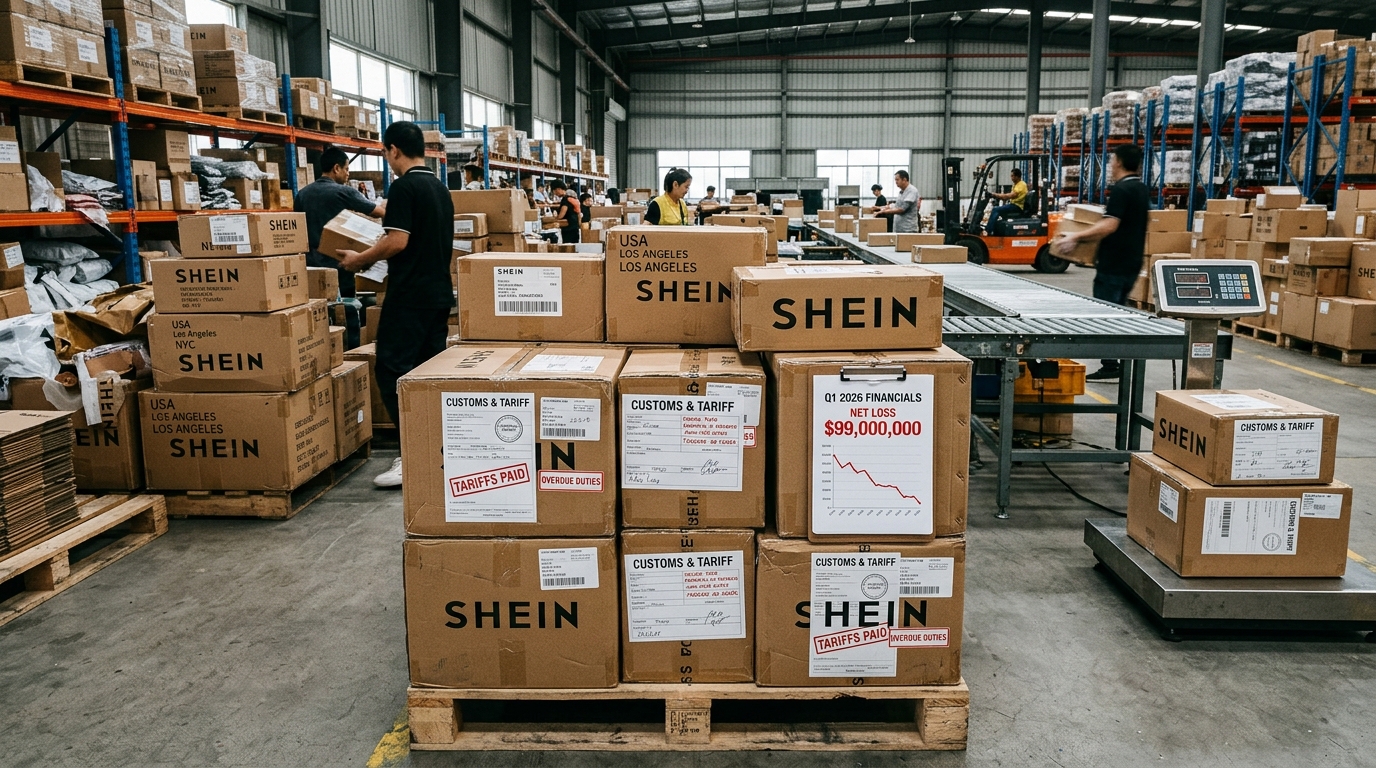
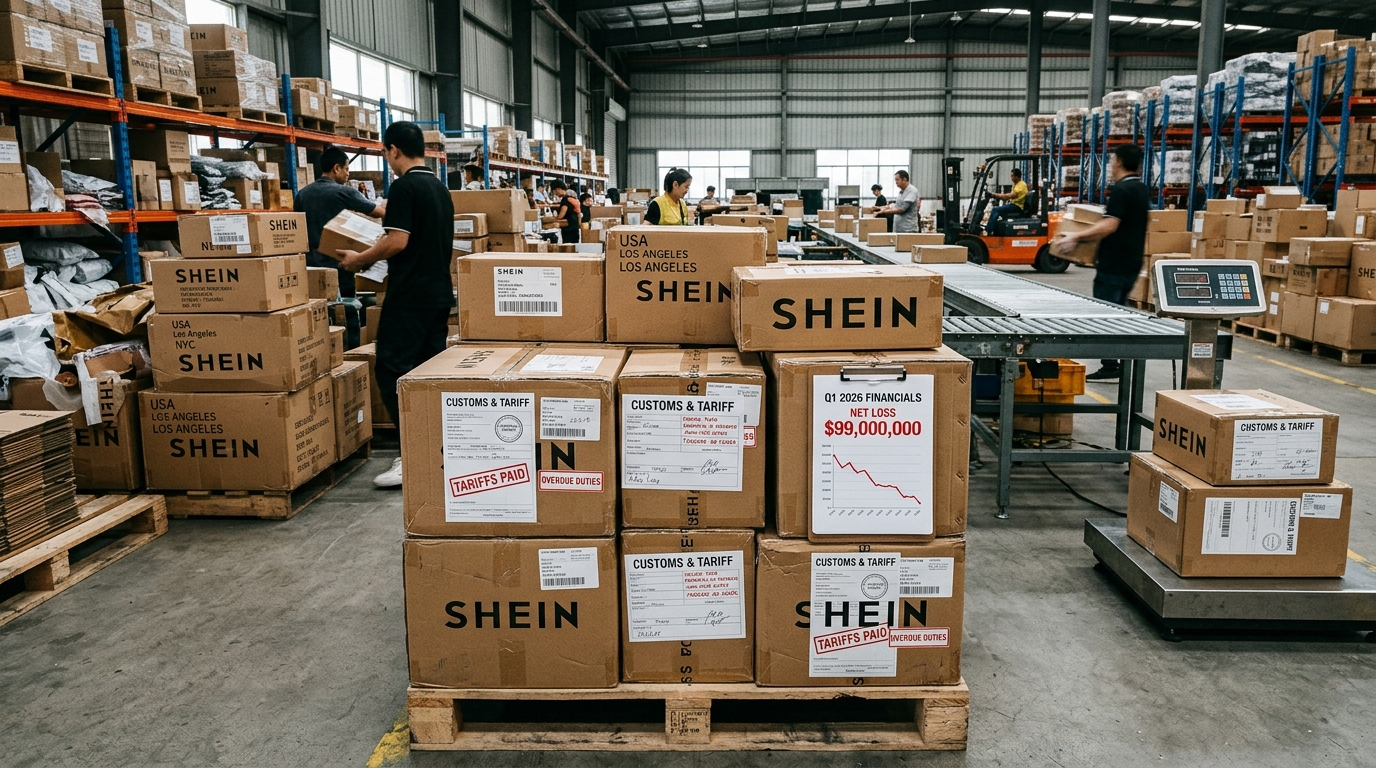
Pre-IPO documents filed with the Hong Kong Stock Exchange on July 26 showed the fast-fashion company swung to a $99 million net loss in Q1 2026, compared with net income of $395 million in the same period a year earlier. That is a brutal year-over-year swing. The culprits: a sharp slowdown in U.S. sales after the death of the de minimis exemption, and a one-time $328 million fair-value accounting charge tied to convertible redeemable preferred shares ahead of the listing.
Strip out the accounting charge and the underlying business is still clearly under pressure. It is not just a one-quarter blip.
Company Profile
Founded in Nanjing, China, and now headquartered in Singapore, Shein built its empire on one core proposition: ultra-cheap, trend-driven fashion shipped directly from Chinese warehouses to customers in roughly 160 countries. We are talking $5 dresses and $10 jeans at scale. In 2025, products stored in Chinese central warehouses accounted for more than 90% of net revenue. That concentration is both Shein’s greatest strength and, right now, its most glaring vulnerability.
Iran War TRUTH: What Was Revealed Behind Closed Doors
There’s a strategy behind the Iran war.
I know because I heard it directly in a closed-door meeting with a source whose connections run deep into global power networks.
He walked me through the real purpose and the massive deal tied to it.
The Numbers
- Q1 2026 net loss: $99 million (vs. net income of $395 million in Q1 2025)
- Q1 2026 operating margin: 2.9%, down from 3.9% a year earlier
- Full-year 2025 revenue: $41.85 billion, up 8% year-over-year (slowing sharply from 20.7% growth in 2024)
- Full-year 2025 net income: $2.06 billion, down 38.7% from the prior year
- U.S. revenue in Q1 2026: $2.04 billion, down 14.3% from $2.38 billion in Q1 2025
- U.S. share of quarterly revenue: 22.5%, down from 29.4% of annual revenue in 2023
- Active customers (year to end of March 2026): 281 million, up more than 16% year-over-year
- Total orders placed in the same period: more than 1 billion
Worth flagging: the $328 million preferred share charge is a non-cash, accounting-driven event. It does not reflect a cash outflow. That said, even adjusting for it, the operating picture in Q1 2026 was considerably weaker than a year ago.
Why the Business Is Under Pressure
The de minimis rule previously allowed packages worth less than $800 to enter the United States without import duties. For Shein, that loophole was not just helpful, it was foundational to the entire low-price model. The Trump administration ended that exemption for Chinese-origin goods in May 2025. The result: Chinese-origin products sold through Shein and shipped to the U.S. are now subject to tax rates ranging from 10% to 87.5%, according to the company’s own prospectus language.
The impact was immediate. U.S. revenue fell 14.3% in Q1 2026. The company acknowledged the removal has had an “adverse impact” on both U.S. sales and overall growth, and has also driven expenses higher.
Slight tangent worth noting: Shein actually had a strong Q1 2025 partly because U.S. shoppers front-loaded purchases ahead of the exemption expiring. That pre-tariff surge made the year-over-year comparison look even worse now.
Macro and Regulatory Context
The U.S. situation is real and material. But Europe could be the next shoe to drop.
The European Union, which accounted for roughly one-third of Shein’s revenues in 2025, imposed a new €3 fee on low-value e-commerce imports this month to curb what the bloc calls unfair competition from China. Shein’s own prospectus was candid about the risk: “Although it remains too early to fully assess, it is possible that trends in the EU could be generally in line with or exceed the impact observed in the U.S.” That is a notable admission to put in an IPO document.
Meanwhile, the broader U.S.-China trade standoff remains in a partial pause. If that changes, Shein’s cost structure gets hit again. The company has been exploring diversification into manufacturing bases outside China, but with over 90% of net revenue still tied to Chinese warehouses in 2025, that pivot takes time.
The IPO Situation
This is where things get interesting from an investor standpoint.
Shein received approval from China’s Securities Regulatory Commission for its Hong Kong listing on July 10. The company is targeting a valuation of $40 billion to $50 billion, per Reuters. Compare that to the $100 billion valuation it received in a 2022 funding round. That is a 50% to 60% markdown from peak. The Hong Kong listing is expected in the coming months, though Shein did not disclose offer price, deal size, or a precise timeline in the draft prospectus.
This follows failed listing attempts in both New York and London. The IPO path has been anything but straight.
Bull / Base / Bear
- Bull: Customer growth remains strong at 281 million active users, up 16% year-over-year. If Shein successfully diversifies its supply chain and adapts pricing, it can defend margins in a higher-tariff world. The Hong Kong IPO proceeds could fund that transition. Europe absorbs the new fee without a meaningful sales decline.
- Base: U.S. revenue stabilizes at a lower level as consumers adjust to higher prices. Revenue growth stays in the low-to-mid single digits. Operating margins stay compressed. The IPO prices at the lower end of the $40 to $50 billion range. European headwinds are real but manageable.
- Bear: EU trends mirror or exceed the U.S. drop. That is roughly one-third of Shein’s revenue base facing simultaneous pressure. U.S.-China trade tensions escalate again. The IPO is delayed or prices below expectations. Profitability deteriorates further as expenses climb and top-line growth stalls.
“By July 30, Elon Musk’s Prophecy Will Fulfill Itself”
The two investment legends who picked Nvidia 10 years ago are predicting that by the end of this month, Elon Musk’s new AI breakthrough they call “M.A.G.I…” will collide with a strange market pattern with a flawless 100% track record of massive market gains.
What Investors Should Watch
- EU sales trends in Q2 and Q3 2026, the first full quarters affected by the new €3 import fee
- U.S. revenue trajectory: does it stabilize or continue to decline?
- Operating margin recovery: Q1 2026 came in at 2.9%, down from 3.9% a year ago
- IPO pricing and investor demand when bookbuilding opens
- Any further changes to U.S.-China trade policy or tariff levels
- Progress on supply chain diversification outside China
Bottom Line
The $99 million quarterly loss is the headline, but the deeper story is structural. Shein built one of the most efficient fast-fashion machines in history on a model that depended on low-cost shipping, duty-free small packages, and a single concentrated supply chain. Two of those three pillars are now under direct regulatory attack simultaneously, in its two largest markets.
The customer base is still growing. Revenue is still large. But the path from here to a credible public company at a $40 to $50 billion valuation requires Shein to prove it can adapt its cost model fast enough to stay ahead of the policy environment closing in around it. The IPO will tell you a lot about whether investors believe that story.
For informational purposes only.