September 8, 2026
Bonus Content: Amazon’s Drone Network Is a Logistics Shift, Not a PR Stunt
Prepare for Anthropic’s possible October 1 IPO
Anthropic is set to go public as soon as October 1…
Sparking a $4 trillion tech IPO wave Harvard calls “The AI IPO Tsunami.”
The best part of it all?
I discovered that you can stake your claim in this $4 trillion opportunity, with three overlooked stocks right now.
Click here now for my full presentation.
Regards,
Jason Bodner
Founder, Outlier Alpha
Amazon’s Drone Network Is a Logistics Shift, Not a PR Stunt
Analyst Targets
- Morgan Stanley: Overweight, $335 price target
- Canaccord Genuity: Buy, $330 price target
- Consensus (38 analysts): Strong Buy, about $323 average target, no Sell ratings
The Expansion in Real Terms
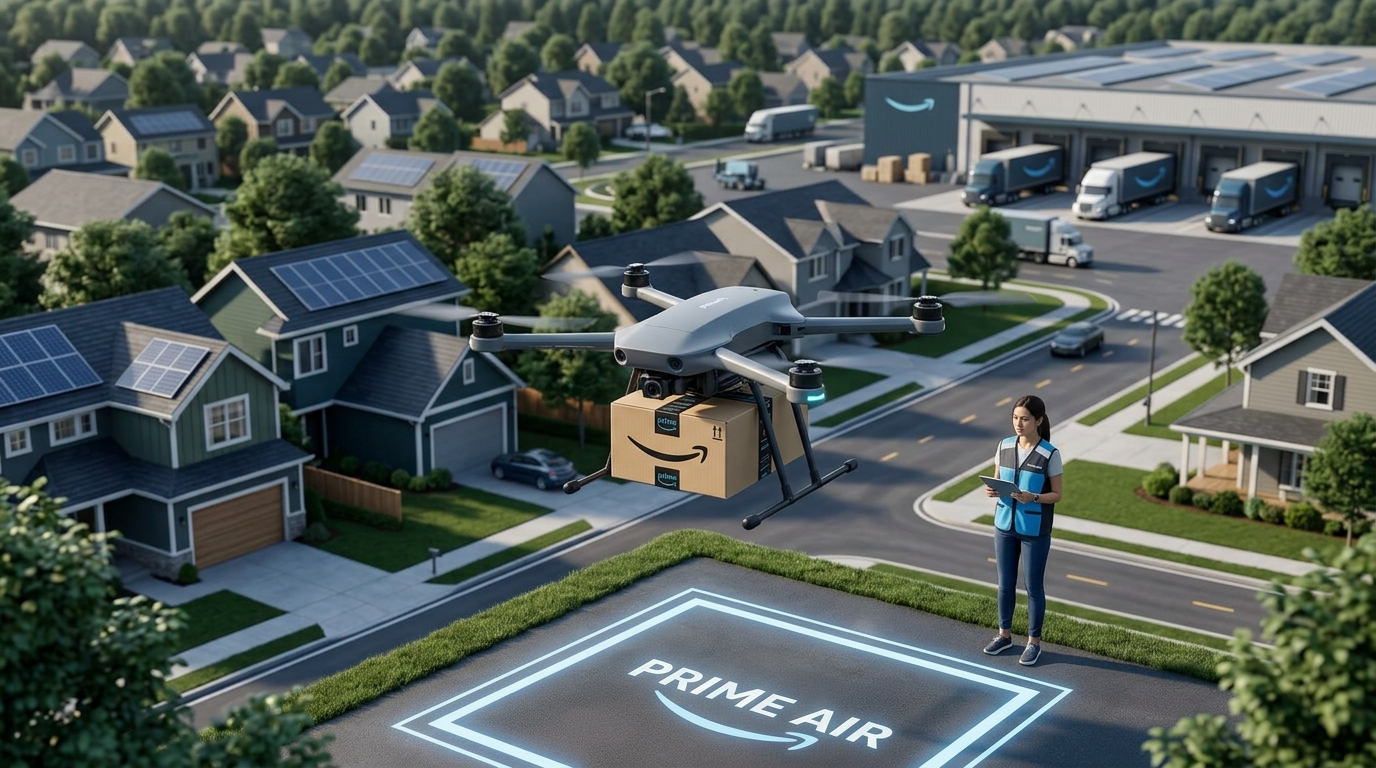
Amazon’s Prime Air service plans to reach nearly 500 cities and towns in the United States by the end of 2026, a sixfold increase from its current footprint, bringing ultrafast drone delivery to communities with tens of millions of customers across the country. That headline figure deserves scrutiny. The nearly 500-community figure does not mean Amazon intends to construct a separate hub in each place. Its count includes every city and town within a launch site’s service area, and each Prime Air site serves an area of approximately 175 square miles.
Prime Air currently offers drone delivery from 11 sites across 10 U.S. metro areas: Phoenix, Arizona; Tampa, Florida; Kansas City, Kansas; Baton Rouge, Louisiana; Detroit, Michigan; Omaha, Nebraska; Houston, Texas; Dallas, Texas; San Antonio, Texas; and Waco, Texas.
Amazon said it plans to launch soon in the metro areas of Chicago, Syracuse, Cleveland, Atlanta and Boise, with more locations to come later this year.
Why This Is a Structural Shift, Not a Volume Story
Amazon says Prime Air has already delivered hundreds of thousands of packages this year. Hundreds of thousands sounds like a lot until you put it inside Amazon’s network. The company moves billions of packages annually. Drones will not displace vans at scale.
That is the wrong frame. When a customer wants one lightweight item in 30 or 60 minutes, the economics and the service requirement change. Putting that item on a conventional route may still be the cheapest transportation option, but it may also mean waiting several hours. A drone can pull that order out of the batch and move it directly from a nearby fulfillment node to the customer.
That is the real value proposition: not replacement, but triage of the highest-urgency, lowest-weight orders.
Prime Air drones are rated for packages up to 5 pounds, a threshold the company says covers more than 60% of its most commonly ordered products. Eligible products include groceries, medications, electronics, and cosmetics.
Regulatory Risk Is the Live Variable
The expansion comes as the FAA continues work on standardized beyond-visual-line-of-sight rules, a regulatory milestone that could allow operators to scale drone delivery far more broadly than is currently possible under individual waivers.
Amazon already holds Part 135 certification, but a permanent rulemaking framework would remove the single biggest ceiling on how fast this network can grow.
The incident record introduces caution. In October 2025, federal investigators opened probes after two Prime Air drones collided with a crane boom in Tolleson, Arizona. A separate FAA probe was opened after a drone struck a wire line and snapped an internet cable in Waco, Texas in November 2025. Multiple active regulatory inquiries is not a disqualifier, but it is a ceiling on how aggressively Amazon can cite safety as a competitive differentiator.
The Competitive Pressure Is Real
Rival Alphabet’s Wing has completed well over 1 million commercial deliveries and has been expanding with Walmart toward nearly 20 U.S. markets. Zipline has surpassed 2 million commercial deliveries spanning four continents.
The move arrives as Walmart continues expanding its own drone delivery service with Wing, including plans to add new markets and expand store coverage over time. Both Amazon and Walmart tout drone deliveries that can reach a customer in under an hour.
Bottom Line
Amazon posted Q2 2026 diluted EPS of $5.75 and revenue of $200.6 billion, with net income rising to $62.6 billion. Against that backdrop, Prime Air is not moving AMZN’s valuation this week.
Amazon has said it now expects 2026 capital expenditures of approximately $220 billion, with the increase driven largely by AI and cloud infrastructure needs (and higher memory costs). That massive investment is pressuring free cash flow.
Drone delivery is a long-duration option on logistics margin improvement, not a near-term earnings catalyst. The investors who should be paying attention are not those watching Q3 guidance. They are the ones modeling what Amazon’s cost-per-delivery looks like in 2029, when a mature Prime Air network handles the 30-minute, sub-5-pound segment without a driver. That is the number this expansion is quietly building toward.