
September 27, 2026
Bonus Content: The Refinery Is the Chokepoint. These Are the Companies That Own It.
A message from America’s Gold Company
URGENT ALERT
Your Retirement Has a $40 Trillion Problem
America’s debt just reached a level no nation has ever seen, and paper savings sit directly downstream.

If you have a 401(k), IRA, or TSP, and it sits entirely in paper assets, then every dollar of it depends on the strength of a currency now backed by nearly $40 trillion in debt.
According to U.S. Treasury data, the national debt is closing in on $40 trillion. More than any nation has ever owed. And with long term borrowing costs at some of their highest levels in years, Washington is paying real money just to service what it already owes.
But here is what most people are not being told: a government this deep in debt rarely defaults loudly. History suggests it quietly pays its bills with dollars that buy less, year after year. And the savings built on those dollars feel it first.
One bad year. One shock. One crisis of confidence.
History shows how quickly paper savings can give back years of gains, and how long rebuilding can take.
There is a way savers have historically prepared, and it is available to you right now.
Long standing IRS rules generally allow you to move a portion of your retirement savings into physical gold and silver, a time tested store of value, and you may be eligible to do it without triggering taxes or penalties.
Everything you need to know is laid out in the FREE Precious Metals Retirement Guide from America’s Gold Company. Download your free copy here!
Inside, you will learn how the process generally works, who may qualify, and the specific questions to ask before moving a single dollar. The guide is free, with no obligation of any kind.
Yes, Send Me the FREE Precious Metals Retirement Guide!

Free to Claim. Includes Retirement Rollover Basics, Step by Step.
100% free. No credit card. Delivered straight to your inbox.
Or speak with a precious metals specialist at 1-888-691-8238.
The Refinery Is the Chokepoint. These Are the Companies That Own It.
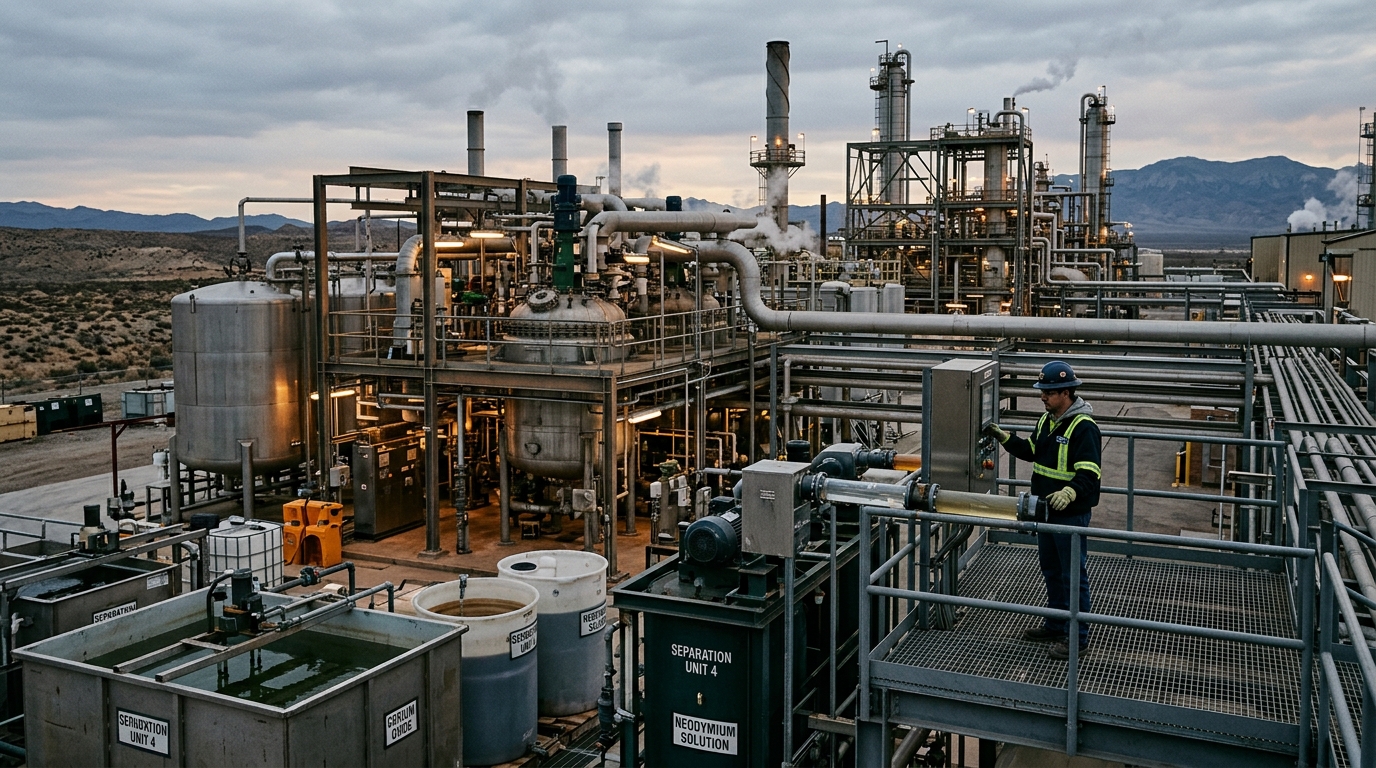
Everyone is watching the mines. The money is in the refineries.
China controls roughly 85% to 90% of global rare earth oxide separation and metal refining capacity based on 2024-2026 estimates published by the IMF and other recent research, a concentration that renders domestic mining ambitions largely academic. Digging neodymium out of California soil accomplishes little if the ore must cross the Pacific to become magnet-grade oxide. That structural gap, the processing bottleneck between raw concentrate and finished separated oxides and metals, is where the asymmetric opportunity sits for investors willing to look past the mining headlines.
The Pentagon read this correctly. In mid-June 2026, the Department of Defense’s Office of Strategic Capital committed $1.225 billion in conditional loans split between two non-mining processors: $725 million to Energy Fuels (NYSE: UUUU) to expand rare earth separation at its White Mesa Mill in Utah and support a planned rare earth metals and alloys facility in the U.S., and $500 million to Phoenix Tailings to scale domestic midstream processing, including a new U.S.-based separation and metallization facility. That is not mining capital. That is midstream capital, directed deliberately at the step China owns.
Three Companies, Three Distinct Models
Energy Fuels is the clearest public equity expression of the thesis. Its White Mesa Mill already completed Phase 1 rare earth separation, and its January 2026 bankable feasibility study outlined a Phase 2 expansion designed to scale NdPr oxide output from roughly 1,000 tonnes per year to up to 6,000 tonnes per year, plus separated dysprosium and terbium oxides. These are the elements semiconductor, EV, and defense magnet supply chains actually need. CEO Mark Chalmers has consistently framed the project as directly addressing a U.S. processing bottleneck in the company’s public filings and investor materials.
Phoenix Tailings operates differently. The company positions its process as a cleaner alternative to conventional solvent-extraction-heavy flowsheets. Its Exeter, New Hampshire facility, which opened in October 2025, is a rare earth metallization site that the company says operates without reliance on Chinese inputs, equipment, or technology. In May 2026 it acquired the technology company Machinery Partner to expand internal AI, automation, and digital manufacturing capabilities. The Pentagon’s conditional loan would support a scaled platform intended to process mined concentrates and recycled material into rare earth metals domestically.
Then there is ReElement Technologies, which has been working to expand U.S. refining capacity for rare earths and other critical minerals across Indiana sites in Noblesville and Marion. In May 2026, POSCO INTERNATIONAL announced an agreement with ReElement to establish a U.S. joint venture focused on rare earth separation and purification, alongside a broader plan to build out a U.S. rare earth magnet value chain. Separately, the Pentagon announced a $25 million investment with ReElement in July 2026 to expand domestic refining capacity at its Marion, Indiana facility. ReElement has also publicly indicated it is targeting initial commercial germanium runs at Marion in Q3 2026.
Why the Bottleneck Is Durable
The IEA’s 2026 Global Critical Minerals Outlook argues the moat is structural: key magnet-related processing technologies remain highly concentrated, with limited specialized equipment supply outside China and materially higher costs for non-Chinese equipment in certain steps. That is not a gap closed by federal loans alone. It is a technical knowledge, equipment, and scale problem that compounds over time and favors whoever builds processing expertise earliest.
Investors should note the qualification lag. Even a facility that reaches mechanical completion in late 2027 can still take an additional 18 to 24 months to deliver customer-qualified commercial output, depending on product specs and downstream validation cycles. That timeline is the moat. Companies operating today, not breaking ground today, are the ones defense and semiconductor customers will qualify against those deadlines.
What Determines the Next Move
For Energy Fuels, watch the Phase 2 financing path, permitting and engineering progress, and monazite feed availability. For Phoenix Tailings, the critical variable is whether its conditional $500 million facility financing clears due diligence and moves into construction on the timetable the company has discussed. For ReElement, watch execution at Marion, the germanium line commercialization timeline, and whether the POSCO INTERNATIONAL joint venture moves from announcement into binding commercial commitments.
The mining story is already priced. The refining story is not.