
Hey Trader,
I have a huge problem.
I’ve developed a “genius” trading system that picks winners at a 95.3% rate – I’m talking about 838 winners out of the last 879 trades.
But the trading system is so automatic it’s almost boring!
Most days look exactly the same – place the trade in the morning, let it expire that night, and collect the cash. Repeat, repeat, repeat.
If you can stifle a yawn, this is an incredible way to grow a trading account…
Free Report: Super Boring Trade Strategy Spots 95.3% Winning Trades
To Your Success,
Dave Aquino
Boeing Now Holds Both American Sixth-Generation Fighter Programs. Here Is What That Means for the Stock.
Boeing picked up the most consequential defense contract of the decade on September 29, and the market was too busy selling the stock over a software glitch to fully price it.
Analyst Targets
- Consensus 12-month price target (30 analysts): $274, implying roughly 46% upside from current levels near $187
- High target: $320 | Low target: $233
- 2027 consensus revenue estimate: $112.8 billion, up 15% year over year
- 2027 normalized EPS consensus: $4.12, the first meaningful positive number since the company’s extended run of losses
Two Headlines, One Company
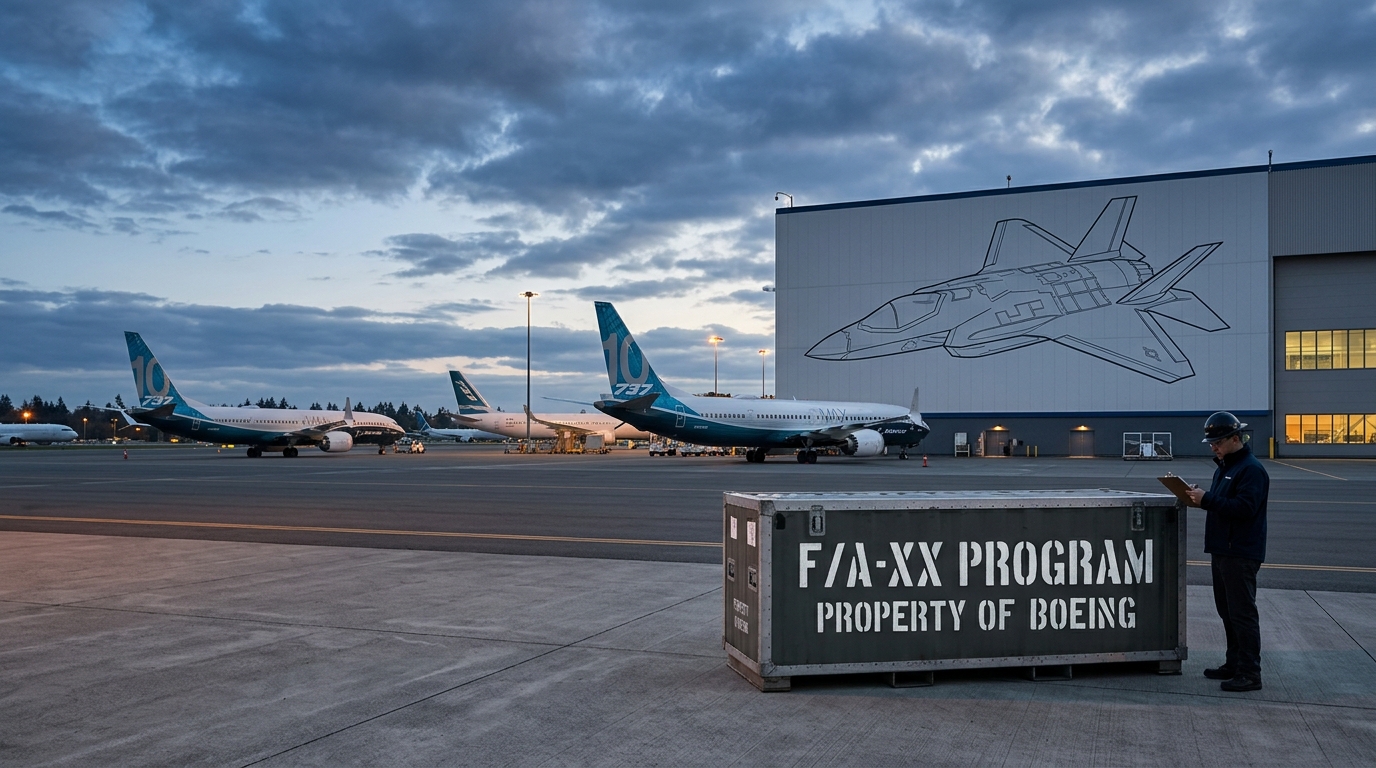
On September 28, the FAA said it would not certify the 737 MAX 10 until it resolves a newly disclosed software issue affecting automated flight guidance during go-around procedures. Boeing shares fell 6.9% that day. Then, one day later, the Department of Defense and the Navy announced Boeing had won the F/A-XX program, a full-scale development contract valued at more than $20 billion to build the Navy’s sixth-generation carrier-based strike fighter.
The two events are not remotely equivalent in long-term financial weight, yet the market treated them as though they were.
Company Profile
Boeing operates three segments. Boeing Commercial Airplanes generated $9.2 billion in Q1 2026 revenue, up 13% year over year, as the 737 MAX production rate stabilized. Boeing Defense, Space and Security posted $7.6 billion in Q1 revenue, up 21% year over year, with BDS backlog reaching a record $86 billion entering the second half of the year. Boeing Global Services contributed $5.4 billion. BDS is now profitable at the operating line, while BCA remains in the red.
The F/A-XX Win in Context
The deal gives Boeing its second sixth-generation fighter program, following the Air Force award of the NGAD Platform contract for the F-47 in March 2025. No other American defense contractor holds a single sixth-generation fighter program. Boeing now holds both.
Boeing beat Northrop Grumman for the F/A-XX in a full-scale development contract valued at more than $20 billion. The F/A-XX will initially augment and eventually replace legacy combat aircraft such as the F/A-18E/F Super Hornet and the EA-18G Growler, starting in the 2030s. The contract does not cover series production, and the Navy has not said how many F/A-XX fighters it plans to buy. That production tail is where the real revenue sits.
Boeing’s St. Louis facility is expected to be the main production center for the F/A-XX as work on the 1.1 million square foot expansion continues, with construction scheduled in multiple phases through 2030.
The MAX 10 Problem: Real, But Bounded
The software issue, which Boeing disclosed to operators in August, could cause pilots to lose access to automated flight guidance during a specific go-around scenario. The FAA has not given a timeline, though Administrator Bryan Bedford said the fix could take days, weeks, or months.
The MAX 10 is the largest variant in the 737 MAX family, designed to compete with Airbus’s A321neo in the single-aisle market segment. Boeing had expected to receive certification very soon, as CEO Kelly Ortberg told investors on September 16. That timeline is now open-ended. Boeing’s SEC filings warn that if it is unable to certify the 737-7 and 737-10 models consistent with its assumptions, its financial position, results of operations, and cash flows could be adversely affected.
The MAX 10 delay is a cash flow event, not a structural one. A software fix does not alter the aircraft’s order book or Boeing’s long-term competitive position in single-aisle jets.
Which Event Moves 2027 Estimates
The MAX 10 software issue pushes revenue recognition into later quarters. It does not eliminate demand. Airlines that have ordered the MAX 10 need a large single-aisle jet whether certification arrives in Q4 2026 or Q1 2027. The revenue defers; it does not disappear.
The F/A-XX contract, by contrast, begins booking into BDS revenue under cost-incurred accounting. Congress has already directed hundreds of millions of dollars toward accelerating F/A-XX in fiscal 2025, and Senate appropriators said the FY 2026 defense appropriations bill advances additional funding for the program.
Bull / Base / Bear Scenarios
Bull: FAA resolves the MAX 10 software issue within 60 days, certification lands in Q4 2026, and Alaska Airlines and other launch customers begin taking deliveries on schedule. BDS revenue accelerates through 2027 as F/A-XX and F-47 program spending ramps. The market re-rates BDS as a franchise defense business, compressing the discount applied to the commercial segment’s ongoing losses.
Base: MAX 10 certification slips to Q1 2027, creating a modest cash flow gap in the December quarter. F/A-XX revenue ramps gradually. The 2027 consensus revenue estimate of $112.8 billion proves achievable, and EPS turns positive for the first time in years.
Bear: The FAA determines the software issue requires deeper remediation rather than a patch. MAX 10 certification moves to mid-2027. Airbus wins incremental single-aisle market share in the window. BDS margins face pressure from cost growth on new development programs.
Technical Overlay
BA has been consolidating in a range roughly between $180 and $215 since July. The 6.9% drop on the MAX 10 news dragged the stock toward the lower end of that band. The F/A-XX announcement provided an immediate partial recovery, but the net of the two events leaves the stock sitting below its 50-day moving average. A sustained close above $210 would confirm that the defense catalyst is winning the near-term argument against the MAX 10 overhang.
What to Watch
- FAA findings on the MAX 10 software issue and any interim operating guidance for airlines
- Q3 2026 earnings: BDS revenue trajectory and whether F/A-XX program costs begin appearing in segment disclosures
- Analyst price target revisions following the F/A-XX award; most targets were set before this contract was confirmed
- Any Northrop Grumman protest of the F/A-XX award, which would introduce timeline uncertainty
Bottom Line
The market priced the MAX 10 delay with precision and the F/A-XX win with a shrug. That is the wrong order of priority. A certifiable software fix has a clear path to resolution. A monopoly on both American sixth-generation fighter programs does not come with a ceiling. The debate heading into 2027 is whether Boeing’s defense business can carry the stock while commercial aviation completes its slow climb back to profitability. This week’s two headlines answered that question more clearly than any analyst note: the defense franchise just got bigger, and the commercial setback is temporary. Investors who separate those two facts will find a different stock than the one the headline risk suggests.