
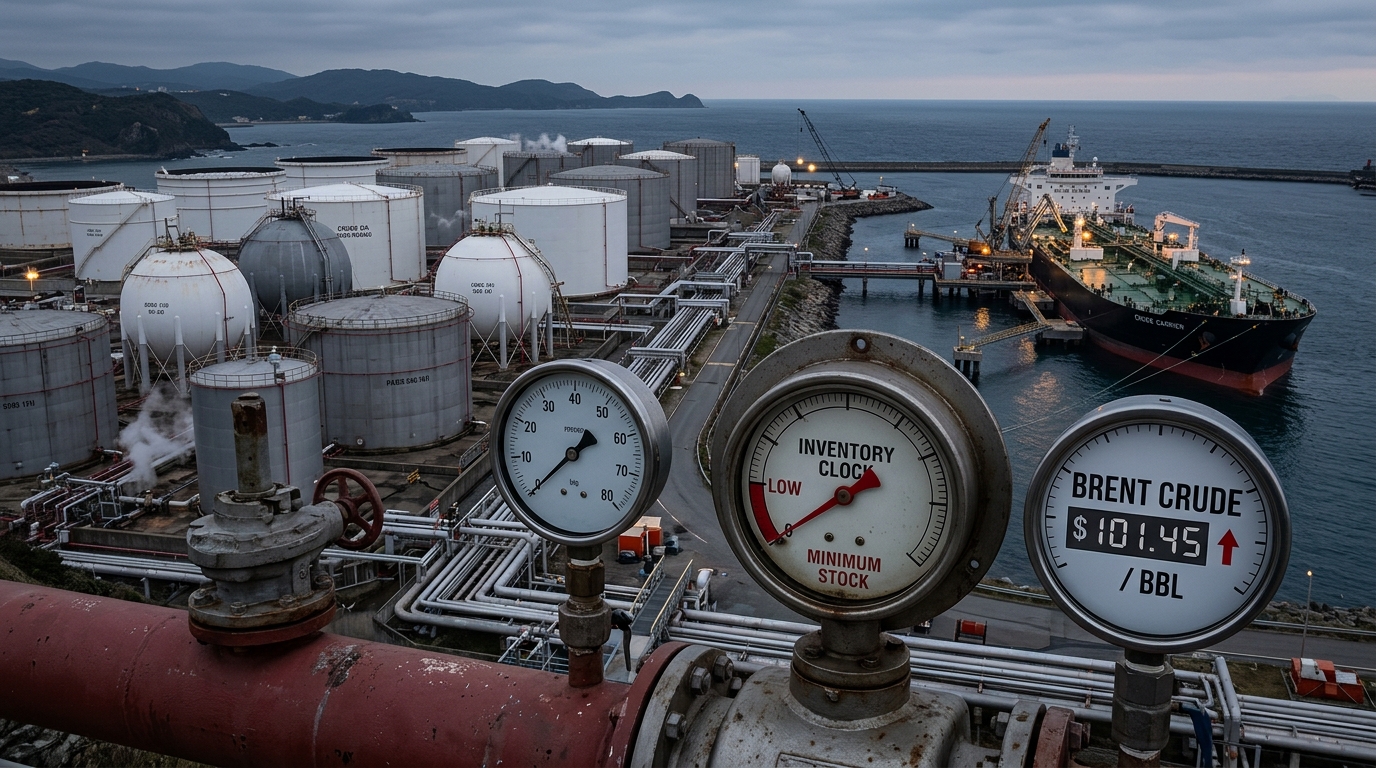
Amin Nasser does not have a habit of crying wolf. When the CEO of the world’s largest oil producer told the Energy Intelligence Forum in London on Monday, October 5, 2026, that global stockpiles are dangerously thin, he backed it with specifics. He said estimates suggest less than 6 billion barrels of commercial inventories remain, with the vast majority not practically available, leaving the global supply cushion “scarily thin.”
Nasser warned against reading headline reserve figures at face value, noting that only a small fraction of reported commercial stockpiles is practically accessible, because a large portion represents minimum operating volumes required to keep infrastructure running. That is the actual buffer between orderly markets and a genuine supply shock.
The EIA’s October Short-Term Energy Outlook drops today, October 6, 2026. Its September edition already confirmed the direction: global oil prices rose to an average of $91 per barrel in August, inventories had decreased by 400 million barrels so far this year, and the agency expected inventories to keep falling through year-end, with Brent forecast to average around $90 per barrel in the second half of 2026. Brent is trading at roughly $100 this morning. The market has outrun the EIA’s own September baseline by about $10 a barrel. Whatever the October revision says, it is likely to validate tighter conditions, not loosen them.
Meanwhile, the physical market keeps delivering new evidence. UKMTO reported a tanker struck by an “unknown projectile” while transiting the Strait of Hormuz on October 4. Trump said over the weekend the war will end “very soon, probably right after the midterms,” and also said oil prices could fall sharply once the conflict ends. That political ceiling on crude is real. But the inventory math argues the opposite: until Hormuz fully reopens and confidence returns, pressure at both ends of the barrel will intensify, and even then, replenishing inventories while meeting demand could take up to two years, Nasser said.
Where the Opportunity Actually Sits
Brent near $101 looks like an oil trade. It isn’t, or at least it shouldn’t be your primary position. Saudi Aramco cut its November selling price of Arab Light to Asian buyers to $5 per barrel below the regional Oman-Dubai benchmark, a steeper discount than the $2 offered for October, suggesting stronger competition for market share as flows recover. That kind of pricing behavior is a ceiling, not a floor, on crude.
The structural opportunity is downstream: storage, shipping, and refining. Reuters reported that Aramco is in talks with governments about storing crude overseas and is studying additional export routes and additional overseas storage facilities. Every barrel that needs to reach market through a workaround route generates outsized demand for tanker capacity and storage infrastructure, regardless of whether the headline Brent price holds or fades.
On the refining side, refining stocks have been breaking away from the integrated majors, with Marathon Petroleum climbing 5% and Valero Energy gaining 4% as recently as October 1. When crude falls, integrated majors like XOM and CVX lose upstream margin, but Valero’s earnings equation depends on whether refineries can buy crude cheaply enough and sell products at wide enough margins, regardless of the absolute oil price. In a world where the EIA already flagged that U.S. distillate inventories were expected to fall below 100 million barrels in September and remain below the 2021-2025 low through the end of 2026 and most of 2027, VLO carries the more targeted thesis.
Risk Dashboard
The central risk to this framework is not another tanker strike. It is a ceasefire announcement. Trump said he expects the war with Iran to end very soon and predicted oil prices will fall sharply once the conflict is over. Any credible diplomatic development would compress the risk premium in crude quickly, and refining stocks would not be immune to that move on the open. Position size accordingly.
Today’s EIA release is the near-term catalyst to watch. If the agency validates continued inventory draws and raises its Brent forecast above the $90 baseline, that confirms the structural thesis. If it signals any surprising build, crude could pull back toward $95 and test conviction across the entire energy complex. Know your level before the data lands.