
October 11, 2026
Tuesday’s ‘Welcome home’ event brings a smart display and a Siri AI bet, but iPhone 18 Pro demand is the harder story.
Analyst Targets
- Bank of America Securities – Buy, $370
- Citi – Buy, $365
- Morgan Stanley – Buy, $355 (trimmed from $360 on Oct. 1, citing softer iPhone pricing and rising memory costs)
- Bernstein SocGen Group – Buy, $370
- Street consensus – Buy, average target about $328 across 44 analysts; AAPL closed Thursday at $336.64, above the mean
Two Stories, One Stock
Apple arrives at Tuesday’s ‘Welcome home’ event carrying contradictions. The company is about to open an entirely new product category, the HomePad smart display, while simultaneously managing a demand shortfall in its most important revenue line. Investors heading into October 13 need to hold both ideas at once.
Jim Rickards: “This AI Giant is About to Go Bust”
Jim Rickards just released shocking new research predicting this AI giant is about to go bust…
Triggering a full-blown AI meltdown that could wipe out 80% of the stock market.
He says this could be 10 times bigger than Lehman Brothers.
Click here to get the name of this company, completely free of charge…
And learn the five steps he’s recommending you take.
The event takes place in Tribeca, New York, beginning at 9:00 a.m. local time. The ‘Welcome home’ theme points clearly to the smart home: the HomePad, a new Apple TV 4K, and the HomePod mini 2 are expected. It is Apple’s first hardware event since the September ‘Surprise and Shine’ launch of iPhone Duo and iPhone 18 Pro.
Company Profile
Apple generates revenue across five reported segments. In Q3 fiscal 2026, iPhone contributed $54.3 billion, or 50% of revenue; Services $30.7 billion, or 28%; Mac $10.4 billion; Wearables, Home and Accessories $7.9 billion; and iPad $6.2 billion, for a total of $109.4 billion. Home hardware is not broken out separately inside that Wearables bucket, which is precisely why Tuesday matters: Apple is trying to build a category large enough to eventually deserve its own disclosure line.
The HomePad: What Is Actually Arriving
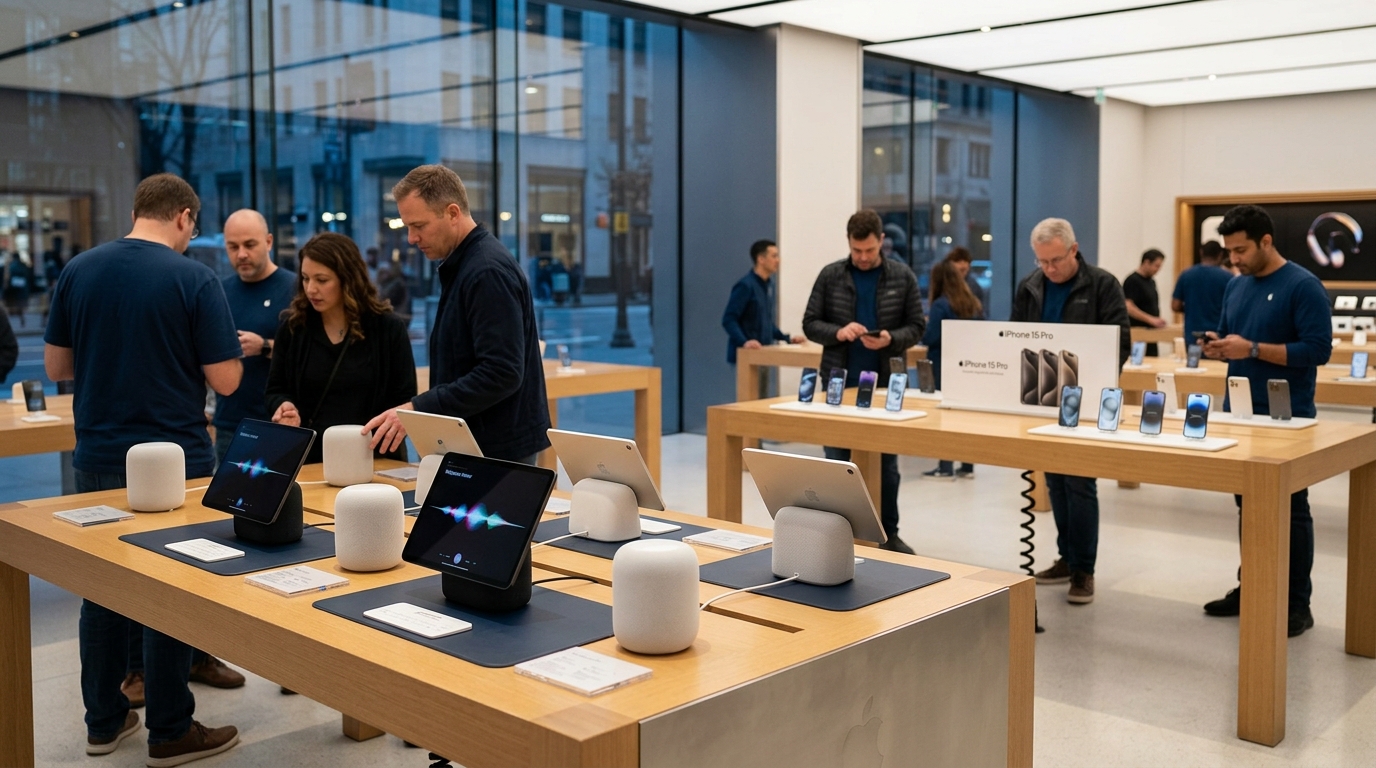
The centerpiece of the event is the HomePad, Apple’s first smart home hub. The standard version is widely expected to pair a compact display with a speaker base and to run a new ‘homeOS,’ with a renewed emphasis on Siri AI and privacy features such as on-device processing and Apple’s Private Cloud Compute, as Bloomberg has reported.
Two versions are reportedly planned: one with a conventional speaker base and another designed for wall mounting. A starting price around $350 has been discussed; Apple has not announced a retail price. Alongside the HomePad, an A19-powered Apple TV 4K is expected to support new Apple Intelligence features, and a second-generation HomePod mini with a faster processor and new colors is anticipated.
The iPhone Problem
The harder number in Apple’s current picture has nothing to do with Tuesday. Apple asked some suppliers to reduce component production for the iPhone 18 Pro and iPhone 18 Pro Max after demand fell short of expectations, with October component orders cut by 15% to 20% compared with original requests, per Nikkei Asia. Morgan Stanley has backed those reports, adding further weight to signs of softer-than-expected demand for Apple’s latest flagship models.
A 90-Year Cycle May End Soon, Creating Real Wealth for Early Adopters.
In 1933, Executive Order 6102 forced everyday Americans to hand over their gold at a fixed rate. Everyday citizens lost a sizable amount of their hard earned wealth at the stroke of FDR’s pen.
The iPhone 18 Pro and Pro Max launched at $1,199 and $1,299 respectively, $100 above the prior year’s models. Apple also launched the foldable iPhone Duo, while holding back a standard iPhone 18 for a later release window. Lower shipment volumes may not necessarily hurt revenue, as the 18 Pro models are priced 10% higher than predecessors, but that arithmetic only holds if units don’t fall further.
Macro and Competitive Context
All three home products are thought to have been ready for a while, but Apple reportedly waited for the next-generation Siri AI to launch before rolling out the hardware. The smart home hub was pushed back multiple times due to ongoing issues with the revamped version of Siri. That delay has a competitive cost: Amazon and Alphabet have had the smart display category to themselves for years.
Siri is the single biggest lever in the home push: moving from ‘on par’ to ‘clearly worse’ cuts hub sales by 60%, more than any price or competitive change. Even the best case adds under 2% to Apple’s revenue and under 3% to its EPS, so in the near term the home is a strategic bet more than a financial one.
Bull / Base / Bear
Bull: The HomePad ships with a materially improved Siri, drives Apple One subscription attach rates, and turns the device into a recurring services node per household. The iPhone 18 Pro order cut is absorbed by higher average selling prices. AAPL breaks through the $345 all-time closing high.
Base: The HomePad lands well in the Apple ecosystem but takes 18 to 24 months to reach meaningful volume. Services growth offsets hardware softness. The stock holds the $330-$340 range into the next earnings report.
5 Little-Known Stocks Behind Today’s Defense Tech Shift
Behind the headlines, a major transformation is underway.
Modern warfare is being driven by AI, autonomous systems, and next generation technology. A handful of lesser known companies are helping power this shift.
This report uncovers five stocks quietly playing a critical role in the future of defense.
Bear: Siri underdelivers relative to Google and Amazon alternatives, HomePad adoption stalls, and the iPhone 18 Pro demand shortfall widens in November. The average fiscal 2027 EPS estimate has already slid to $9.58 from $9.68 three months ago, and further cuts at a 35-plus forward multiple would be painful.
Technical Overlay
Apple shares closed at $336.64 on Thursday, below the all-time record closing high of $341.07 reached on September 25. Immediate resistance sits at $335.80, with near-term support anchored at $331.25. The stock dropped roughly 3% on the iPhone order-cut report Friday before recovering ground. A clean reaction to Tuesday’s event above $338 would be constructive; a failure to hold $331 on disappointment reopens the low $320s.
What Investors Should Watch
- HomePad pre-order velocity starting October 16, reported as the likely window
- Siri demo quality at the event – this is the variable analysts cannot model in advance
- Any commentary on iPhone 18 Pro demand trajectory ahead of the next earnings call
- Whether Morgan Stanley or Bank of America revise targets post-event
- Services attach rate data when Apple next reports Wearables, Home and Accessories
Bottom Line
The ‘Welcome home’ event is genuinely important strategically. Apple is planting a Siri-powered device at the center of the household, a position Amazon and Google have occupied for years. Apple earned 40.1% on products and 75.6% on services in Q3, so most of the value of a home push comes from what it does for services and loyalty to iPhone, not from the hardware margin itself.
But the event does not solve the iPhone 18 Pro demand question, and that is what determines the stock’s next material move. Tuesday’s Siri performance is the single variable worth watching most closely. If it impresses, it changes the conversation about Apple’s AI position across every product line. If it doesn’t, the home push becomes another category Apple will need to iterate through before it matters to the income statement.