
October 14, 2026
Strip out the non-deductible charge and the quarter looks far stronger than the after-hours selloff implied.
Analyst Targets
- Barclays: Buy, $72
- Goldman Sachs: Buy, $66 (lowered from $76 in early October)
- JPMorgan: Overweight, $62
- UBS: Buy, $67 (lowered from $70)
- TD Cowen: Hold, $60 (initiated October 8)
- Consensus (about 18 analysts): Buy, average target $66.59
The Penalty First, Then the Quarter
Bank of America arrived at its Q3 earnings this morning carrying a $1.2 billion regulatory bill announced on Tuesday, October 13, 2026, less than 24 hours before results. U.S. regulators said the bank had broad anti-money laundering and sanctions compliance failures, including insufficient monitoring and reporting tied to priority risks such as Chinese money-laundering networks and illicit finance along the southwest border.
NASA Is Paying Elon Musk $843 Million to DESTROY a $150 Billion Space Station
It cost $150 billion and took 16 nations 13 years to build.
It is the most expensive object human beings have ever made.
Now SpaceX has been hired for what one outlet calls “the most expensive demolition job ever commissioned.”
But here is the part almost nobody has caught yet.
Elon is NOT building the replacement.
That job is poised to go to a company less than half a percent the size of SpaceX.
It is the real winner in this deal.
Former Wall Street CEO Dylan Jovine has laid out the whole story, including the tiny firm’s name.
The enforcement actions include a $1.2 billion assessment from FinCEN and a $750 million civil money penalty from the OCC, which the OCC said is the largest penalty in its history. The OCC penalty is credited against FinCEN’s assessment, leaving the net civil penalty at $1.2 billion, alongside a separate $11.6 million settlement with OFAC over apparent sanctions violations.
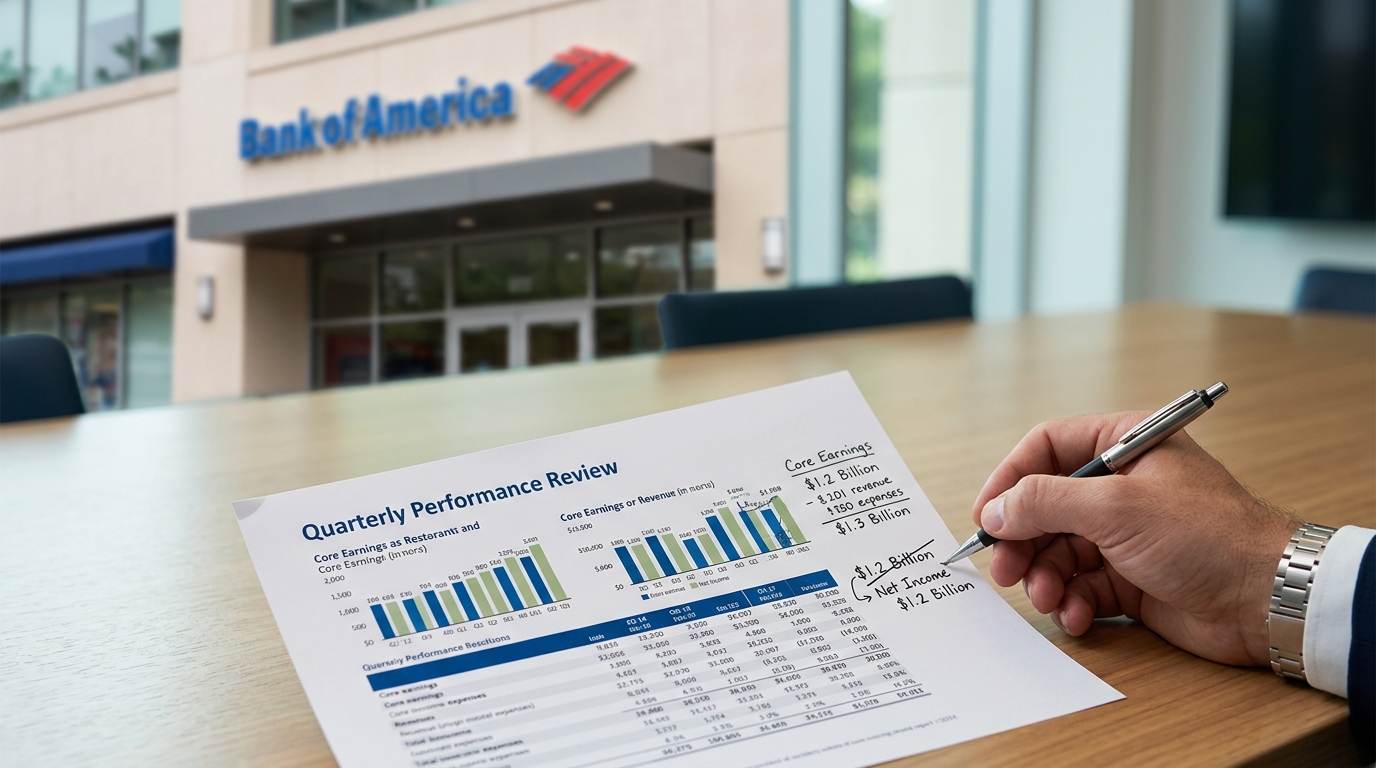
Bank of America said the results will include a $1.2 billion non-tax-deductible charge. That is the number distorting today’s read.
Company Profile
Bank of America provides banking and financial services to about 69 million consumer and small business clients and is a leading small business lender in the U.S. Its four principal segments are consumer banking, global wealth and investment management, global banking, and global markets. Net interest income is the largest single revenue driver, which is precisely why this quarter’s NII trajectory matters more than the penalty headline.
The Numbers: What the Quarter Actually Shows
Before the penalty distortion, the Q3 consensus heading into this morning called for:
- EPS of $1.11 per share and revenue of $30.58 billion.
- Net interest income (fully tax-equivalent basis) of $16.55 billion, versus $15.39 billion in the same quarter last year.
- The consensus estimate for tax-equivalent NII implies a 7.5% increase year over year.
The penalty, being non-tax-deductible, was described by the bank as a $1.2 billion charge; investors will focus on the post-charge EPS bridge management provides on the call. Add-back math can be directionally useful, but the cleanest read will be the underlying pre-charge performance and forward guidance once management quantifies the per-share impact.
The Q2 2026 comparison matters for context. Bank of America reported Q2 net income rising to $9.1 billion, or $1.21 per share. Growth was driven by strong markets and deal activity, with sales and trading revenue rising 33% to $7.1 billion and equities revenue up 70% to $3.6 billion, while investment banking fees increased 50% to $2.1 billion. Q3 was never going to match that, and management signaled as much explicitly.
Why Nov. 12 Could Matter for Your Money
If you own stocks, bonds, or have retirement savings, Nov. 12 deserves your attention. Jeff Opdyke warns China’s next financial move could hit the U.S. dollar – and your wealth. See why.
Why the Stock Is Moving
The after-hours reaction on Tuesday overstated the fundamental damage. The stock closed at about $53.96 on Tuesday, October 13, 2026, down roughly 1.14%, then slid about 2.29% to $52.73 in after-hours trading once the penalty became public. The selloff conflated a one-time, fully disclosed compliance charge with deterioration in the bank’s core earnings power.
Some analysts described the action as reputationally painful but financially manageable. That framing matches the professional consensus: uncomfortable, but likely containable if the core earnings engine and forward NII outlook hold up.
Peer Context: JPMorgan’s NII Raise, Wells Fargo’s Miss
Tuesday’s peer results set the backdrop. JPMorgan raised its net interest income outlook to $106.2 billion for 2026, compared with prior guidance of $105.5 billion. Its NII ex-markets guidance moved to $97.2 billion from $96.5 billion. That upward revision signals the rate environment is still constructive for asset-sensitive banks, a direct tailwind for Bank of America.
Wells Fargo missed. Wells Fargo’s NII came in at $12.52 billion versus analyst estimates of $12.64 billion, a roughly 1% shortfall. Total revenues increased to $21.87 billion from $21.44 billion a year ago but missed Wall Street’s expectations. A miss from Wells sets a lower bar for Bank of America’s NII delivery to land favorably by comparison.
Forward Scenarios
Bull
Underlying NII lands at or above the $16.55 billion consensus. Operating leverage holds near the 300-400 basis point full-year target management set after Q2. The 8:30am call produces Q4 NII guidance above $17 billion, aligning with JPMorgan’s directional upgrade. The market looks past the penalty noise and trades BAC back toward the $60-$62 range where multiple analysts have clustered their targets.
Base
NII comes in line. Investment banking fees drop the guided 10% sequentially. The penalty charge defines the quarter’s reported EPS. Shares stabilize in the $53-$56 range as investors wait for Q4 evidence that core earnings trajectory is intact. Bank of America has been on a multi-quarter streak of topping consensus revenue and EPS expectations, a pattern that matters for institutional positioning even in a noisy report.
Bear
NII disappoints on margin compression. The remediation obligations embedded in the enforcement actions prove more persistent than investors expect. The consent-order requirements impose ongoing expense headwinds, and independent assessments of compliance controls add to the structural cost burden.
Amazon Cut 30,000 Jobs, then Marc Chaikin Created the 401(ai)
The shift underway at America’s biggest tech companies led Marc to a provocative new idea. He calls it the 401(ai) approach.
Technical Overlay
The stock pulled back from its 52-week high of $65.22 set on August 17, 2026, and has traded near $54 ahead of this report, well below the 12-month consensus target. Support at $52-$53 is the level that held after-hours. A close above $56 on today’s session would confirm the penalty-driven selloff has been absorbed and reset the technical picture toward the $60 range that most analysts regard as fair value given current NII trajectory.
The rate environment shaping BAC’s NII outlook runs through the same bond market move hitting borrowers everywhere. Mortgage rates climbing past 7% show how Treasury yield pressure transmits directly into bank lending volumes and margins.
What Investors Should Watch
- Q4 NII guidance on the 8:30am call: any figure above $17 billion will be read as confirmation the rate environment is still working in BAC’s favor.
- Whether management characterizes compliance remediation costs as contained within the existing expense base or signals incremental spend.
- Operating leverage and efficiency ratio: BAC delivered 6.6% operating leverage and a 59% efficiency ratio in Q2 2026. Management has raised full-year operating leverage guidance to 300-400 basis points. Any deterioration on these metrics raises a bigger question than the fine itself.
- Analyst revisions following the call, particularly from Goldman Sachs and Barclays, which carry the highest targets at $66 and $72 respectively.
Bottom Line
The $1.2 billion penalty is large enough to dominate the headline, not large enough to alter Bank of America’s earnings trajectory by itself. Regulators said the bank faces compliance remediation and independent oversight going forward, which is a real governance mark. But the operational question this morning is simpler: did NII grow, and what does Q4 look like?
With JPMorgan guiding NII higher and Wells Fargo missing the bar, Bank of America’s core lending franchise has a clear opportunity to stand out. Strip the penalty impact from reported EPS and the number that emerges will tell investors whether the underlying quarter was worth owning or not. That is the figure most likely to determine the stock’s medium-term direction.