
Back in the 1860s, settlers from France, Italy, and Germany built grand Parisian boulevards…
…neoclassical facades…

… and cobblestone Bavarian villages halfway across the globe.
Then the rest of the world largely forgot about them.
Today, expats are uncovering a European standard of living…
… Lakefront rental homes for $721 a month…
… private chauffeur service…
… and elite healthcare – completely free from tourist crowds and inflated European price tags.
Constellation Energy Beats Estimates by 30% and Raises Its Full-Year Outlook
Analyst Targets
- Morgan Stanley: Overweight, price target $391
- TD Cowen: Buy, price target $374
- Wells Fargo: Overweight, price target $352
- Barclays: Overweight, price target $345
- BMO Capital: Buy, price target $316
- Bank of America: Buy, price target $346
The Quarter
Constellation reported adjusted operating earnings (non-GAAP) of $5.06 per share against a consensus of $3.90, while revenue of $9.55 billion topped estimates by roughly $320 million. Revenue grew 45.4% year-over-year, surpassing forecasts and highlighting the company’s ability to capitalize on favorable electricity market conditions.
Adjusted operating earnings rose versus the $3.04 per share reported a year ago, reflecting favorable market and portfolio conditions and the addition of Calpine, partially offset by higher interest expense and nuclear production tax credit dynamics.
Management raised full-year 2026 adjusted operating earnings guidance to a range of $12.50 to $12.80 per share, up from the previous range of $11.50 to $12.50. That is the second upward revision this year, and the low end of the new range now equals the top of the old one.
Company Profile
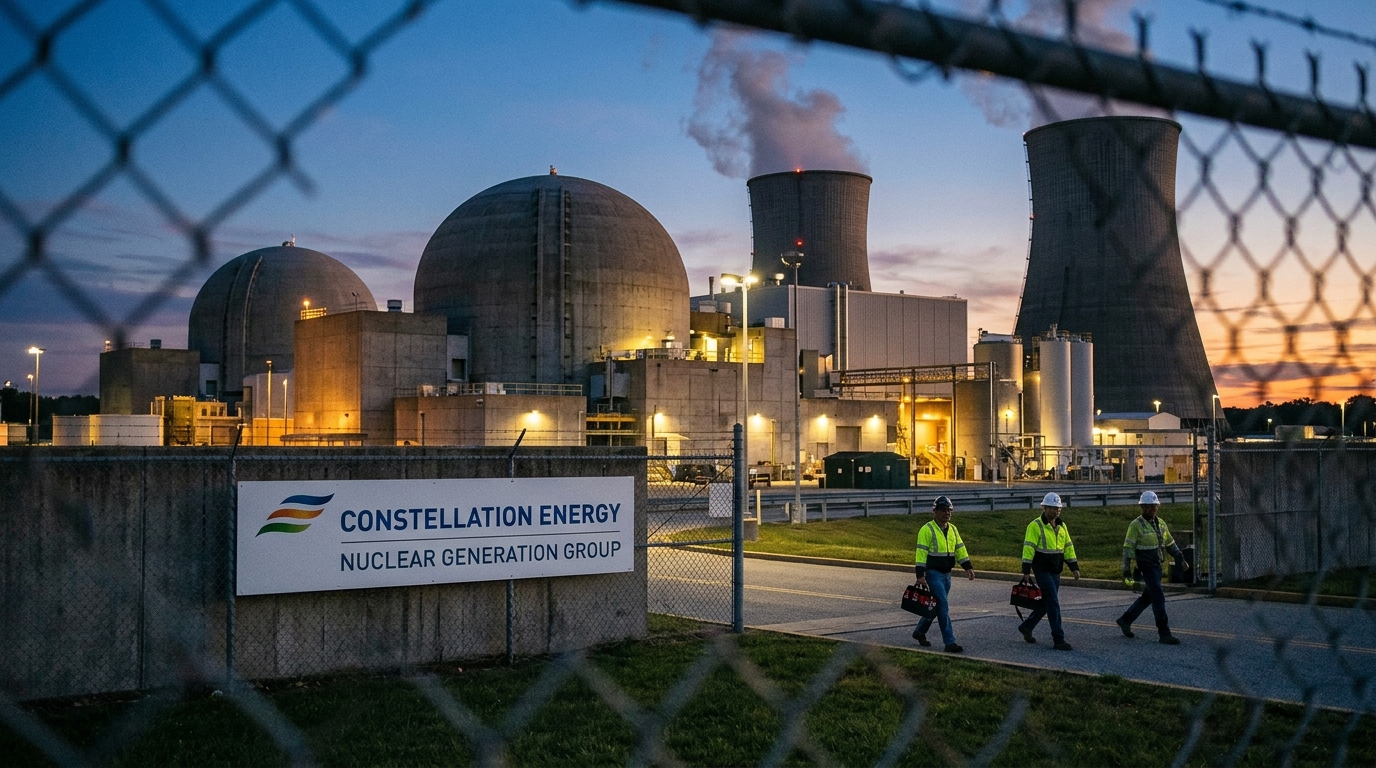
Constellation Energy is the largest producer of carbon-free electricity in the United States, operating the nation’s biggest fleet of nuclear power plants, 21 reactors across the Midwest, Mid-Atlantic, and Northeast, plus hydro, wind, and solar assets. The January 7, 2026 acquisition of Calpine added a substantial natural gas and thermal portfolio, transforming the company into a diversified power producer with significant merchant generation exposure.
Why the Stock Is Moving
The 30% EPS beat is the headline, but the more durable driver is contracted volume. In Q3, Constellation secured approximately 4,560 MW of long-term agreements with three customers, including contracts with Google and Amazon, bringing the year-to-date total to over 8,500 MW.
The Google deal, announced in October 2026, is a 20-year PPA that will enable more than $4.3 billion of investment across 11 nuclear units in Illinois, Pennsylvania, and New Jersey to add approximately 890 MW of incremental generation capacity to the PJM grid, with the first uprate expected in 2028. That 890 MW of incremental capacity is comparable to multiple small modular reactor units.
One agreement includes a 20-year, 270 MW contract through the company’s Peak+ offering, which pairs unit-contingent energy, capacity, and nuclear attributes from the existing fleet with additional solutions designed to support peak demand growth. On the gas side, Constellation agreed to acquire RISEC Holdings, the owner of the Rhode Island State Energy Center, from Shell Energy North America for $715 million. The facility is a combined-cycle natural gas plant capable of generating up to 609 megawatts. The company says the acquisition will be immediately accretive to operating earnings and clears its internal threshold of a 10% unlevered return.
Operational Performance
Constellation’s nuclear fleet demonstrated exceptional reliability during the critical summer demand period, achieving a capacity factor of 99.2% during June through August when the PJM grid set peak load records. For the full quarter, the capacity factor reached 97.2%, up from 96.8% a year earlier. At scale, the difference between 96% and 99% nuclear availability is not an operational footnote. It is hundreds of millions of dollars in captured revenue.
Macro Context
Rising electricity demand from AI computing has renewed interest in nuclear power, which offers steady, carbon-free energy. Constellation is better positioned than most peers to monetize that trend: it already owns the fleet, the contracts are multi-decade, and technology hyperscalers are helping fund uprates rather than relying primarily on ratepayers. Rivals Vistra and NRG are building their own merchant power books, but neither holds a nuclear asset base of comparable scale.
Forward Scenarios
Bull
Nuclear uprate capacity comes online ahead of schedule beginning in 2028, additional hyperscaler PPAs close at above-consensus pricing, and PJM capacity prices stay elevated. Guidance for 2027 moves materially above the current Street consensus. Shares test the high end of the analyst target range near $391.
Base
Full-year EPS lands near the $12.65 guidance midpoint. The Rhode Island acquisition closes without regulatory friction. The Google nuclear uprate program proceeds on schedule. Shares consolidate between $260 and $310 as the market digests a richer earnings multiple.
Bear
Nuclear production tax credit headwinds worsen, PJM capacity auction results disappoint, or integration costs from Calpine run above plan. A softer demand environment for AI infrastructure would delay additional hyperscaler PPA signings. The stock revisits the low end of the analyst target range around $238.
Technical Overlay
CEG closed at $276.09 on November 9, 2026. The gap from last night’s close through the $264 to $271 range is the first resistance zone to clear on a sustained basis. A clean hold above $270 opens the path toward the $316 to $346 cluster where most analyst targets are concentrated.
The fuel cycle underpinning Constellation’s fleet carries its own supply constraint. Uranium procurement is tightening as the world’s largest producer deliberately cuts output while reactor demand accelerates.
Bottom Line
The 30% EPS beat and the guidance raise matter, but they are the rear-view mirror. The forward question is whether Constellation can sustain this contract cadence. Since the Q2 report, the company signed three additional long-term agreements totaling about 4,560 megawatts, with nearly 3,500 megawatts supporting the existing fleet and roughly 1,100 megawatts supporting new nuclear capacity through the uprate program. That is not a one-quarter phenomenon. The real determinant of where this stock trades in 12 months is the pace at which uprate megawatts reach commercial operation and whether the PJM grid tightness that powered this quarter persists into 2027.