Dear Reader,
Before Bear Stearns collapsed … Lehman Brothers went bankrupt … and Washington Mutual became the largest bank failure in American history …
Our company Weiss Ratings was already warning investors about these risks.
Unfortunately, by the time most Americans realized how serious the problem was, the financial crisis was already upon us and much of the damage was already done.
That’s why we’re speaking out today.
The founder of Weiss Ratings, Martin Weiss, a Wall Street Journal, BusinessWeek and New York Times best-selling author …
Has been running Weiss Ratings as a 100% conflict-free, independent financial rating agency for 55 years.
And during those 55 years, he’s publicly warned investors before six major American crashes.
Right now, he believes another dangerous credit crisis is building beneath the surface.
Banks … insurance companies and annuities … investment funds and retirement portfolios could all feel the effects if it spreads.
However, many Americans don’t realize how exposed their money already is.
Don’t make that mistake.
That’s why he’s laid out five specific steps you can take now to help protect your wealth before this new crisis spreads.
The first step alone could help you identify where your money could be vulnerable. And the remaining steps show you what he believes you should consider doing with your money instead.
Please don’t wait for another Lehman-style headline before you take this seriously.
See Martin’s warning and the five steps he recommends taking now
Sincerely,
Eliza Lasky
Weiss Advocate
Siemens Closes Record FY2026. The Industrial AI Bet Grows.
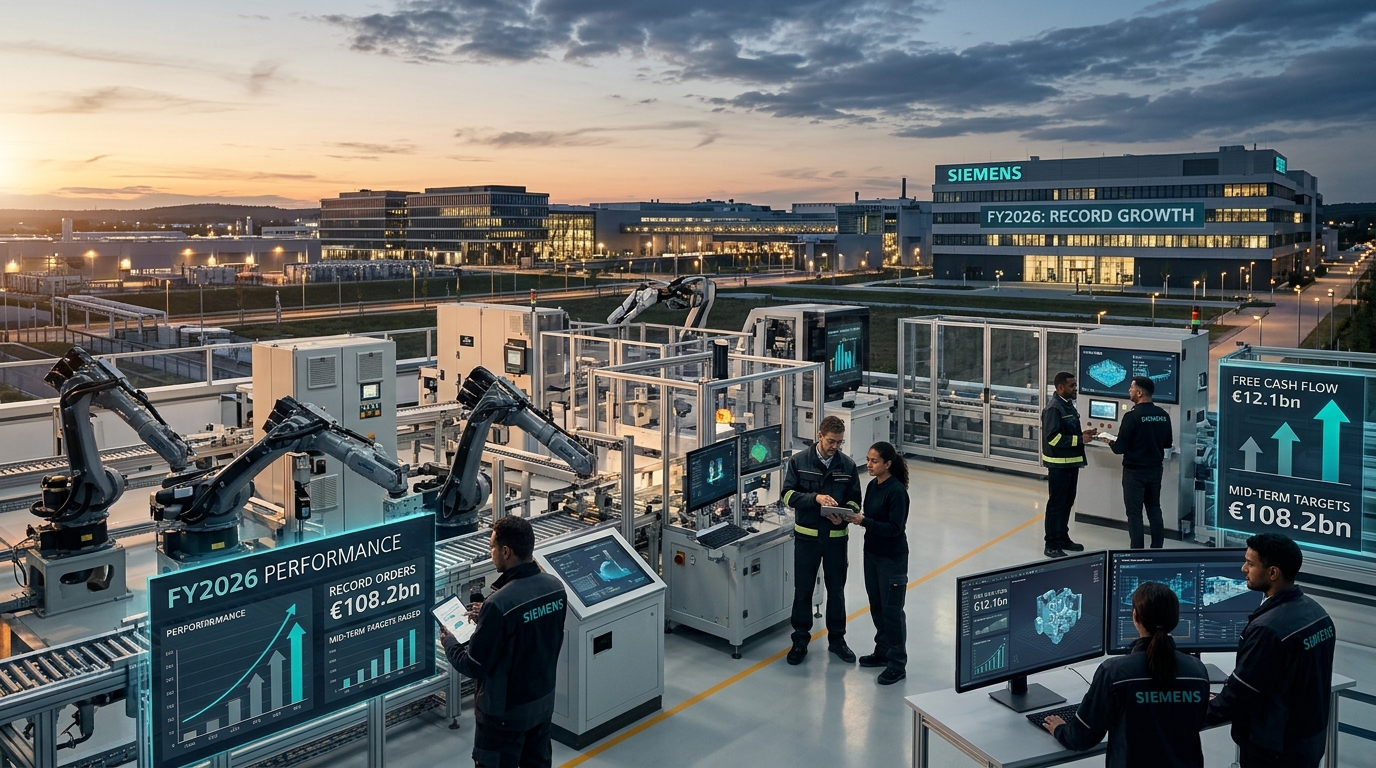
The numbers that landed this morning are unambiguous. Siemens closed fiscal 2026, ended September 30, with records across every metric that matters: orders, profit, and free cash flow. Comparable orders rose 25% to a record €108.2 billion, while revenue grew 8% to €83.4 billion. Free cash flow reached a record €12.1 billion. And management did not stop there.
Siemens raised its mid-term outlook and now expects comparable annual revenue growth of 7% to 11%, up from its previous forecast of 6% to 9%. It also raised its target for annual earnings per share growth to the double-digit range, from the high single-digit range. That is a meaningful step-up, and the question every investor should ask is whether the order book actually supports it.
The Numbers
- Full-year orders: €108.2bn, up 25% on a comparable basis (FY2025: €88.4bn)
- Full-year revenue: €83.4bn, up 8% comparable
- Industrial Business profit: rose 13% to €13.3 billion for the fiscal year
- Q4 orders: rose 58% to a quarterly record of €34.8 billion
- Q4 Industrial Business margin: 16.8%, with profit of €3.9 billion, a record
- Free cash flow: €12.1bn (FY2025: €10.8bn)
- Proposed dividend: €5.50 per share (FY2025: €5.35)
- Fiscal 2027 guidance: comparable revenue growth of 9% to 11%, EPS pre PPA of €10.20 to €10.80
Why the Order Book Is the Real Story
Fiscal 2026 orders exceeded revenue by €24.8 billion by rough arithmetic, and the backlog ended fiscal 2026 at a record €143 billion (FY2025: €117 billion). That is a tangible base for the 9% to 11% revenue growth Siemens guides for fiscal 2027. That is not demand speculation. That is contracted work already on the books.
The composition of that order surge matters as much as the total. Siemens said record-high order intake was driven by growth in all industrial businesses and led by particularly strong contributions from Mobility and Smart Infrastructure. Smart Infrastructure orders rose 40% to €8.67 billion in Q4, helped by numerous larger contract wins from data center customers, predominantly in the U.S. and in Europe.
Siemens is not the only industrial capturing that data center wave. Eaton’s electrical segment has been posting outsized organic data center revenue growth as hyperscalers race to secure power and cooling capacity.
What ‘Industrial AI’ Is Actually Worth
Under CEO Roland Busch, Siemens has tied its strategy to scaling Industrial AI by combining the real and the digital worlds, with results showing up most clearly in the digital business. Digital business revenue reached €10.9 billion for fiscal 2026, up 16%. Digital Industries software revenue grew 13% on a comparable basis to €7.2 billion, with comparable annual recurring revenue (ARR) up 12% to €6.1 billion. Recurring revenue in a hardware-heavy industrial business is structurally different from the cycle-driven order patterns in automation or mobility. It compresses earnings volatility and deserves a premium multiple.
Reuters reported Thursday that Siemens lifted its mid-term growth outlook after better-than-expected quarterly profit, as the group continued to see strong demand from data centers used to power AI. That is a demand tailwind with a named end market. It is not theoretical.
Bull / Base / Bear
Bull: The €143bn backlog converts at the guided 9% to 11% revenue growth rate, Smart Infrastructure continues winning data center contracts through 2027, and software ARR sustains double-digit expansion. EPS reaches the top of the €10.20 to €10.80 range and the mid-term 7% to 11% revenue target proves conservative. The stock re-rates toward a true tech-industrial blended multiple.
Base: Revenue lands in the middle of fiscal 2027 guidance, margins hold broadly stable, and software growth moderates slightly as hyperscaler capex plateaus. The raised mid-term targets prove achievable but not beatable. Shares trade in line with European industrial peers at a modest premium.
Bear: A macro slowdown stretches order-to-revenue conversion timelines, Digital Industries automation demand softens alongside a broader manufacturing contraction, and the data center order cycle peaks earlier than management expects. Backlog size obscures margin pressure on the lower-quality segments of that €143bn.
Bottom Line
The fiscal 2026 results close every debate about whether Siemens has real demand or inflated order counts. Reuters reported Thursday that the German engineering group continued to see strong demand from data centers used to power AI. The backlog is €143 billion. The free cash flow conversion implied by fiscal 2026 results is strong for a company of this complexity.
What determines the next move is not whether fiscal 2026 was strong. It was. The question is whether the digital software layer, now at €10.9 billion in revenue and growing at 16%, can sustain that rate long enough to shift how the market values the whole group. If it does, the raised mid-term targets look reasonable. If software growth decelerates toward the high single-digit range, the new 7% to 11% revenue band will feel like a stretch.