April 30, 2026
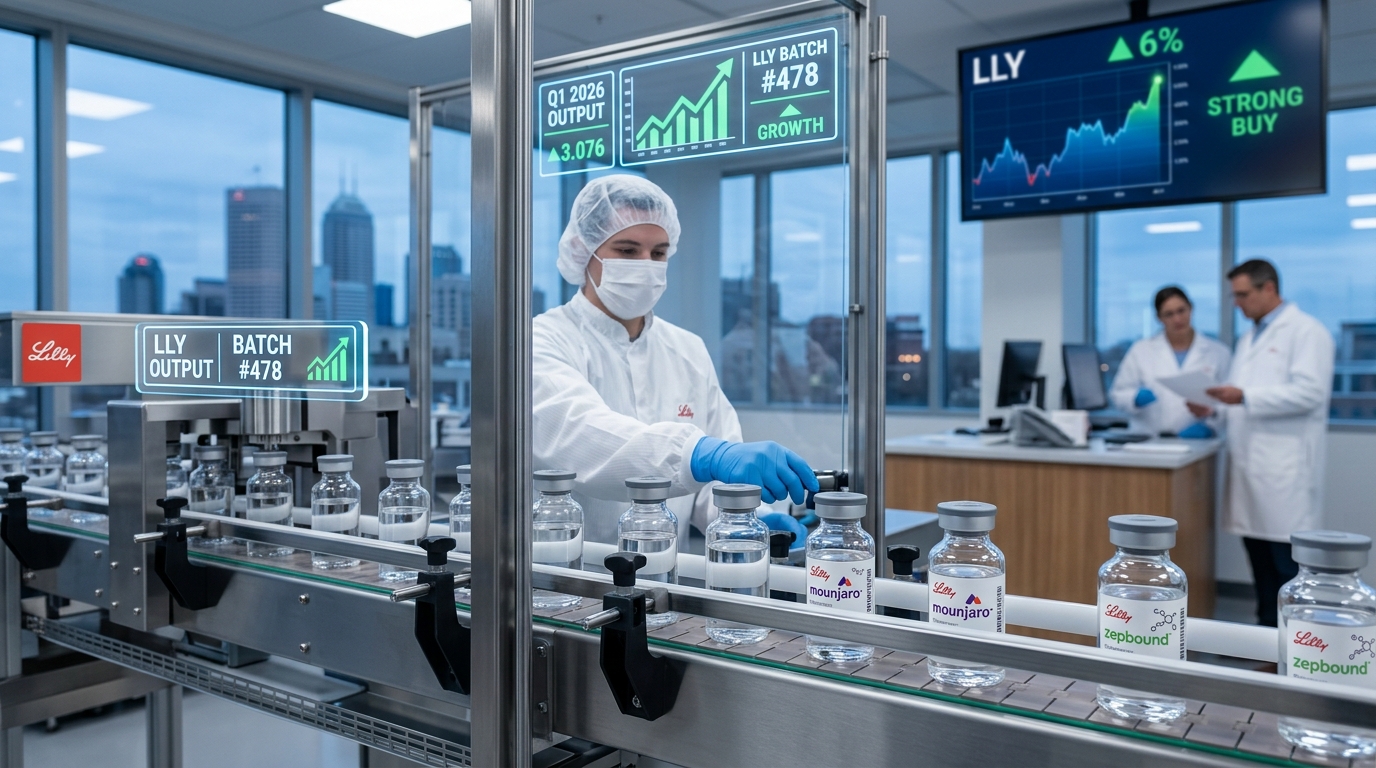
Eli Lilly (LLY) +6%: Mounjaro and Zepbound Are Running the Company Now
Q1 2026 earnings just delivered the clearest case yet that this is the most important pharmaceutical growth story in a generation.
Analyst Price Targets
- Consensus rating: Strong Buy (per TipRanks, 72 Buy / 2 Hold / 2 Sell in the current month)
- Average 12-month price target: ~$1,214–$1,254 across major aggregators
- High target: $1,500 | Low target: $830
- RBC Capital (Trung Huynh): $1,250 price target
- Implied upside from recent levels: approximately 35% based on consensus
Eli Lilly just reported Q1 2026 results this morning, and the numbers weren’t close. The company posted $19.8 billion in revenue against a Wall Street estimate of $17.62 billion. Adjusted EPS came in at $8.55 versus an expected $6.66. Shares jumped more than 6% in premarket and extended gains through the session.
That’s not a beat. That’s a category of performance that most large-cap pharmaceutical companies don’t touch in their best years.
And the thing is — this is now the fifth or sixth consecutive quarter of results that look roughly like this. Revenue exploding off a large base, EPS torching consensus, guidance going up. At some point, the skepticism has to give way to acknowledgment: Lilly has built something that doesn’t show obvious signs of slowing down yet.
Louis Navellier: Don’t buy OR sell another AI stock…
Until you’ve heard this urgent AI warning from the man who called Nvidia before its 44,000% rise…
According to Louis, a massive reset is coming in an obscure corner of the AI market.
This $100 trillion disruption could send some of the world’s biggest AI stocks to zero… and one off-the-radar stock soaring… starting now.
Company Profile
Eli Lilly is an Indianapolis-based pharmaceutical company founded in 1876. For most of its history, it operated as a broadly diversified drug maker with products across diabetes, oncology, immunology, and neuroscience. That changed dramatically when tirzepatide — the active ingredient behind both Mounjaro and Zepbound — became the fastest-growing drug franchise in the history of the pharmaceutical industry.
Mounjaro is approved for type 2 diabetes. Zepbound targets obesity and weight management. Both are injectable GLP-1/GIP dual agonists. The dual-agonist profile is critical — it delivers approximately 20% average weight loss in clinical trials compared to roughly 14% for semaglutide-based drugs, the active ingredient in Novo Nordisk’s Ozempic and Wegovy. That clinical superiority has been the single biggest driver of Lilly’s market share expansion over the past two years.
The company also has meaningful revenue from Verzenio (breast cancer), Kisunla (Alzheimer’s), Jaypirca (leukemia), and several other franchises. But none of them move the stock the way the incretin portfolio does. Mounjaro and Zepbound jointly generated $12.8 billion in global revenue in Q1 2026 alone. That’s the whole conversation right now.
The Numbers — Q1 2026
- Total Revenue: $19.8 billion vs. estimate of $17.62 billion (+56% year-over-year)
- Adjusted EPS: $8.55 vs. estimate of $6.66 — a 28.4% beat
- Reported EPS: $8.26 (up 170% year-over-year from $3.06 in Q1 2025)
- Net Income: $7.4 billion vs. $2.76 billion in Q1 2025
- Adjusted Operating Income: $8.92 billion vs. estimate of $7.54 billion
- Adjusted Operating Margin: 45%, up 14.8 percentage points year-over-year
- Gross Margin (non-GAAP): 82.6% of revenue
- U.S. Revenue: $12.1 billion (+43%), driven by a 49% volume increase
- International Revenue: increased meaningfully, driven by Mounjaro expansion in China, Brazil, UK, and Korea
- Mounjaro Worldwide Revenue: $8.66 billion vs. estimate of $7.26 billion (+125% YoY)
- Zepbound U.S. Revenue: $4.1 billion (+79% YoY vs. $2.3 billion in Q1 2025)
- Volume growth: +65% worldwide, partially offset by a 13% decline in realized prices
- R&D Expenses: $3.5 billion (18% of revenue)
- Full-Year 2026 Revenue Guidance (raised): $82–$85 billion (prior: $80–$83 billion)
- Full-Year 2026 Adjusted EPS Guidance (raised): $35.50–$37.00 (prior: $33.50–$35.00)
The volume story here is worth pausing on. A 65% volume increase while absorbing a 13% price decline and still growing revenue 56% — that’s an access and demand dynamic, not a pricing story. Lower prices are accelerating scripts, not contracting the business.
Why the Stock Is Moving
A few things happened simultaneously in this report that matter beyond just the headline beat.
First, Mounjaro’s worldwide revenue came in at $8.66 billion — more than $1.4 billion above what analysts were modeling. International markets drove a meaningful portion of that outperformance. Lilly had slowed global launches when it ran into supply constraints in late 2024. Those constraints are now largely resolved, and the company is now hitting its stride in third and fourth-quarter launches across Europe, China, and Brazil. Markets where patients are paying entirely out of pocket are showing far stronger uptake than many expected.
Second, EPS came in at $8.55 against an estimate of $6.66. That’s not a minor revision to models — that forces a meaningful recalibration of full-year earnings expectations across the sell side. When you compound a beat that large through a full-year model, you get a material step-change in intrinsic value estimates.
Third — and this one is underappreciated — the guidance raise. Lilly moved its full-year revenue outlook up by $2 billion at each end of the range and lifted its adjusted EPS guidance by $2 per share at the midpoint. That’s not a token adjustment. Previous guidance had already been set above consensus. The new range goes further.
The Foundayo launch (orforglipron, its newly approved oral GLP-1 pill) is also in focus but absent from Q1 financials — the drug launched in early April, so its revenue impact starts in Q2. Early prescription data came in below some analyst estimates around 3,700 scripts in the first week, which is the one soft data point worth watching.
Macro and Industry Context
The GLP-1 market is projected to exceed $100 billion annually by 2030, and by some estimates, $150 billion or more over the next decade. Lilly currently holds approximately 60% of the U.S. GLP-1 market — a position it built by taking share directly from Novo Nordisk, which once dominated this space with Ozempic and Wegovy.
The divergence between the two companies in 2026 is striking. While Lilly is raising guidance and posting 56% revenue growth, Novo Nordisk projected a sales decline of 5% to 13% at constant exchange rates for the full year. That’s a first-sales-drop for Novo since 2017. The reasons are familiar — semaglutide patent expirations in key markets, pricing pressure from Lilly’s superior efficacy data, and competition from compounded drugs. Lilly has largely navigated those same pressures through volume growth that more than offsets price concessions.
On the policy side, Lilly struck a deal with the Trump administration in late 2025 to lower obesity drug prices across several channels in exchange for Medicare access and a tariff carve-out for three years. That agreement is now starting to pay off. CMS has extended the Medicare GLP-1 Bridge program through December 2027, capping out-of-pocket costs at $50 per month for Medicare beneficiaries — a development that dramatically expands the potential patient population starting July 1.
A slight tangent here, but relevant: Lilly’s CEO David Ricks estimates global GLP-1 use will grow from approximately 20 million patients at end of 2025 to 30 million by end of 2026. That’s a market expansion dynamic, not a share-taking dynamic. If he’s right, even Novo’s decline is a temporary trough, not an existential problem — and Lilly’s 60% share of a growing market compounds aggressively.
Patent exclusivity is another important layer. Tirzepatide’s protection is expected to extend into the back half of the 2030s in major markets. Novo faces patent losses on semaglutide in China, Brazil, and Canada in the nearer term. That structural asymmetry explains much of the current divergence between the two companies.
Your Free Options Book Is About to Vanish
In case you missed it… make sure you get your free “Simple Options Trading For Beginners” book before your link expires.
I eventually plan to charge money for this training, so do yourself a favor and download it now…
That way, no matter what it costs in the future, you’ll have a free copy.
Sound good?
Bull / Base / Bear Scenarios
Bull Case: Foundayo ramps faster than early scripts suggest — insurer coverage confirmations at two of the three largest PBMs take effect mid-May, and the Medicare bridge starting July 1 adds a wave of new patients. International Mounjaro launches in China and Brazil continue hitting stride. The $80+ billion revenue year that seemed aggressive 12 months ago gets eclipsed. Retatrutide and a pipeline of next-generation obesity drugs extend the franchise runway into the early 2030s. Analysts project Lilly’s cardiometabolic revenue could surpass $100 billion by 2034. Price targets in the $1,350–$1,500 range come into view.
Base Case: Foundayo builds gradually through Q2 and Q3 as payer coverage expands. Volume growth continues to offset ongoing price headwinds. Full-year 2026 revenue lands in the middle of the $82–$85 billion range. The stock grinds higher but not dramatically, as the current valuation premium requires continued execution at this level to justify. Consensus price targets of $1,200–$1,250 serve as a reasonable medium-term destination.
Bear Case: Foundayo’s slow early launch data is a signal, not just an artifact of newness. Novo Nordisk’s oral Wegovy pill holds more market share than expected in the oral segment. A pricing environment gets more competitive as new entrants from Amgen, Viking Therapeutics, and others move through late-stage trials. Meanwhile, U.S. price declines in the low-to-mid teens compound against a higher revenue base. The stock, trading well above its 50-day and 200-day moving averages before this morning’s gap, faces valuation compression if growth decelerates at any point. The low price target of $830 implies that scenario is on the table for more skeptical analysts.
Technical Overlay
LLY had been trading in a compressed range in the weeks heading into this report — sitting below its 50-day moving average of approximately $973 and testing its 200-day moving average near $903. The stock had spent the better part of Q1 2026 working through post-Q4 consolidation after a strong Q4 2025 rally.
The earnings gap this morning changes that picture. A +6% or greater opening gap reclaims the 50-day moving average and puts the stock back above near-term resistance in one session. The Fibonacci pivot point value had been sitting around $879, and that level likely becomes near-term support following today’s move.
The immediate question is whether the gap holds and becomes a base, or whether some of the move fades intraday as traders who were long into earnings take gains. Worth watching whether $950–$960 — the old 50-day area — acts as support on any pullback. Prior to today, the 200-day near $903 had been the key structural level. Above that is constructive. A failure back below $903 on any post-earnings reversal would change the read.
What to Watch From Here
- Foundayo weekly prescription data (IQVIA) — the early read of 3,707 scripts in week two is below estimates near 8,000; the ramp trajectory into May and June is the near-term signal
- Payer coverage expansion for Foundayo — two of three major PBMs confirmed, third still outstanding
- Medicare GLP-1 Bridge program launch (July 1) — could meaningfully accelerate senior patient volumes in H2 2026
- Mounjaro international volume — specifically China NRDL pricing impact vs. volume growth in Q2
- Analyst estimate revisions — a beat of this magnitude typically triggers broad upward EPS revisions across the sell side, which can sustain multiple expansion
- Next earnings report: August 6, 2026 — consensus estimate currently $8.15 EPS, likely to move higher post-today
- Retatrutide Phase 3 data (obesity + osteoarthritis) — a potential next-generation catalyst in the back half of 2026
- Competitive pipeline: Viking Therapeutics oral dual-agonist entering Phase 3 in late 2026 is a longer-term watch item
Bottom Line
Here’s the honest framing: Lilly has now beaten on both revenue and EPS for multiple consecutive quarters, raised guidance each time, and watched the stock spend meaningful stretches below its prior peaks because investor expectations keep resetting higher. That’s a strange problem to have, but it’s the one Lilly has.
Today’s report doesn’t change the fundamental debate about valuation — a company this large growing at these rates still commands a significant premium, and whether that premium is justified depends almost entirely on whether Foundayo’s oral GLP-1 category expands the addressable market or competes with Zepbound and Mounjaro for existing patients. CEO David Ricks has said the oral drugs will reach a somewhat different user base — patients who won’t self-inject. If that’s true, and the Medicare bridge program comes online in July as expected, the second half of 2026 could look materially different from the first.
What the bear case needs is a quarter where volume growth finally starts to flatten — where the price compression doesn’t get offset by enough new patients. That hasn’t happened. The volume keeps coming. Until it doesn’t, the path of least resistance for the business fundamentals remains clear.
The stock is not cheap. It’s never been cheap in this cycle. The question has always been whether the growth justifies the multiple — and this morning’s numbers made that case again, more clearly than most expected.
For informational purposes only.