May 12, 2026
Aurora Innovation: $14 Billion for a Truck That Just Started Hauling
Driverless semis are finally on real roads. The valuation math is where it gets complicated.
Something quiet happened in the freight industry last week. A Berkshire Hathaway subsidiary started letting a computer drive its trucks.
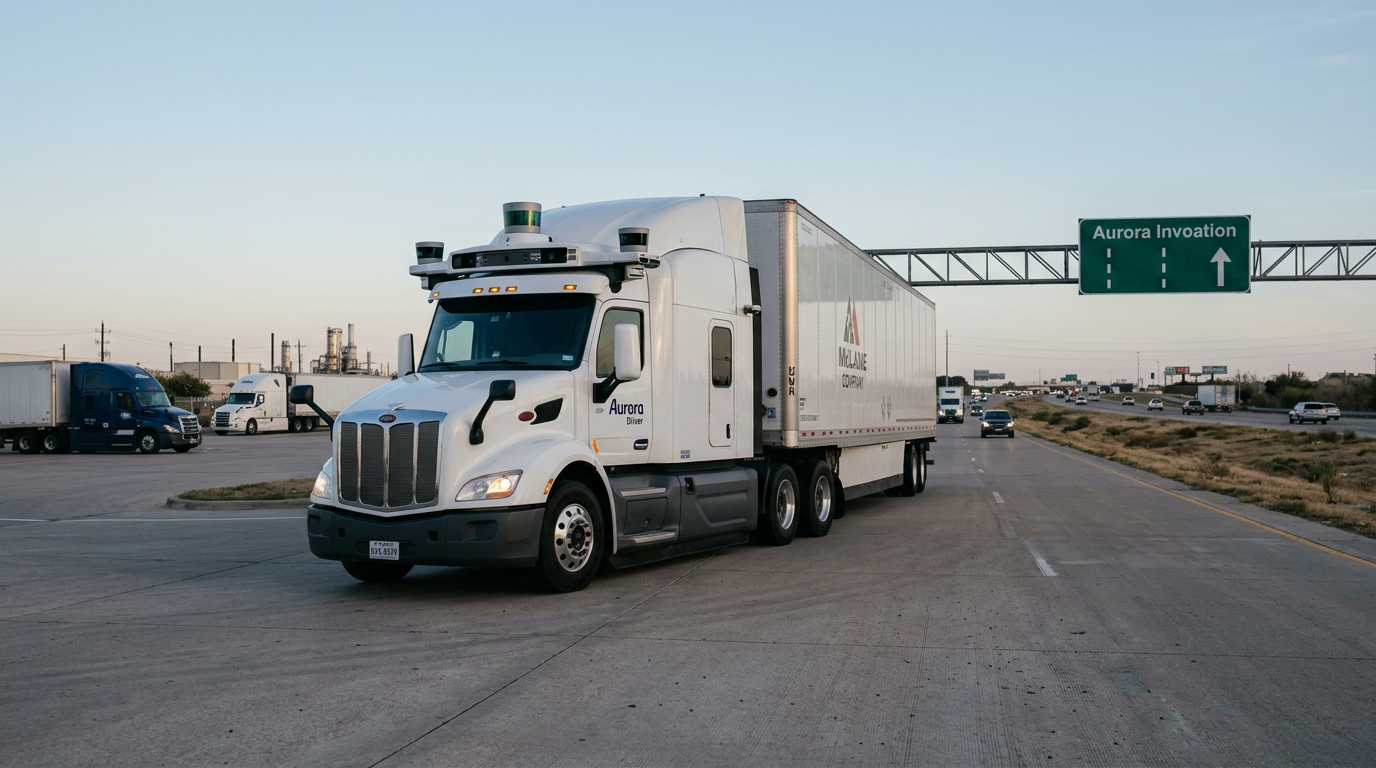
McLane Company – one of the largest supply chain distributors in the U.S. – announced it will begin driverless hauls in Texas using Aurora Innovation’s self-driving system. No safety driver. No observer. Just the Aurora Driver, an SAE Level 4 autonomous system, running long-haul routes across the Sun Belt.
That’s not a demo. That’s commerce.
Aurora (AUR) is one of the most searched and debated names in the market right now. The stock surged on the McLane news, then pulled back – volume hit 48.4 million shares in a single session, roughly 136% above its three-month average. The price action tells you everything about the tension in this name: real operational milestones on one side, a cash burn and valuation problem on the other.
[Urgent] Starlink Set For The Largest IPO In History?
He turned PayPal from a tiny, off-the-radar startup to a massive $64 billion giant.
Then, he did it again with Tesla, which is up more than 19,500% since 2010.
For perspective, that turns $100 invested into almost $20,000!
And now, Elon could be set to do it for the third and final time with what might be his biggest breakthrough yet.
And for the first time ever, you have the rare chance to profit BEFORE the upcoming IPO.
What the business actually is
Aurora develops autonomous driving systems for commercial trucks and passenger vehicles. Its core product – the Aurora Driver – powers its two service lines: Aurora Horizon for trucking and Aurora Connect for ride-hailing. The company targets a subscription-based, capital-light model where trucking carriers pay per mile rather than owning the hardware outright.
The company is also in a deal with Hirschbach Motor Lines for 500 Aurora-powered trucks, has expanded routes between Dallas and Oklahoma City in partnership with Volvo Autonomous Solutions, and is targeting over 200 driverless trucks in operation by year-end 2025.
Revenue for the trailing twelve months? Roughly $4 million. Operating cash burn in Q1 2026 alone: approximately $159 million.
Here’s where it gets interesting – and uncomfortable.
Aurora carries a market cap near $13.9 billion on $4 million in trailing revenue. Morningstar’s quantitative model flags the stock trading at a significant premium to estimated fair value. Meanwhile, a commissioned Aurora study projects autonomous trucking could add $70 billion to U.S. GDP by 2035 – a figure management is leaning on hard to build the longer narrative.
Needham has a Buy rating with a $13 price target. Goldman Sachs is Neutral with a $5 target. The spread between those two tells you where the debate lives.
- Market Cap: ~$13.9B
- Trailing 12-Month Revenue: ~$4M
- Q1 2026 Operating Cash Burn: ~$159M
- Target fleet by year-end: 200+ driverless trucks
- Projected 2026 revenue growth: ~400% (off a tiny base)
- Positive free cash flow target: 2028
Elon Musk: Buy Alert
The world’s richest man just launched a new $480 trillion disruption, which could make you massive gains this summer. It has nothing to do with space, robots or AI. It’s much, much bigger.
The bull case is real and growing: Berkshire’s endorsement via McLane is not nothing, the regulatory environment is loosening, and the freight industry’s driver shortage is structural. If Aurora gets to 5,000 trucks at meaningful per-mile fees, the math eventually starts to work.
The bear case is also real: cash burn at this rate requires continued dilution or fresh capital raises, the competitive set includes well-funded players, and the path from 200 trucks to commercial scale is long and expensive. This is not the kind of name where you size up and walk away.
The Cheap Investor’s honest read: Aurora is fascinating, operationally further along than most give it credit for, and priced for a future that still has significant execution risk baked in. It’s not a value play. It’s a conviction bet on a technology that just crossed from theory into a Texas freight lane.
Whether that justifies $14 billion – that’s the question the tape is still working through.