May 19, 2026
Palantir Grew 1,363% This Company Did 32,481%
FEATURED: Blackstone (BX): This Isn’t an AI Bet. It’s a Infrastructure Takeover.
A note from Mode Mobile
Anyone who invested in Palantir at its IPO in 2020 could be sitting on nearly 1,363% gains right now.
But that great return is already in the past, and the stock is now one of the S&P 500’s most expensive.
But while Palantir was climbing on the back of your public information, another company was redefining big data.
Mode Mobile has already delivered 32,481% revenue growth before even going public.
Mode has:
- 490M+ users
- $1B+ paid to users
- $115M+ in real revenue
- Nasdaq ticker secured for potential IPO
- Pre-IPO shares available for a limited time
Mode’s model pays users for their screen time and turns Big Tech’s free data mining play into a cash-generating engine for everyone.
Palantir now trades at 113x forward earnings, which means Wall Street has already priced in massive expectations.
But Mode?
Still private.
That means the market hasn’t had its say yet.
Right now, investors can get Mode Mobile shares at early-stage pricing.
When the Nasdaq ticker potentially goes live, that window could close fast.
59,000+ shareholders have already invested in Mode, and pre-IPO shares are still available at $0.50/share.
Palantir’s moment has passed.
Mode’s may just be starting.
$71M+ already raised – claim your stake at $0.50/share and earn up to a 20% bonus!
Blackstone (BX): This Isn’t an AI Bet. It’s a Infrastructure Takeover.
Everyone’s been chasing the same AI trade. Chips. Hyperscalers. Software wrappers with 40x revenue multiples. Blackstone looked at all of it and effectively said: we’d rather own the building the whole thing runs inside.
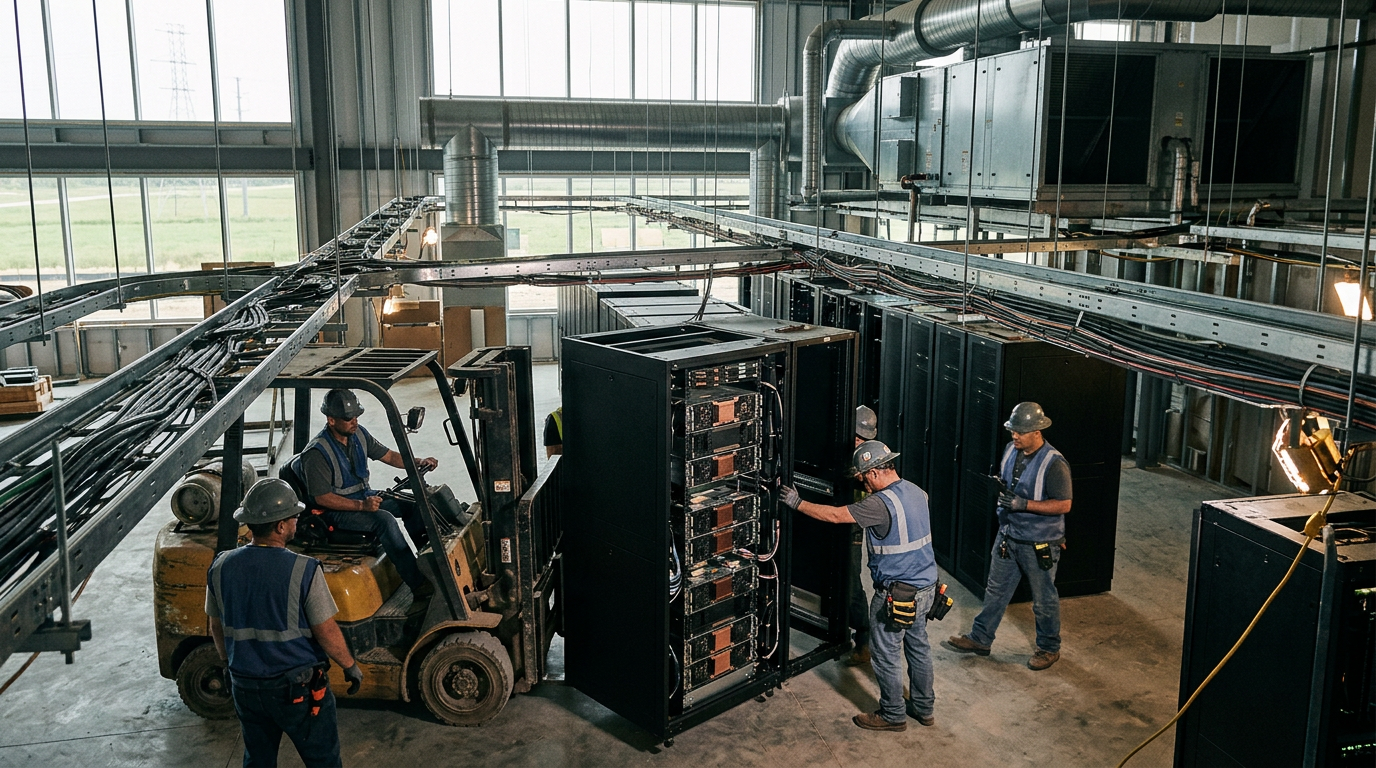
Monday morning, Google and Blackstone announced a joint venture to launch an independent AI cloud company in the U.S. Blackstone puts in $5 billion in equity and holds majority ownership. Google brings the silicon – its proprietary Tensor Processing Units – plus software and services. Lever it up and total exposure across the vehicle reaches $25 billion. Target capacity: 500 megawatts of compute by 2027.
That’s the headline. Here’s what actually matters.
This is a standalone company. Not a fund investment. Not a minority stake in someone else’s infrastructure. Blackstone controls the entity. Google is effectively a hardware and technology vendor inside a structure that Blackstone owns the majority of. The company will sell data center capacity, networking, and TPU-based compute as a service – think CoreWeave, but majority-owned by the largest alternative asset manager on earth, running on Google’s custom silicon instead of Nvidia GPUs.
The CoreWeave comparison is worth sitting with for a second.
CoreWeave IPO’d in 2025 – largest U.S. tech offering since 2021 – by doing one thing: reselling Nvidia GPU access through owned infrastructure. It worked. The market rewarded it. What Blackstone is building now is structurally identical but with a different silicon stack, a different ownership profile, and a balance sheet that CoreWeave simply cannot match. This isn’t an homage to that model. It’s a competitive pressure test on it.
Slight tangent, but it matters: Blackstone didn’t wake up and decide to become a data center operator this week. They bought QTS in 2021. They acquired AirTrunk in 2024. At this point, Blackstone controls more data center capacity than any other private investor in the world. The Google venture isn’t a new direction. It’s vertical integration on an existing dominant position – adding a compute-as-a-service revenue layer on top of infrastructure they already own and operate.
Five days before this announcement, Blackstone’s Digital Infrastructure Trust priced a $1.75 billion U.S. IPO at $20 a share. 87.5 million shares. The proceeds target newly constructed data center assets. Connect those dots and you start to see the architecture: private infrastructure funds on one side, a public vehicle on the other, and now an operating company generating contracted compute revenue sitting in the middle. Multiple capital pools. One thesis.
Modern Defense Has a Redundancy Problem
Modern military defense strategy is built around one key idea: redundancy. Instead of relying on a few large, vulnerable systems, the U.S. is shifting toward distributed networks – constellations of satellites, layered communications, and backup capabilities that keep working even if one piece fails.
Redundancy only works if replacement and testing can happen quickly. A satellite that takes a year to replace isn’t real redundancy. A system that can’t be validated fast enough doesn’t stay reliable.
That’s where logistics – not just technology – become strategic. A small aerospace company is building its model around speed, flexibility, and rapid access – helping reduce the time between need and deployment.
In a world where resilience defines readiness, that capability is gaining attention.
See why investors are watching this overlooked layer of defense and space infrastructure
The arm running all of this is called BXN1, led by Jas Khaira – who, before this role, managed Blackstone’s investment in CoreWeave. That’s not a coincidence. He watched that model generate real returns and is now building the next version of it from the majority-ownership seat. BXN1 already has a second deal in market: a $1.5 billion joint venture with Anthropic, Goldman Sachs, and Hellman & Friedman, selling Claude-based AI tools into private equity portfolios. One venture sells the output. The other sells the compute that generates it. Khaira essentially said exactly that.
Major tech firms are tracking toward $700 billion-plus in AI infrastructure capex this year. Ares has estimated the independent data center opportunity at $900 billion. Blackstone is not passively benefiting from that spend – it’s building the infrastructure those dollars have to flow through.
BX’s stock reaction has been measured. That’s actually the tell. When a deal confirms a thesis the market already believes, you don’t get a gap. You get a drift. The question sitting underneath all of this isn’t whether the deal is good – it clearly is. The question is how much of a $25 billion venture is already priced into a stock that’s been compounding on this infrastructure narrative for four years running.
That gap between announcement and contracted revenue is where the trade lives. Watch 2027 capacity milestones. Watch whether BXN1 closes a third deal before year-end. That’s the real signal – not today’s press release.
For informational purposes only.