June 10, 2026
Union Pacific (UNP): The Land Route Wall Street Is Watching
Cross-Border Supply Chain Resilience and the Case for Domestic Rail
Analyst Price Targets
- Susquehanna – Positive | $305 (raised from $290)
- Jefferies – Buy | $300 (raised from $285)
- BMO Capital – Outperform | $295 (raised from $255)
- Citigroup – Buy | $285 (raised from $270)
- Benchmark – Buy | $275
- Consensus (23 analysts) – Buy | Avg. Target $291.73
The Strait of Hormuz has been effectively closed to commercial shipping since late February 2026. That sentence alone should stop anyone managing a portfolio cold.
What began as a geopolitical escalation between the U.S., Israel, and Iran has evolved into something the logistics world has never confronted at this scale. For the first time in modern history, both of the Middle East’s primary maritime corridors are simultaneously blocked. The Strait of Hormuz – the world’s most critical oil and trade chokepoint – and the Red Sea route are both offline. There is no shortcut. There is no easy workaround.
Negotiations are ongoing. Trump has called a deal “largely negotiated.” Iran disputes that characterization. The blockade remains. And as of this writing, analysts expect disruption to persist through the remainder of 2026.
That is the environment. And in that environment, one question matters for equity investors: who benefits when ocean shipping breaks down and supply chains are forced onto land?
Trump to Unleash Giant $2.7 Trillion Gold Mine?
Executive Order #14153 outlines what Jim Rickards believes are Trump’s intentions to unleash the largest mineral reserve in the country.
According to Jim’s research, he estimates it contains up to $2.7 trillion in gold, silver, copper, and other precious elements that could:
- Build 12,500 AI data centers
- Power 24 million tomahawk missiles
- Rebuild America’s broken electric grid – 25 times over
- Construct 3 million high-performance jet engines for the Air Force and Navy
- And repair nearly every major bridge, skyscraper and pipeline across the country
This single company – trading for just $2 per share – holds 100% of the rights to this asset.
But you need to act before June 30 to take advantage before the President makes his next move…
That’s when a landmark policy decision could reprice this $2 stock, overnight.
This opportunity is so explosive, it’s possible shares could skyrocket 50-times or more by the end of Trump’s term.
But – time’s running out.
Company Profile
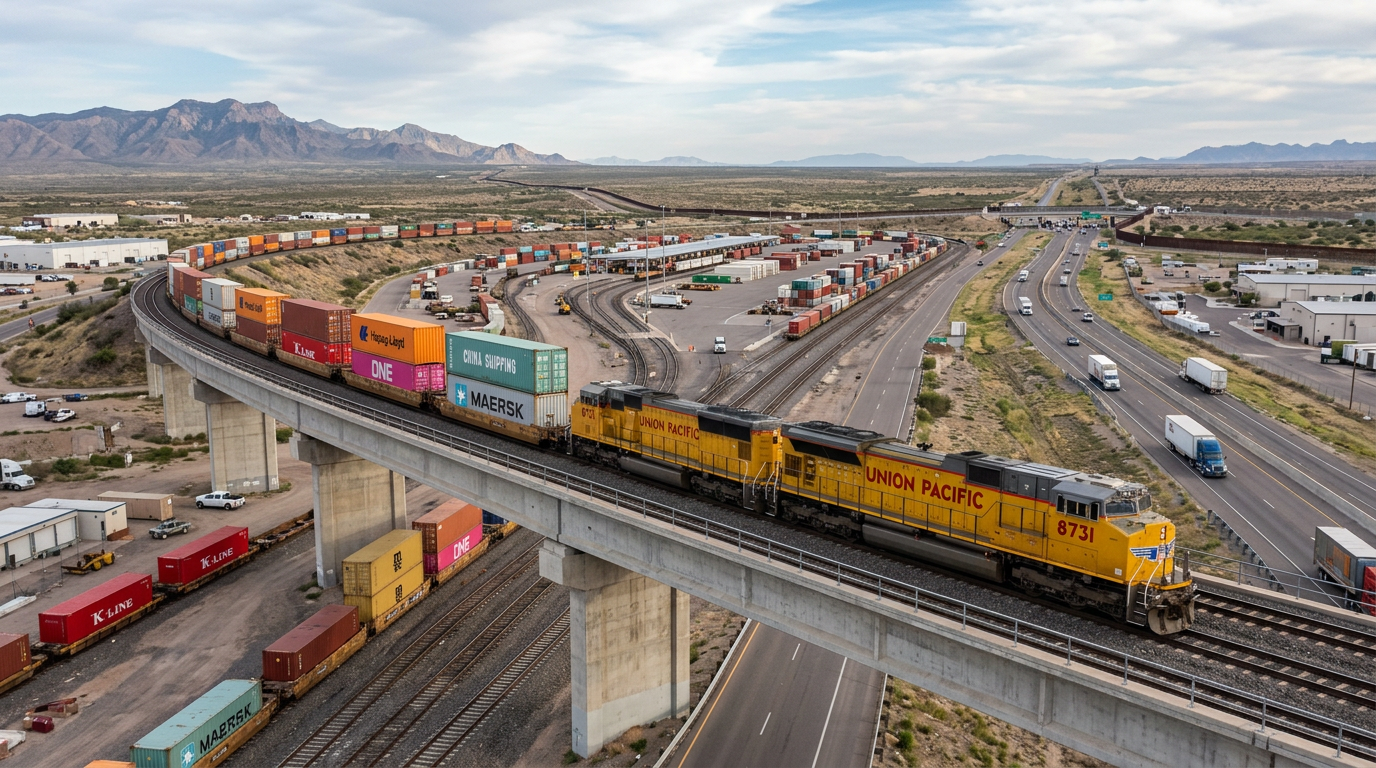
Union Pacific Corporation (NYSE: UNP) is the largest public railroad in North America. Founded in 1862 and headquartered in Omaha, Nebraska, the company operates over 32,000 miles of track across 23 western U.S. states, connecting West Coast and Gulf Coast ports with key inland hubs including Chicago, Dallas-Fort Worth, Denver, and every major gateway into Mexico. It is the only railroad to service all access points into Mexico.
Along with BNSF Railway – owned by Berkshire Hathaway – Union Pacific holds a near-duopoly on freight railroad transportation west of the Mississippi River. That geographic reality is not accidental. It is a structural moat built over 160 years, reinforced by track, right-of-way agreements, terminal infrastructure, and a regulatory framework that makes replication by new competitors essentially impossible.
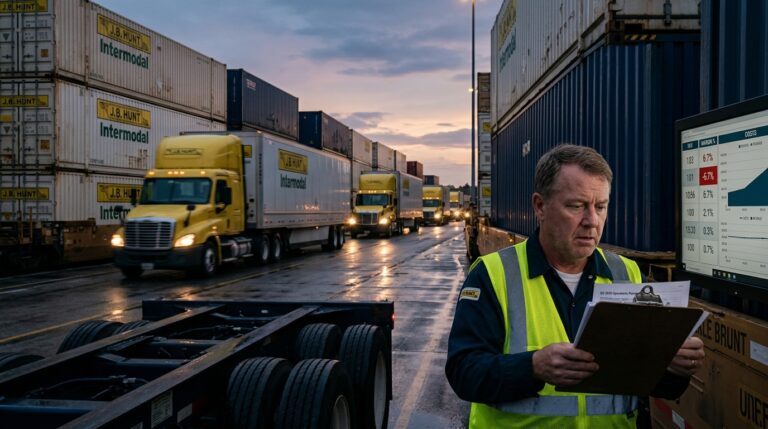
Revenue streams span bulk commodities (grain, coal, fertilizer), industrial freight (chemicals, metals, plastics, petroleum), premium intermodal containers, and automotive products. The company invests approximately $10 million per day in its infrastructure, technology, and network.
One more thing worth flagging: UNP is in the middle of a proposed $85 billion merger with Norfolk Southern that would create America’s first transcontinental railroad. The Surface Transportation Board has requested additional information, and a 2027 close remains the target. That process matters for the long-term story, but it is not the core thesis here.
The Numbers
Q1 2026 results, reported April 23, were the strongest first quarter in company history across operating revenue, operating income, net income, freight revenue, and freight revenue excluding fuel surcharge.
- Q1 2026 EPS (adjusted): $2.93 – beat consensus of $2.85–$2.89
- Q1 2026 operating revenue: $6.2 billion, up 3% year-over-year
- Freight revenue: up 4% year-over-year
- Net income: $1.7 billion, up 5% year-over-year
- Reported operating ratio: 60.5%, improved 20 basis points
- Adjusted operating ratio: 59.9%, improved 80 basis points
- Full year 2025 EPS: $11.98 (record); net income up 6%, EPS up 8%
- Full year 2025 return on invested capital: 16.3%
- 2026 guidance: mid-single digit EPS growth off the $11.98 base
- Current stock price: ~$268 | Market cap: ~$159 billion | P/E: ~22x
- 52-week range: $210.84 – $279.70
The Q1 beat prompted a 6–7% single-day move in the stock. Management acknowledged headwinds from higher fuel costs and softer international intermodal, but offset both through pricing and efficiency gains. The stock remains below its 52-week high, which is part of what makes this conversation worth having right now.
Investors are watching this fast-growing tech company
No, it’s not Nvidia… It’s Mode Mobile, 2023’s fastest-growing software company according to Deloitte.
Their EarnPhone has helped users earn and save over $1B, driving $115M+ in revenue and an eye-popping 32,481% revenue growth. And having secured partnerships with Walmart and Best Buy, Mode’s not stopping there…
Like Uber turned vehicles into income-generating assets, Mode is turning smartphones into an easy passive income source. The difference is, investors like you still have a chance to invest in Mode’s pre-IPO offering at $0.52/share.
They’ve just been granted the stock ticker $MODE by the Nasdaq and over 59,000 investors participated in their previous rounds.
$71M+ already invested – claim your stake at $0.52/share and earn up to a 20% bonus
Please read the offering circular at invest.modemobile.com. This is a paid advertisement for Mode Mobile’s Regulation A Offering.
Why This Stock Matters Right Now
Three things are converging that did not exist simultaneously a year ago. Each one benefits Union Pacific directly.
First: the Hormuz crisis is forcing a structural rethink of global supply chains. Vessel transits through the Strait have fallen 95% – from an average of 129 per day in February to roughly six in March. UNCTAD has warned that global merchandise trade growth will halve in 2026 as a direct result. Businesses that initially treated this as a short-term event are now planning for sustained alternative routing through the second half of 2026 and beyond. When both major maritime corridors are blocked, overland freight does not just become an option – it becomes the only option for large categories of cargo.
Second: nearshoring is not a theory anymore. As manufacturing has shifted from China to Mexico over the past several years, Union Pacific’s cross-border gateways have become some of its most strategically valuable assets. The company offers customers access to all six major gateways on the U.S.-Mexico southern border. In Q1 2026, Union Pacific hauled a record grain volume – surpassing its prior Q1 record from 2008 – driven in part by high demand from Mexico. The company is also developing the 2,000-acre Mainline Texas Industrial Park near Houston, positioned along its main rail line with access to major gateways including Laredo, Eagle Pass, and El Paso.
Third – and this is the part people skip – fuel surcharges. Union Pacific’s intermodal fuel surcharge stood at 31% in January 2026. By April 2026, as Brent crude climbed above $90 per barrel on Hormuz supply concerns, it had jumped to 50.5%. That is not a minor adjustment. That is a direct, systematic pass-through of rising energy costs to corporate clients. The mechanism is structural: when diesel prices spike, surcharge revenue climbs nearly in lockstep. In Q1 2026, fuel surcharge revenue was a cited driver of overall revenue growth. Shippers absorb it. Union Pacific collects it.
Slight tangent, but worth noting: the rail industry’s fuel efficiency advantage – one gallon of diesel moving one ton of freight approximately 450 miles – becomes a more compelling value proposition for shippers precisely when fuel costs are high. The more expensive energy gets, the wider the cost gap between rail and truck. This is not a small thing in a $90+ Brent environment.
Macro Context
The 2026 Hormuz closure is categorically different from prior maritime disruptions. The Red Sea crisis created a reroutable problem. Hormuz does not. There is only one way in and out of the Persian Gulf, and it is currently controlled by Iran. Even after a formal ceasefire – if and when one arrives – logistics experts warn that weeks of suspended trips, diverted cargo, and stressed feeder networks will take months to clear. Hapag-Lloyd’s senior communications director put it plainly: when the war is officially over, that does not mean the war is over for logistics.
This is accelerating a structural shift that was already underway. Cross-border corridors in North America are drawing capital as supply chains reroute around geopolitical risk. Manufacturing shifts to Mexico are adding density to north-south rail lanes, lifting cross-border volumes by double digits. The rail freight transport market – estimated at $340.5 billion in 2026 – is expected to reach $423.9 billion by 2031, with containerized and intermodal freight growing at a 6.23% CAGR. That is the backdrop Union Pacific is operating in.
There is also a longer-range question forming about the geopolitical risk baseline for all chokepoint-dependent trade flows. The events of 2026 have demonstrated that maritime chokepoints are active instruments of geopolitical coercion. The market is beginning to price in that this is not a one-time event.
Forward Scenarios
Bull Case
The Hormuz disruption persists through late 2026. Nearshoring volumes accelerate as multinationals lock in Mexico-based manufacturing to reduce maritime exposure. Fuel surcharge revenue remains elevated, padding top-line growth even as carload volumes face pressure. Core pricing continues at 3–4% above inflation. The Norfolk Southern merger clears the STB by late 2027, unlocking $2 billion in targeted net new revenue and creating a 50,000-mile transcontinental network spanning 43 states and 100 ports. Stock targets the $295–$305 range cited by Susquehanna, BMO, and Jefferies.
Base Case
A partial Hormuz reopening occurs in Q3 2026, easing energy prices and trimming fuel surcharge revenue. Nearshoring volumes sustain mid-single digit growth. EPS grows in line with management’s guidance of mid-single digits off the $11.98 base. The merger process drags but ultimately advances. Stock trades in the $265–$280 range, roughly in line with current levels and the consensus $291 target remaining a 12-month objective.
Bear Case
A comprehensive peace agreement reopens Hormuz quickly, oil prices fall sharply, and fuel surcharge revenue collapses. A broader economic slowdown pressures freight volumes across all categories. The STB blocks or substantially delays the Norfolk Southern merger. Volume weakness from softer international intermodal worsens. Stock revisits the $210–$230 range seen in the prior 52-week low. This is the scenario where the bull thesis unwound faster than most modeled.
“$893 Profit in 8 Days, on My First Trade.”*
A former hedge fund manager will show you how to “skim” profits from the oil markets, without owning a single oil stock.
*The investment results described in this testimonial is not typical. Investing in securities carries a high degree of risk; you may lose some or all of the investment.
Technical Overlay
UNP is currently trading near $268, sitting roughly 4% below its 52-week high of $279.70 and well above the 52-week low of $210.84. The stock surged over 6% in a single session following the Q1 2026 earnings release on April 23, reaching a new 52-week high at that time before consolidating. That post-earnings gap represents a meaningful support zone in the $255–$262 range.
The $279–$280 zone is the near-term ceiling to watch. A sustained move through that level on volume would signal a broader re-rating toward analyst targets in the $285–$305 range. On the downside, a break below $255 would suggest the post-earnings move is being given back and warrants reassessment of near-term momentum.
P/E of roughly 22x is a modest premium to the broader market, justified by the infrastructure moat, consistent EPS growth trajectory, and 16.3% return on invested capital. The quarterly dividend of $1.38 per share reflects a 127-year payout streak – not nothing when you are building a position in a volatile macro environment.
What Investors Should Watch
- Hormuz status: Any durable reopening compresses the fuel surcharge thesis quickly. Watch Iran-U.S. negotiations for credible resolution signals vs. continued diplomatic theater.
- Fuel surcharge trajectory: The April 2026 surcharge hit 50.5%. Any sustained move above that level on persistent oil price pressure directly expands UNP’s top line.
- Carload volumes in Q2 2026: Q1 saw 1% fewer carloads despite revenue growth. Management flagged capacity and readiness for volume acceleration. The Q2 2026 earnings release – expected July 23 – will test whether volume recovery is materializing.
- Mexico cross-border data: Monitor USTR and AAR cross-border rail statistics. Nearshoring volumes are the multi-year growth engine; any meaningful deceleration there changes the long-term case.
- STB merger review: The Surface Transportation Board paused its review to seek additional information. Any acceleration or formal denial of the Norfolk Southern application is a significant catalyst in either direction.
- Analyst revision cycle: With a median target around $275–$281 and top targets at $305, the next revision wave will likely follow Q2 results. Earnings estimate momentum is worth tracking closely.
Bottom Line
The debate around Union Pacific tends to get framed around volume cycles and merger risk. That framing misses what is actually happening in 2026.
A closed Strait of Hormuz, combined with accelerating nearshoring from Mexico and a fuel surcharge mechanism that automatically passes energy cost inflation to customers, has created a rare alignment of structural tailwinds for a company that already holds an unmatched infrastructure position. You cannot build a competing western U.S. railroad. The land is spoken for. The track is down. The regulatory barriers are real.
What changes this story is a quick and credible peace deal that durably reopens the strait and collapses energy prices. That is the primary risk. It is a real one. But even if it happens, the nearshoring volume growth and the long-term structural shift away from single-corridor maritime dependency do not reverse overnight.
The question is not whether UNP is a good company. Everyone agrees it is. The question is whether the market has fully priced the duration and depth of what a prolonged Hormuz disruption means for North American land freight. Based on where the stock sits today relative to analyst targets, the answer may be no.
For informational purposes only.