
June 9, 2026
What Happens to Your Retirement When SpaceX Goes Public
Featured –
Nvidia: Strong Fundamentals, Bigger Question
Dear Reader,
When the SpaceX IPO hits, trillions of dollars inside the financial system will move.
Not toward you.
Fund managers liquidate. Institutions rebalance. Wall Street reshuffles to capture the payday of a decade. Your retirement sits inside that machinery. You don’t get a vote on which direction it moves.
You never did.
That’s the part no one is talking about.
Physical gold held outside the banking system works differently. No fund manager can rebalance it. No institution stands between you and it. No IPO frenzy touches it.
We put together a Free 2026 Gold Guide explaining exactly how to move a portion of your retirement outside the system tax-free, penalty-free, and in days.
It costs nothing. Takes 30 seconds to request.
While everyone else is looking at SpaceX, this is the move to protect your wealth from what’s coming.


Nvidia: Strong Fundamentals, Bigger Question
Analyst Price Targets
- Bank of America: Buy – $275 (reiterated, citing AI platform momentum and strong cash returns)
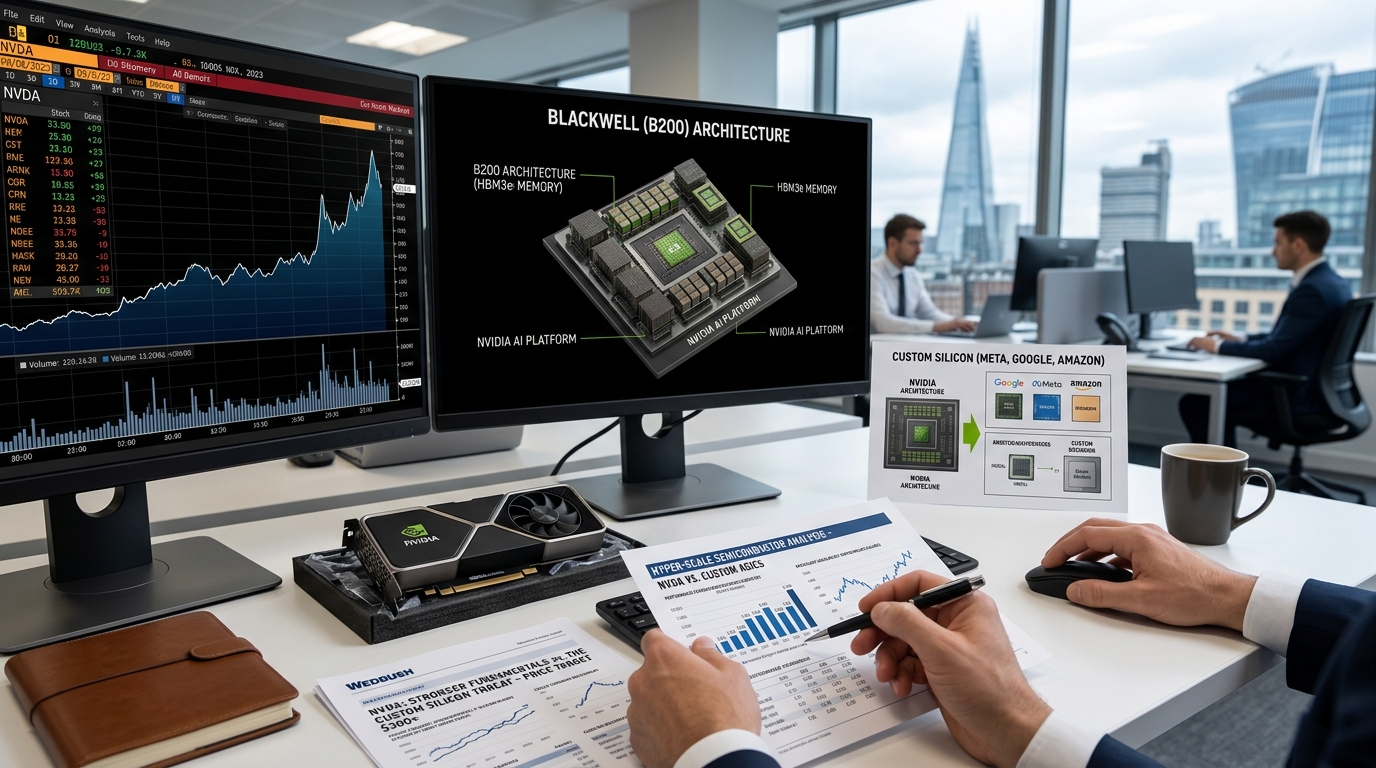
- Wedbush: Buy – $300+ (bullish on Blackwell ramp and sovereign AI expansion)
- Wall Street Consensus (62 analysts): Strong Buy – Average 12-month target ~$298–$305
- Implied upside from current ~$208: approximately 43–47%
Why Nvidia Is Moving Today
Nvidia (NVDA) is trading higher in Monday’s session, recovering alongside the broader semiconductor complex after a sharp sector-wide selloff last week erased roughly $1.3 trillion in chip-related market value. Dip buyers are back, and NVDA is one of the clearest beneficiaries.
What’s interesting is that the stock is climbing even as the central debate around it intensifies: Alphabet reportedly placed an order with Intel for more than three million tensor processing units targeting 2028 delivery. That’s not a small signal. It’s the kind of news that, in a different market regime, would have hammered NVDA. Instead, buyers stepped in.
The market is pricing something specific here: that demand for AI compute is expanding fast enough to absorb both Nvidia’s GPU dominance and the parallel rise of custom silicon – at least for now.
Company Profile
Nvidia operates as a data center-scale AI infrastructure company, with two primary segments: Compute & Networking, and Graphics. The Compute & Networking segment – which houses Data Center, AI software, InfiniBand and Spectrum-X Ethernet, autonomous driving platforms, and robotics – is the engine driving every major financial metric. Graphics, which includes GeForce GPUs for gaming and Quadro/RTX products for enterprise workstations, remains substantial but has become secondary to the AI infrastructure story.
The company holds an estimated 70–80% share of the merchant AI accelerator market. That moat is built on silicon, but it’s reinforced by software. CUDA – Nvidia’s proprietary developer ecosystem – remains the dominant framework for AI model training and inference. Competitors can build faster chips. Displacing CUDA is a different problem entirely.
The Numbers
The most recent quarter – Q1 FY2027, reported May 2026 – delivered $81.6 billion in revenue, up 85% year-over-year and 20% sequentially. Data Center revenue came in at $75.2 billion, up 92% from a year ago, driven by the ramp of Blackwell 300 products and demand for InfiniBand and NVLink networking solutions. GAAP gross margin was 74.9%. Net income reached $58.3 billion, up 211% year-over-year. Diluted EPS of $2.39 GAAP, with non-GAAP EPS at $1.87.
For context, full fiscal year 2026 (ended January 2026) posted $215.9 billion in revenue – a 65% increase over the prior year.
- Q1 FY27 Revenue: $81.6B (+85% YoY, +20% QoQ)
- Data Center Revenue: $75.2B (+92% YoY)
- GAAP Gross Margin: 74.9%
- GAAP Net Income: $58.3B (+211% YoY)
- GAAP Diluted EPS: $2.39 (+214% YoY)
- Full FY2026 Revenue: $215.9B (+65% YoY)
- Next Earnings: August 25, 2026 (est.)
- Market Cap: ~$5.05 trillion
- 52-Week Range: $140.86 – $236.54
One notable shift: hyperscaler revenue held at approximately 50% of Data Center, while the remaining 50% came from AI clouds, industrial, enterprise, and sovereign customers. That diversification is meaningful. It means Nvidia’s growth is no longer fully tethered to spending decisions at just three or four companies.
The Custom Silicon Threat: Real, But Overestimated Right Now
Here’s where it gets genuinely complex. Alphabet, Amazon, and Microsoft have all moved beyond experimental phases into deploying large-scale fleets of custom-designed AI silicon. Google’s Ironwood TPU (v7), Amazon’s Trainium series, and Microsoft’s Maia 200 – built on TSMC 3nm with over 140 billion transistors – are live, production-grade chips optimized for their specific model architectures. Meta is spending up to $135 billion on AI infrastructure in 2026 alone, with Broadcom custom ASICs as a central pillar.
ASIC-based AI server shipments are projected to reach 27.8% of the market in 2026, growing at 44.6% year-over-year – nearly triple the 16.1% growth rate projected for merchant GPUs. Broadcom alone carries a $73 billion AI backlog and is targeting $100 billion in annual AI chip revenue by 2027. That’s not a rounding error.
Slight tangent, but it matters: OpenAI – arguably Nvidia’s most strategically important customer – is now developing its first custom AI chip with Broadcom, targeting deployment in 2027. When the company that effectively launched the modern AI era starts building its own hardware, the direction of travel is clear.
But here’s the structural reality: the developer ecosystem is still overwhelmingly built on CUDA. Overcoming that requires hyperscalers to invest heavily in compilers and open-source frameworks. That’s a multi-year software problem, not a 2026 risk. And even analysts who view the custom silicon trend most bearishly concede that Nvidia will maintain dominance in the merchant GPU market for the foreseeable cycle.
Forward Scenarios
- Bull Case: Blackwell Ultra ramp accelerates through H2 2026. Vera Rubin platform – targeting up to a 10x reduction in inference cost – broadens the addressable market further. Sovereign AI and enterprise deployments diversify revenue away from hyperscaler concentration. Stock re-rates toward analyst consensus of $298–$305.
- Base Case: Solid revenue growth continues into Q2 FY27 (guidance: ~$78B, excluding China Data Center compute). Hyperscaler custom silicon captures incremental inference workloads but doesn’t materially displace Nvidia at scale. Stock range-trades between $200–$240 pending August earnings confirmation.
- Bear Case: China export restrictions deepen. Q2 FY27 guidance of ~$78B already excludes any Data Center compute revenue from China – a meaningful headwind. If hyperscaler capex moderates or custom silicon ramps faster than expected, multiple compression could push the stock toward the $160–$175 range. The forward P/E near 21x would need to hold, and that’s not guaranteed in a risk-off environment.
Technical Overlay
NVDA is recovering from last week’s selloff that pushed the stock into the $206 area. The 52-week range sits between $140.86 and $236.54, meaning the stock is trading roughly in the middle of its annual band – not extended, not deeply discounted. The $205–$210 zone has proven to be near-term support twice in recent weeks. The $226–$236 zone represents near-term resistance and the upper boundary of recent consolidation. A confirmed close above $236 would be the first clear technical signal of a resumption toward analyst targets. Until then, this is recovery within range.
What Investors Should Watch
- August 25, 2026 earnings: Q2 FY27 results will be the first clean read on the Blackwell Ultra ramp without China Data Center noise
- Hyperscaler capex guidance: Any sign of slowdown from Alphabet, Amazon, or Microsoft in upcoming earnings would hit NVDA sentiment directly
- Custom silicon adoption curves: Watch for enterprise adoption data on Google Ironwood TPU and Amazon Trainium – these are the early indicators of longer-term share shift
- CUDA ecosystem competition: Progress on open-source ML compiler frameworks (particularly Triton) is the long-term risk Nvidia monitors most closely
- China policy: Any reversal or modification of H20 export controls could be a significant positive catalyst – or a further restriction could add incremental revenue headwind
Bottom Line
The custom silicon expansion at hyperscalers is real, it’s accelerating, and it’s structurally important. But the timeline for it to meaningfully displace Nvidia at scale is still measured in years, not quarters. The CUDA moat is a software problem that custom hardware alone doesn’t solve. Meanwhile, Nvidia’s Q1 FY27 revenue of $81.6 billion – up 85% year-over-year – reflects a company whose growth is broadening beyond its original hyperscaler base into enterprise, sovereign, and industrial markets.
The real debate isn’t whether custom silicon is a threat. It clearly is. The question is whether Nvidia can grow its total addressable market fast enough that even a 15–20% shift in inference workloads toward custom ASICs still leaves it with a larger absolute revenue base. The August earnings report will be the next major data point on that question.
For informational purposes only.