
August 31, 2026
This tiny piece of glass could be bigger than GPUs
Bonus Content: One Chip Market, Two Different Cycles
Hi,
Take a look at this…
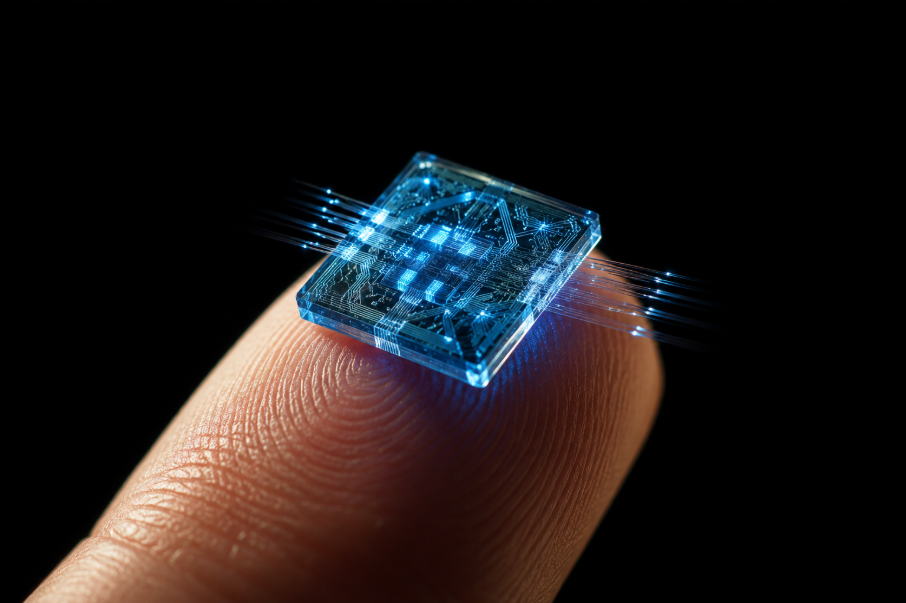
It’s smaller than a fingertip…
It’s made of glass…
And it’s about to unlock the next wave of AI growth.
Jensen Huang, Nvidia’s CEO, says this “light-speed” device is shattering the limitations of AI… and without it, AI can’t scale.
Google Ventures says it’s the future of AI compute…
And Sequoia Capital – the firm that backed Anthropic and OpenAI – calls it a “holy grail.”
Already, Elon Musk, Mark Zuckerberg, Cathie Wood, and Bill Gates are moving money to prepare for what’s coming…
Yet most Americans have never heard of it.
Wall Street insider Jason Bodner – the same man who called Nvidia at $4.50 – says this device is about to launch a whole new wave of AI winners…
And to prove it, he’s giving away his #1 stock involved with it – for free.
Click here to learn more. (No purchase necessary.)
We have so much to look forward to,
Jeff Brown
Founder & CEO, Brownstone Research
P.S. Stocks tied to this “light-speed” device already surged 133%, 217%, and even 320% – in a few short months. But it’s just getting started. Click here before the mainstream catches on.
One Chip Market, Two Different Cycles
The number looks extraordinary. WSTS now projects global semiconductor sales at roughly $1.65 trillion in 2026, a figure that would represent about 108% growth from 2025’s $795.6 billion. SIA reported Q2 sales alone at $403.3 billion, up 35.1% sequentially. Equipment makers are riding the wave too: SEMI expects capital equipment sales to reach $165.9 billion this year, a 23.2% increase.
Stop there. Because what the aggregate conceals is more important than what it reveals.
The Fracture Line
Memory is projected to grow roughly 250% in 2026. Logic is up approximately 37%. Analog is tracking around 10%. Sensors and optoelectronics: 3%. An industry growing over 100% in aggregate, while its product categories range from 3% to 250%, is not experiencing one uniform cycle. That dispersion is the story, and investors pricing semiconductors as a single trade are doing it wrong.
The split runs along a clear fault line. On one side: leading-edge logic, high-bandwidth memory, advanced packaging, high-speed networking, and optical connectivity. These segments are capacity-constrained, pricing is firm, and allocation is the only conversation that matters. HBM capacity is widely described as sold out through the end of 2026. Micron has said its HBM supply for calendar 2026 is sold out, and industry commentary has repeatedly pointed to tight HBM availability at the other major suppliers as well. TrendForce forecasts server DRAM contract prices rising 13% to 18% quarter-over-quarter in Q3 2026 alone, following sharp DDR5 and broader DRAM price moves as wafer capacity has been reallocated toward HBM production.
On the other side: analog, MCUs, automotive logic, mature nodes, and smartphone SoCs. Smartphone SoC shipments fell 15% year-over-year in the first half of 2026, according to Counterpoint Research. Qualcomm handset revenue declined 13% year-over-year in its fiscal second quarter of 2026. Higher memory costs are squeezing smartphone manufacturers into cutting production of lower-margin models. This is AI demand creating collateral damage in consumer electronics.
Where the Pressure Is Showing
The supply chain tightening is not limited to advanced nodes. A Q3 2026 supply chain update from Garner Osborne Circuits identified a decisive move into more restricted conditions across PCB materials, components, and upstream raw inputs, with structural demand growth and geopolitical pressures expected to influence availability well into 2027.
Memory inventory at the three major producers has been described by industry analysis as roughly 3 to 5 weeks of supply, far below prior-cycle levels that often precede downturns. New capacity takes 18 to 24 months to bring online, which means meaningful supply relief is unlikely before 2028. Reuters reported in June 2026 that Morgan Stanley has described the pricing dynamic as “chipflation,” framing it as a structural shock rather than a normal cyclical move.
What Investors Should Watch
- Inventory days outstanding across analog and MCU suppliers: the recovery signal for the lagging half of the cycle
- DRAM spot prices: stabilizing in August, but the trajectory through Q4 determines whether the memory super-cycle cools or extends
- Automotive logic demand: growing around 6% while AI compute accelerators expand far faster, meaning auto-exposed names remain among the weakest performers in the sector
- Equipment spending: bullish for demand confirmation now, but a $165.9 billion capex year plants the seeds of a future oversupply condition
Bottom Line
The $1.65 trillion headline is real. So is the divergence buried inside it. The companies worth owning right now are those with direct exposure to HBM, advanced packaging, and AI infrastructure interconnects. The analog and mature-node recovery is coming, but it is a 2027 trade, not a 2026 one. Treating this as one semiconductor cycle will produce the wrong answer on both sides of the fault line.