June 16, 2026
A massive Fed surprise is coming soon…
Featured – American Airlines: The Fuel Trade Just Got Very Real
Editor’s Note: Larry Benedict – the hedge fund legend who beat the S&P 500 by 18 times in 2025 and made his clients $95 million during the 2008 crisis – says Trump’s installation of a new Federal Reserve chair is triggering the most significant shift in U.S. markets in nearly 20 years. He has already identified the one ticker he believes will be at the center of the money flows – and he’s revealing it completely free. Read more below…
Dear Reader,
The market is about to fall.
Click here to hear what Larry is saying now.
Two years later, Larry told a reporter that another massive collapse was coming.
Again, few believed him.
The S&P fell 20%. The Nasdaq lost a third of its value.
But Larry went 11 for 11 that year, including recommending one trade that returned 117% in under a month.
Now Larry Benedict is speaking out again.
He says a historic shift is coming to the Federal Reserve, and what follows will likely create the biggest divide between market winners and losers in nearly 20 years.
He’s urging everyone he knows to get positioned in one specific ticker before it arrives.
Click here to hear exactly what Larry is warning about right now.
Best wishes,
Lauren Wingfield
Managing Editor, The Opportunistic Trader
P.S. The last time the Fed made a shift this significant – 2022 – Larry’s readers had the chance to double their money in under a month.
American Airlines: The Fuel Trade Just Got Very Real
Analyst Targets
- Morgan Stanley – Overweight | Target: $24 (raised from $20)
- JPMorgan – Overweight | Target: $20 (raised from $17)
- Deutsche Bank – Buy | Target: $18 (raised from $13)
- UBS – Buy | Target: $18 (raised from $16)
- TD Cowen – Hold | Target: $17 (raised from $10)
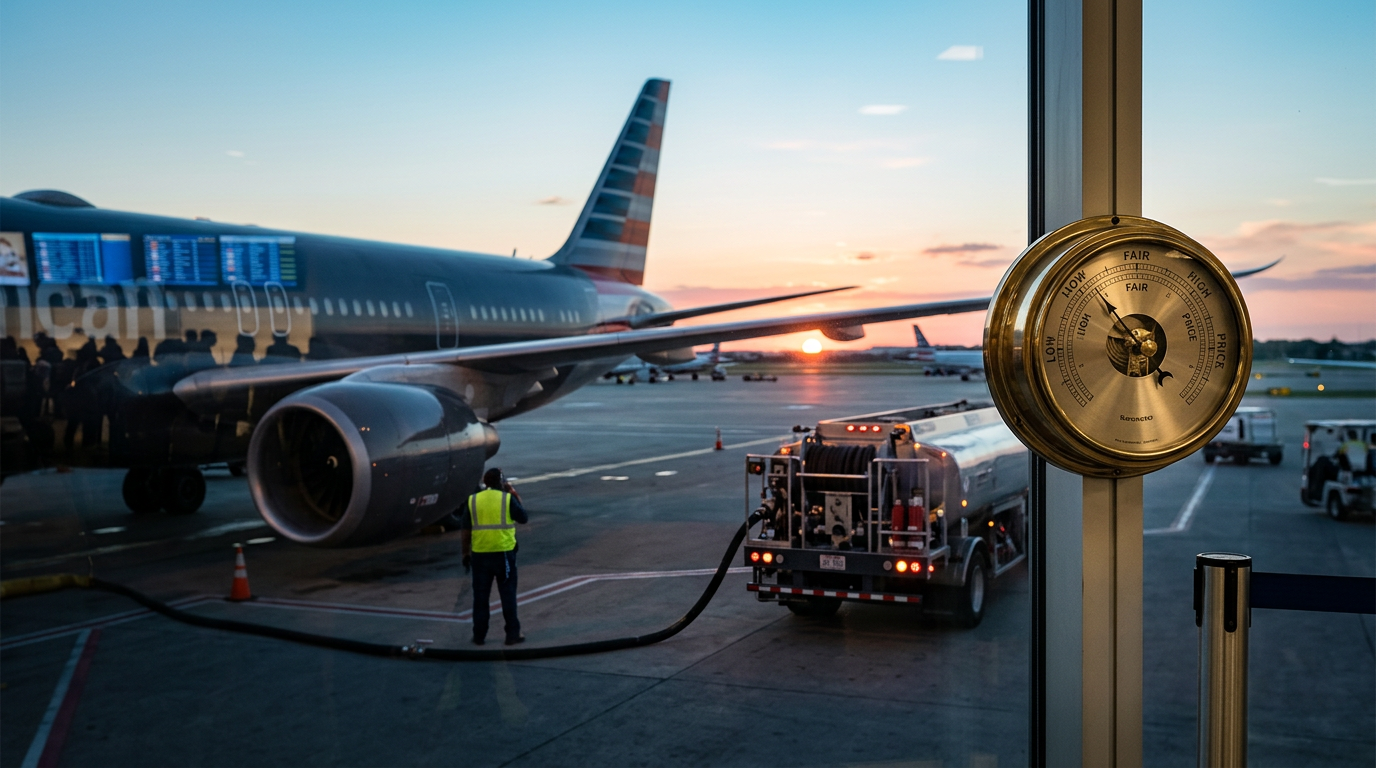
Something shifted overnight. The U.S. and Iran agreed to a peace framework, and the first place it showed up was in the energy market. WTI crude closed down 4.8% to $80.75 a barrel. Brent dropped 4.7% to $83.17. Heating oil, a direct proxy for jet fuel, fell more than 3.5%. For airlines, that is not a background event. That is a direct hit to their single largest cost line.
American Airlines (AAL) opened Monday trading up roughly 3.44%, with shares pushing toward $15.50 from a May low near $13.59. The move is clean and measured – not a panic squeeze, not a one-day anomaly.
The whole sector moved. American, United, Delta, and Southwest each posted gains of 3% to 4% in overnight activity. But AAL has a specific reason to attract attention beyond the macro trade.
Company Profile
American Airlines Group (NASDAQ: AAL) is a Fort Worth-based holding company operating one of the world’s largest airline networks. The carrier serves passengers and cargo across Domestic, Latin America, Atlantic, and Pacific segments through hubs in Charlotte, Chicago, Dallas/Fort Worth, Los Angeles, Miami, New York, Philadelphia, Phoenix, and Washington, D.C. International partner gateways include London, Doha, Madrid, Sydney, and Tokyo. The mainline fleet runs 1,013 aircraft. As of mid-June 2026, the company employs approximately 139,100 people. Full-year 2025 revenue came in at $54.63 billion.
The 2026 Elon Crash
Every bank in America is now facing an imminent crisis. One that could see trillions of dollars rush out of the traditional financial sector… and into a new store of wealth.
Ultimately, this could trigger a collapse of the entire banking system. The catalyst isn’t the war in Iran, rate cuts, or pumped-up AI stocks… It’s Elon Musk.
This has to do with a new project he’s just launched that almost no one is talking about (except this one banking insider). It’s a direct threat to every bank in America, including yours.
Why This Stock Is Moving Today
The peace framework between the U.S. and Iran is the event. President Trump confirmed the lifting of the U.S. naval blockade and the imminent reopening of the Strait of Hormuz to commercial shipping after more than 16 weeks of closure. That waterway handles a meaningful portion of global energy flow. Its effective closure since late February pushed oil up more than 50% in March alone – the largest monthly gain since May 2020.
Airlines absorbed most of that. The International Air Transport Association (IATA) had already downgraded its industry profit outlook, projecting airline fuel costs would reach $350 billion in 2026 – up from $252 billion in 2025. That figure represents nearly one-third of total industry operating expenses. Even with strong passenger demand and revenue tracking toward $1.17 trillion industrywide, the fuel burden had become a margin problem the sector could not offset through ticket pricing alone.
Monday’s oil move starts to close that gap. Not all the way – Brent is still roughly $11 above pre-war levels, and the fundamental floor sits closer to the $68-$75 range that prevailed before the conflict. But the direction is clearly shifting, and airlines are priced in that direction before the official open.
Slight tangent, but worth noting: WTI at $80.75 is its lowest close since the first week of March. The war premium – estimated at $25 to $30 per barrel at its peak – is largely gone. What remains is a residual uncertainty premium, and that fades incrementally each time the deal holds.
AAL’s Layered Catalyst Stack
This is where it gets more specific to American. The fuel trade is real, but AAL also entered this week carrying a fresh batch of Wall Street upgrades that had nothing to do with Iran. Earlier in June, UBS, Deutsche Bank, and Morgan Stanley all raised price targets – collectively pushing their range to $18-$24 against a stock sitting near $14 at the time. The reasoning was consistent across all three: debt reduction, free cash flow durability, and expected EPS growth above consensus heading into 2027.
Add in the company’s June announcement of a Starlink Wi-Fi partnership covering more than 500 narrowbody jets starting in Q1 2027, a 35-million-gallon sustainable aviation fuel deal with Google, and a planned expansion of its Hyderabad tech hub – and you have a carrier that is not simply riding macro currents. It has product-level catalysts stacking alongside the geopolitical trade.
That combination – cost relief from oil, improving analyst conviction, and internal operational investment – is what gives this morning’s move more structure than a typical macro-driven gap.
Forward Scenarios
- Bull Case: The peace framework holds, the Strait of Hormuz fully reopens within 30 days as agreed, and oil continues pulling back toward the $68-$75 pre-war range. Jet fuel costs compress materially in Q3. AAL margins expand, analyst estimates move higher, and the stock closes the gap toward the $20-$24 target range Wall Street has already assigned.
- Base Case: Oil stabilizes in the low-to-mid $80s as residual uncertainty prevents a full unwind. AAL benefits modestly from lower fuel costs, sustains its current uptrend, and trades in the $15-$18 range through summer. Travel demand remains strong, partially offsetting any remaining margin pressure.
- Bear Case: The ceasefire breaks down. The Strait remains restricted. Oil rebounds toward prior highs, and the war premium returns. AAL loses its recent gains quickly. The stock’s net income trajectory – already challenged, with Q1 2026 posting a net loss of $382 million – deteriorates further and forces guidance cuts.
Technical Overlay
From its May low near $12.11, AAL has staged a roughly 28% recovery. The stair-step structure is constructive: higher lows at $13.50, $14.00, then near $14.65, with buyers consistently stepping in on dips. The stock is trading near the top of its 52-week range and above its 200-day moving average – a technical position that tends to attract trend-following capital. Near-term resistance is the $16-$17 zone. A clean hold above $15 on a closing basis keeps the short-term structure intact.
What to Watch
- Whether the Strait of Hormuz fully reopens on the 30-day timeline specified in the peace agreement
- Jet fuel prices in coming weeks – heating oil already dropped 3.5% Monday, but the sustained trend matters more
- AAL’s next earnings report for Q2 fuel cost data and updated full-year guidance
- Analyst estimate revisions following the oil move – several firms are likely to revisit 2026 and 2027 models
- Whether summer travel demand meets the strong booking signals management cited heading into Q3
Bottom Line
The central question for AAL was never really demand. Bookings are strong. Revenue is growing. The problem has been cost structure, and the primary culprit has been fuel. Monday’s oil move is the first credible relief valve the sector has seen in months. For American specifically, it arrives on top of a round of analyst upgrades, a cleaner balance sheet trajectory, and product investments that were already beginning to shift the story.
Whether $80 oil holds is not guaranteed – the deal still has fragile elements, and there are over 800 tankers currently restricted in the Strait whose movement in the coming days will tell you whether this unwind is real or a head fake. But if the framework sticks, the margin math for U.S. airlines changes meaningfully in the second half of 2026. AAL, at current prices, is one of the more direct ways to be positioned for that outcome.
For informational purposes only.