June 12, 2026
SpaceX IPO and the Musk Premium
The stock jumped, Musk crossed $1T on paper, and valuation discipline got tested on day one.
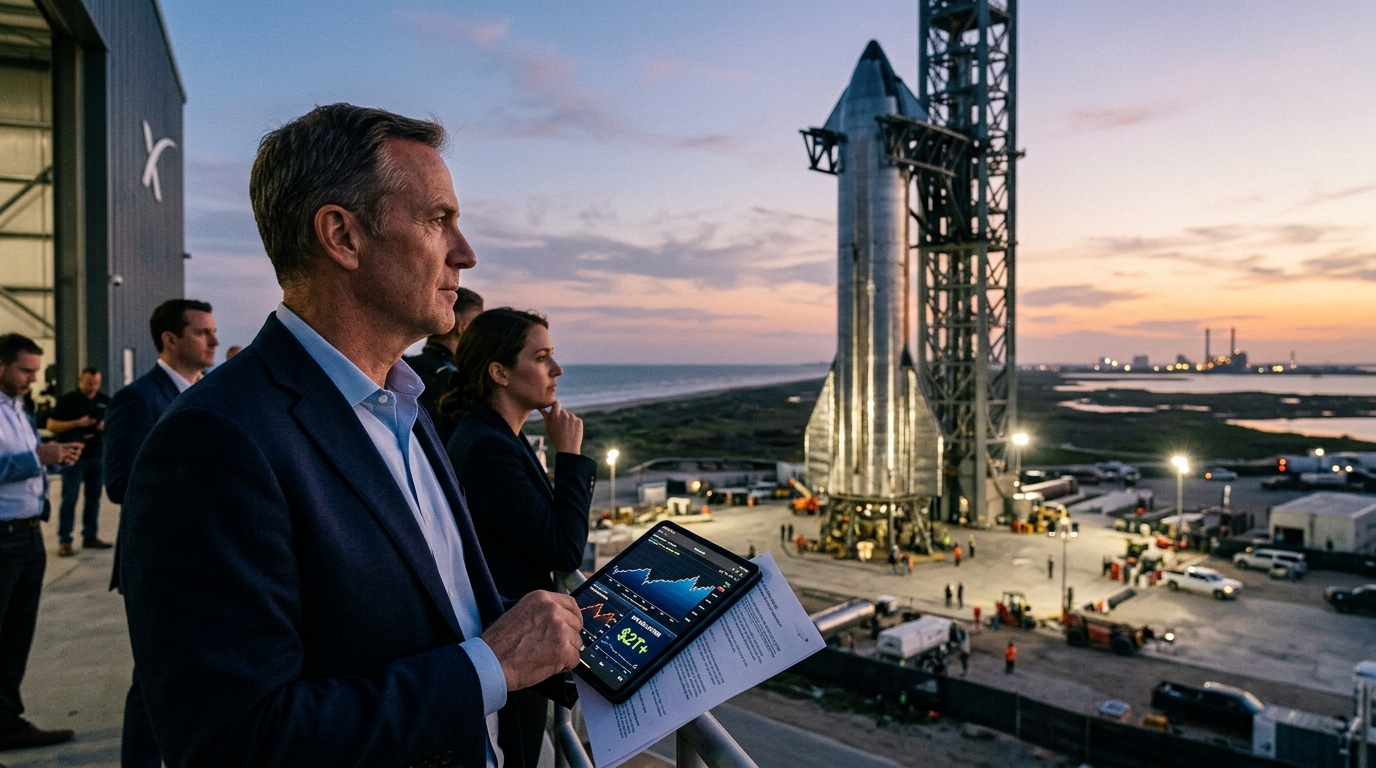
SpaceX went public and the market did what the market does in 2026: it turned a corporate event into a referendum on one person.
Not rockets. Not satellites. Not even cash flow. Elon.
Where the stock landed, fast
- IPO price: $135 per share.
- Capital raised: $75 billion, the largest IPO on record.
- Debut levels: shares opened near $150 and traded as high as $166.90 early in the session.
- Implied market value: about $1.97 trillion at $150 and about $2.18 trillion near $166.90.
The wealth headline followed immediately. AP reported that, after the debut, Elon Musk became the world’s first trillionaire on paper, with Forbes estimating his net worth around $1.1 trillion.
Missed Tesla? PayPal? SpaceX? You Might Regret Missing This One Too…
Many are calling him The Next Elon Musk…
His first company made investors 6,566% before the age of 25…
Now, he’s building one of the most-anticipated companies in the world… with $26 billion in government contracts already in place.
And one rare 4-letter ticker gives you early access – before the IPO.
What investors are actually buying at $2T plus
A $2 trillion valuation forces you to be honest about what is being priced in. You are not buying “a launch company.” You are buying a platform thesis where multiple engines work at once, and where execution speed is treated like a competitive advantage in its own right.
SpaceX has three pillars in the public story:
- Launch: a critical supplier to the U.S. government and commercial customers, with a moat built on cadence and cost.
- Starlink: a global connectivity product that can compound if subscriber growth holds and unit economics improve with scale.
- Long-cycle optionality: ambitions that stretch beyond communications, including space-based infrastructure concepts that investors are now paying for before they exist at commercial scale.
Slight tangent, but it matters: the biggest day-one moves tend to happen when the product story is easy to repeat at a dinner table. “Musk built it” is easy to repeat. A discounted cash flow model is not.
The pushback is not subtle
Institutional skepticism showed up in print immediately, and it is pretty specific. Morningstar called the IPO “significantly overvalued” and put fair value at about $780 billion, citing unproven technology and massive capital needs. That is not a small disagreement. That is a different universe.
Axios also flagged that SpaceX entered the market at roughly 90 times sales. That multiple can be defensible only if investors believe revenue expands rapidly and margins eventually become exceptional. The problem is that “eventually” is doing a lot of work in that sentence.
Macro context: why this worked right now
Risk appetite is still high, and the market has been rewarding companies that can plausibly touch three spending pools at once: defense budgets, connectivity, and AI infrastructure. SpaceX sits close enough to all three that buyers can tell themselves they are diversified while owning a single ticker.
There is also a behavioral angle. The biggest IPO ever creates its own gravity. People do not want to “miss” it. That is not a valuation argument, but it is a real driver of demand.
Massive 512,000-Line Data Leak Exposes Shocking AI Breakthrough
60-year Wall Street veteran and financial technology pioneer Marc Chaikin recently reviewed a massive data leak inside one of the world’s biggest AI labs. He discovered a hidden mechanism in the code that could create extraordinary wealth for savvy investors – and inflict grave financial hardships on everyone else.
Bull, Base, Bear
- Bull case: Starlink scales into a high-margin global network, launch stays dominant, and new space infrastructure lines become investable businesses. The market keeps awarding Musk-led execution a premium.
- Base case: Starlink growth is strong but more price-competitive than hoped, margins improve slowly, and launch remains excellent but not enough to justify $2T by itself. Shares grind while expectations cool.
- Bear case: capital intensity stays heavy, timelines slip, or regulation and spectrum constraints bite harder than expected. A premium multiple compresses quickly when profitability is not in sight.
Technical overlay
There is an obvious near-term range: $135 is the anchor because it is the IPO price, $150 is the first widely watched round level, and the $166.90 area is the early high that will attract attention on any pullback or rebound. If the stock holds above $150 on weakness, it signals demand is still deeper than skeptics expected.
What I’m watching next
- Starlink economics: subscriber adds, churn, and any disclosure around average revenue per user.
- Capital spend pacing: does the company keep stepping on the gas, or does it show discipline now that it has public scrutiny.
- Path to profitability: AP reported SpaceX lost $8.7 billion from the start of 2025 through March 31, 2026. That makes the next few quarterly disclosures critical.
- Analyst target drift: does the Street chase the stock higher, or do targets stay anchored to more conservative valuation work like Morningstar’s.
Bottom line
The first day did not settle the debate. It simply priced the debate.
The Musk Premium is real, and you can argue it is earned. But at roughly $2.0 to $2.2 trillion, buyers are paying not only for category leadership, but for multiple additional businesses to emerge on schedule and at scale. If that happens, today’s price will look early. If it does not, the stock does not need bad news to fall, it just needs time.