July 5, 2026
SpaceX Joins the Nasdaq-100 Monday
Featured: SpaceX Joins the Nasdaq-100 Monday
Dear Trader,
My top income trading expert, Dave Aquino, just released a 1-hour trading strategy designed specifically to help regular investors generate enough income to become financially independent…
Without taking on excessive amounts of risk.
I’m talking about having the opportunity to collect $500 on Monday…
$563 on Wednesday…
Then as much as $625 on Friday.
Week in. And week out.
To better trading,
– Drew Day
Partner
Base Camp Trading
FEATURED
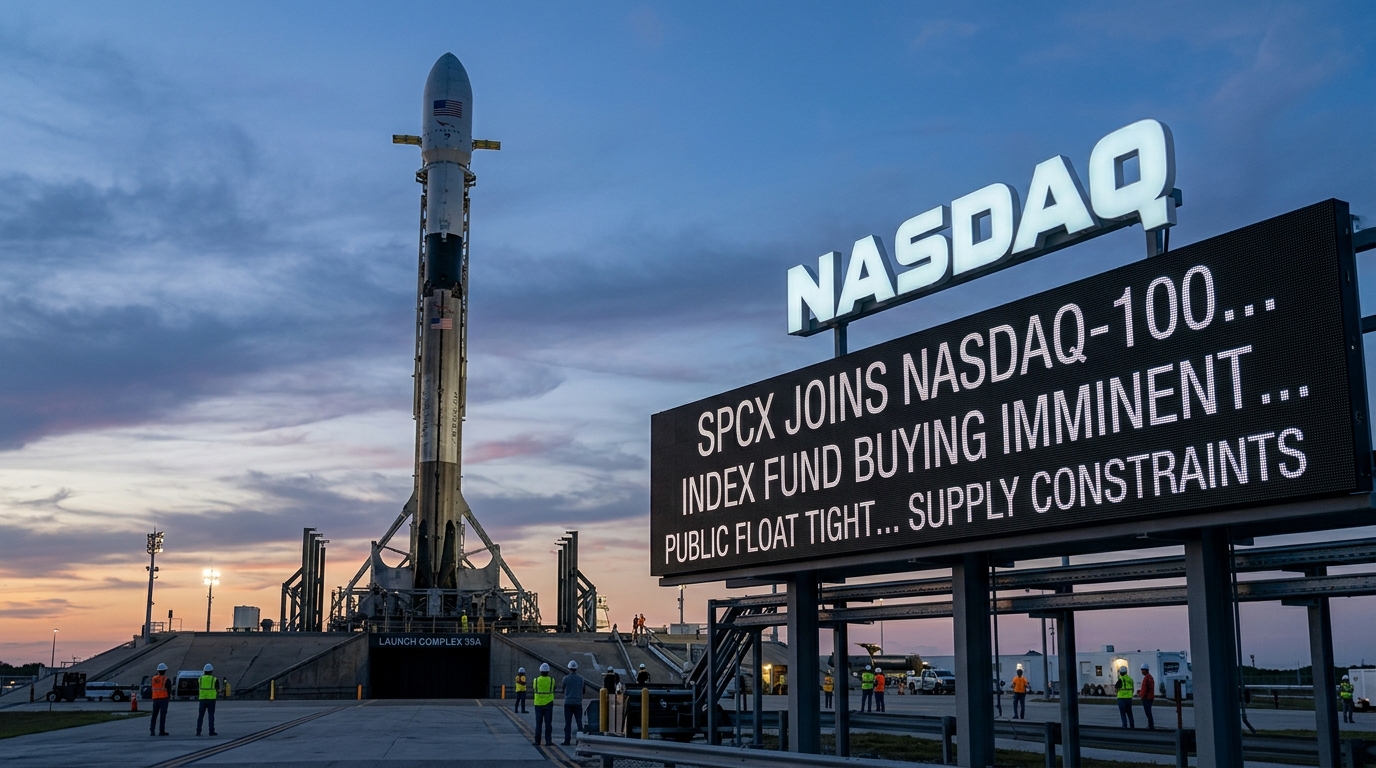
- SpaceX (SPCX) joins the Nasdaq-100 before market open on July 7, just 15 trading sessions after its June 12 IPO, one of the fastest Nasdaq-100 inclusions on record for a newly listed company.
- Passive index-tracking products are estimated to purchase roughly $4.3 billion in SPCX shares as a direct result of the Nasdaq-100 rebalancing, hitting a public float of only 3–5% of 13.16 billion shares outstanding.
- SPCX peaked at $225.64 on June 16 and last closed at $162.00 on July 2, down approximately 28% from that high, with the 52-week low of $147.11 set on June 23 serving as the key floor to watch.
- Analyst coverage is expanding: Wedbush (Outperform, $190), Oppenheimer (Outperform, $250), Susquehanna (Neutral, $170), with a consensus average around $188 per S&P Global and roughly $211 per TipRanks across 9 analysts. Morningstar carries a bear-case fair value of $63.
- SpaceX reported trailing twelve-month revenue of $19.3 billion through Q1 2026, with 2025 full-year revenue of $18.67 billion. At a market cap of approximately $2.13 trillion, the stock trades at roughly 110x trailing sales, compressing toward an estimated 54x on projected full-year 2026 revenue of $38.6 billion if AI compute contracts hold.
- The first public earnings report is scheduled for August 6, which is also expected to trigger the initial lockup release window, introducing new supply into a stock that has traded on structural scarcity since listing.
- Historical data on 35 Nasdaq-100 additions (announced at least 10 days in advance) since 2022 shows an average first-day loss of 1.13% and an average five-day loss of 3.41%. High-profile additions have broken that pattern in both directions, and SPCX’s constrained float introduces dynamics that historical averages do not fully capture.
The Mechanics Most Coverage Is Missing
The index inclusion is confirmed. That part is not in dispute. What is interesting is the collision between the forced-buy mechanics and the supply reality.
SpaceX Just Went Public. Here’s What Nobody’s Telling You to Do Next.
The headlines are calling it the wealth event of our generation.
But the trader whose research has been sought out by legends like Stan Druckenmiller says everyone’s watching the wrong thing.
The real fortune-making move isn’t buying SpaceX.
Instead, it’s positioning yourself for what he calls the “Aftershock” BEFORE it hits.
Click here now to see how Aftershocks have made people rich.
Every ETF, pension, endowment, and passive vehicle that mirrors the Nasdaq-100 must hold SPCX at its index weight starting July 7. That is not discretionary. It is structural. Nasdaq officially confirmed the addition on June 26, and estimates put the forced buying from Nasdaq-100 trackers alone at roughly $4.3 billion in shares. The broader figure, including Russell index reweighting, could be materially larger.
Here is where it gets interesting. SpaceX has approximately 13.16 billion shares outstanding. Only about 3–5% of those are in the public float, meaning the freely tradable supply available to satisfy that index demand is extremely thin. Funds that anticipated the rebalance have already been buying. The pre-positioning crowd likely pulled forward some of the mechanical demand ahead of Monday. The question heading into the week is whether the buying was front-run fully or whether Monday still delivers a genuine supply squeeze.
The AI Revenue Layer
The skeptical case on SPCX almost always anchors to the trailing financials: $19.3 billion in TTM revenue, a GAAP net loss, a valuation near $2.13 trillion. At roughly 110x trailing sales, the argument writes itself.
The problem with that framing is that it ignores the post-xAI merger revenue composition. The February 2026 acquisition of Elon Musk’s xAI brought the Colossus compute cluster onto SpaceX’s books alongside AI compute contracts already generating cash. Oppenheimer noted SpaceX signed over $26 billion in annualized data center capacity deals, including Colossus compute agreements with Anthropic worth $1.25 billion per month and Google worth $920 million per month, though both carry 90-day termination clauses. Stack those against Q1 2026 revenue of $4.69 billion and the company’s annualized run rate looks materially different from the trailing number most bear cases are quoting. The forward multiple on $38.6 billion in projected 2026 revenue compresses to roughly 54x — still expensive, but no longer absurd by the standards of this market’s treatment of high-growth infrastructure names.
Slight tangent, but it matters. Starlink is the only segment currently generating a profit. The Connectivity business had around 12 million subscribers as of early July, with average revenue per user of approximately $66 across its consumer and enterprise fleets. The Space segment covers Falcon 9 and Starship launch operations. The AI division, added through xAI, incorporates Grok, the X platform, and the Colossus data center infrastructure. That is a very different business than investors thought they were buying when the IPO priced at $135.
Sector Backdrop and Macro Context
The S&P 500 closed at 7,483 on July 2 and the Dow closed at a record 52,900. The Nasdaq, by contrast, fell 0.8% as semiconductors dropped for a second straight session. Tech stocks broadly surged through the first half of 2026, and profit-taking rotation is now underway. Chipmakers fell sharply heading into the holiday weekend as investors questioned whether AI optimism had pushed valuations beyond supportable levels.
That rotation matters for SPCX in a specific way. As capital moves from pure semiconductor and software names toward companies with real asset bases and revenue visibility, SpaceX sits at an unusual intersection of old-economy infrastructure (rockets, satellites, ground stations) and new-economy AI monetization. That combination is rare in the Nasdaq-100. Most constituents are software or chip companies. SpaceX is something different, and the index’s composition changes meaningfully when SPCX enters at its sub-1% weighting.
The Lockup Clock
The most underappreciated risk in the SPCX trade is the lockup calendar. The August 6 first earnings report is expected to coincide with the initial lockup release window, with roughly 20% of locked insider shares becoming eligible for sale. Additional tranches unlock at subsequent intervals tied to performance triggers and time-based schedules, with a substantial portion releasing at the 180-day mark in December 2026.
That timeline matters because the forced-buying window from the Nasdaq-100 inclusion occurs entirely before any meaningful supply from insiders enters the market. The July 7 rebalancing demand hits a float of only a few hundred million tradable shares. Once August 6 arrives, the supply equation changes. Traders who enter around the inclusion event need to hold that dynamic clearly in their risk framework.
Your Free Options Book Is About to Vanish
In case you missed it… make sure you get your free “Simple Options Trading For Beginners” book before your link expires.
I eventually plan to charge money for this training, so do yourself a favor and download it now…
That way, no matter what it costs in the future, you’ll have a free copy.
Sound good?
Scenario Modeling
Bull Case
SPCX breaks above recent resistance on the forced-buy volume Monday, triggers short-covering, and pushes toward analyst targets in the $190–250 range. Oppenheimer raised its target to $250, citing SpaceX’s position across the entire AI stack. Wedbush is at $190, also Outperform. The AI compute revenue ramp validates the forward multiple, and the August 6 earnings report shows revenue materially above the trailing run rate. The stock stabilizes well above its IPO price before lockup shares come to market.
Base Case
The inclusion triggers a brief spike Monday as passive rebalancing flows hit the thin float, then the stock fades as pre-positioned funds take partial profits. The $162 area holds through mid-July. The real test becomes the August 6 earnings report. If AI segment revenue is disclosed with specificity and confirms the annualized AI contract figures, the stock likely moves higher ahead of the first major lockup expiration. Consensus stays in the $188–210 range until earnings give the market something concrete to work with.
Bear Case
Historical Nasdaq-100 addition data suggests the average five-day post-inclusion loss is 3.41%. If the forced buying was already fully absorbed by front-running funds, Monday’s open produces a sell-the-news response. SPCX drifts back toward the $147–150 zone. The August 6 earnings report disappoints on GAAP profitability even if revenue beats, triggering the first lockup release into a stock already under pressure. Downside risk toward the $135 IPO price comes into play if institutional holders reassess the 110x trailing revenue multiple in a risk-off environment. Morningstar’s bear-case fair value sits at $63, a reminder of how wide the valuation debate actually is.
Active Trader Framework
The $162 area is the level to watch going into Monday. That is where the stock closed heading into the holiday. A sustained move above that level with volume confirming that index buying is absorbing available supply rather than just moving price temporarily is the signal that the inclusion is acting as a genuine catalyst rather than a pull-forward of demand.
The $147.11 level is the 52-week low and the floor worth watching on weakness. A break below that on meaningful volume before the August 6 report would be a warning that the lockup discount is being factored in early.
Options traders should note the asymmetry carefully. The low float creates conditions where short-dated call options could move rapidly on a supply squeeze, but the same low float means bid-ask spreads in options may be wide and fills unpredictable. Position sizing discipline matters more than usual here. Volatility expectations heading into the August 6 earnings report will likely expand, creating opportunities on both sides of the vol market for those who monitor implied volatility rank carefully.
Why is Elon giving away money?
Elon Musk wants to send you money. It’s a free bonus if you sign up for his new bank. Lots of people are already flocking to the bank – including Star Trek star William Shatner.
What the market may be underestimating is not the July 7 event itself — that is widely covered — but the compound effect of the Nasdaq-100 inclusion combined with the first public earnings disclosure and the first lockup expiration, all stacked within a 30-day window starting Monday. That is a lot of event risk concentrated in a very short time in a stock with one of the thinnest floats in the large-cap universe.
Know your levels. Know the lockup dates. Size accordingly.
For informational purposes only.