July 8, 2026
Burry Just Shorted Micron
Record quarter, sold-out HBM, and the most famous short-seller alive betting the other way.
First a note from Immersed
This Pre-IPO Stock is Up 4,000% Already
How do you follow 4,000% valuation growth? By preparing for an IPO.
That’s what Immersed did, reserving the NASDAQ ticker $IMRS. And the real opportunity for investors is now, before public markets do.
Why? Immersed changed the game in AR/VR, developing the Meta Quest store’s most popular productivity app. More than 1.5M people, including Fortune 500 teams, already use it up to 60 hours a week.
But that’s not all. Immersed’s soon-to-be-released Visor headset has 2M more pixels than Apple’s Vision Pro, for 70% less money, and with 70% less weight. No wonder they’re projecting $71M in first-year sales.
Here’s how they’re redefining the $250B+ future of work:
Breakthrough Platform: Immersed built the first full-stack remote productivity system, combining immersive AR/VR software, an AI assistant that works alongside you, and its own lightweight Visor headset to replace the traditional desktop.
Massive Momentum: Immersed is preparing to ship Visor, its first productivity-focused headset, with 75,000+ already on the waitlist. Meanwhile, its AI assistant, Curator, is rolling out new features to deepen user engagement and adoption.
Opportunity: You can join 6,000+ pre-IPO investors who have already secured pre-IPO shares in Immersed’s growth.
They have partnerships in place with Qualcomm and Samsung. Executives and founders from Intel, Reddit, and Sailpoint are shareholders. You can be, too. But there’s no time to waste.
FEATURED
Burry Just Shorted Micron
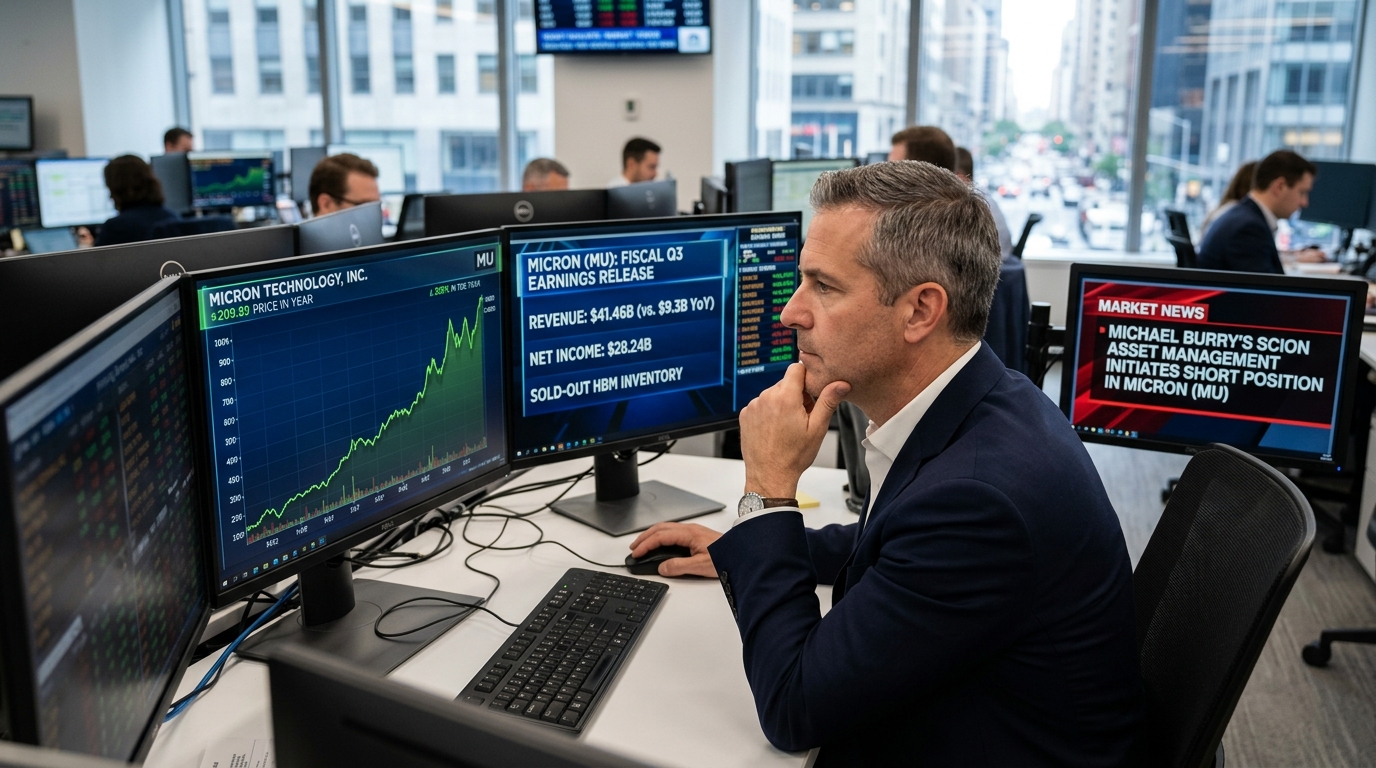
Micron just had the best quarter in its history. Revenue of $41.46 billion, up 346% year over year. Gross margin at 85%. Net income of $28.24 billion versus $1.89 billion in the same quarter last year. Data center revenue alone crossed $25 billion for the quarter. Q4 guidance came in at $50 billion at the midpoint, which beat Wall Street consensus by more than $6 billion. By any reasonable measure, this business is running at a completely different level than it was 18 months ago.
And then Michael Burry shorted it.
On July 2, Burry disclosed via Substack that he entered a short position in Micron at $1,051.87 per share. He said puts looked too expensive, so he went short the stock directly and would look to add puts if volatility cooled. The stock dropped about 5.5% the day the post went live. As of July 7, MU closed at $938.38, down roughly 22.7% from its all-time closing high of $1,213.37 set on June 25.
That’s the situation. Now here’s where it gets interesting.
What Burry Is Actually Saying
His argument is not about Q3 or Q4. It’s about what memory companies always do eventually. He called Micron “the clearest example of cyclicality in the chip sector,” citing 34 drawdowns of more than 30% over the past 42 years. Median return on invested capital of 4%. Median return on equity of 7%. Free cash flow negative roughly 48% of the time historically. These are not numbers you associate with a structurally dominant business.
He also flagged something specific about the technical picture. At the time of his short, Micron was trading farther above its 200-day moving average than at any point since 1984, including the dot-com peak. That is the kind of data point that gets Burry’s attention regardless of fundamentals. His read is that the HBM rally reflects FOMO, not a durable shift in Micron’s long-run earnings power.
Worth noting: this is not a single-stock call. Two days before the Micron disclosure, on June 30, Burry also revealed short positions in Nvidia, Applied Materials, Tesla, and the SOXX semiconductor ETF. He has said AI-related chip stocks are due for a correction on the order of 30%. The Micron short fits inside a much larger sector-level bet.
Slight tangent, but it matters. Burry has been early on cyclical calls before. Not wrong. Early. That distinction is what makes this trade hard to evaluate in real time. Shorts against structurally growing sectors can bleed for a long time before they pay off, if they pay off at all.
The Bull Case Is Not Nothing
Micron has signed 16 multi-year Strategic Customer Agreements with major customers. Fourteen of those 16 include cumulative minimum contract revenue of approximately $100 billion over remaining agreement terms, covering committed volumes through calendar 2030. These are take-or-pay structures. That’s meaningfully different from how memory contracts have been structured historically, and it is exactly the kind of thing that makes the standard boom-bust playbook harder to apply. Management has also said $22 billion in customer deposits and financial commitments are expected under these agreements.
HBM supply is sold out into 2026, with tight conditions expected to persist beyond 2027. Q4 gross margin guidance is approximately 86%. Adjusted free cash flow for Q3 came in at $18.3 billion, a quarterly record. The analyst consensus price target sits around $1,486 based on 45 analysts, with a Strong Buy rating. UBS has said the recent pullback looks temporary and that fundamentals remain strong.
There’s also the Anthropic angle. Micron is Anthropic’s primary memory and storage supplier for next-generation AI systems. The two companies are co-developing HBM and storage technologies, and Micron made a strategic investment in Anthropic’s latest financing round. CEO Sanjay Mehrotra said on the Q3 call that Micron can only fulfill 50% to two-thirds of customer demand in the medium term. Supply shortages, he said, will take considerable time to resolve even as industry supply improves gradually in 2028.
“My system said ‘SELL’ right before this stock tanked. Today, I’m shouting ‘BUY NOW’ before it soars.”
In 2023, Marc Chaikin’s system flashed bearish on an automotive company no one had yet heard of. The stock crashed 35%. Today, his system rates this company “Very Bullish” and Marc calls it a screaming buy thanks to a new “groundbreaking partnership” with Nvidia that hands this company the keys to the self-driving kingdom on a silver platter.
That is not a company on the verge of a demand cliff.
The Wrinkle Landing Thursday
On July 10, SK Hynix begins trading on the Nasdaq as an ADR under the ticker SKHY. The offering targets approximately $29 billion, which would make it the largest ADR listing in history, surpassing Alibaba’s 2014 debut. SK Hynix holds roughly 56% of global HBM revenue. It is Nvidia’s largest memory partner. And now American investors can buy it directly through a standard brokerage account for the first time.
What happens to capital flows around that listing matters a lot in the near term. Some of the money sitting in MU, particularly from investors who want HBM exposure specifically, may rotate into SKHY. That pressure lands on Micron precisely when Burry’s short is already generating negative headlines. It is a crowded moment, and crowded moments in semiconductors tend to produce outsized short-term moves in both directions.
There is also an active class-action lawsuit alleging DRAM price fixing involving Samsung, SK Hynix, and Micron. Not disqualifying. But it adds headline exposure at exactly the wrong time if Q4 results disappoint in any way.
Insider selling has also attracted attention. CEO Sanjay Mehrotra and other insiders have sold over $124 million worth of shares in recent months. That does not confirm Burry’s thesis, but it is the kind of thing that amplifies negative sentiment when a stock is already pulling back.
Where Things Stand Technically
MU closed at $938.38 on July 7, officially in bear market territory, down more than 20% from its all-time high. The stock is showing positive RSI divergence at current trendline support, which some analysts read as a potential bottoming signal. Key resistance is at $1,014. A sustained close above that level would be the first real sign the pullback is over. The 200-day moving average remains well below current price levels, so the longer-term trend is still intact despite the drawdown. The 52-week high is $1,255. The 52-week low is $103.38.
Trump’s Favorite AI Energy Stock??
It’s wildly profitable – Over $3 billion in operating income. It has a partnership with the hottest AI stock on Wall Street.
And Trump has publicly backed it?
What to Watch From Here
- SK Hynix SKHY debut on July 10 and how capital flows in the first days of trading
- HBM spot pricing and any changes in hyperscaler capex commentary heading into earnings season
- Whether Burry adds puts to his position if implied volatility eases
- DRAM price fixing lawsuit developments
- Q4 earnings, currently expected around September 22, and any updates on 2027 and 2028 contract terms
- Samsung’s Q2 results on July 29 and what they signal for memory pricing broadly
Here’s where I’m at on this. Burry is making a cyclical argument against a company that, right now, looks structurally different from the one his historical data describes. Take-or-pay agreements covering $100 billion in committed revenue through 2030 are not a feature of the old memory business. Record margins and sold-out inventory are not the usual conditions preceding a bust.
But Burry does not need to be right immediately. He needs to be right eventually. And memory is a sector where eventually has a way of showing up faster than anyone expects.
The answer is not coming this week.
For informational purposes only.