July 26, 2026
The $16B Kuwait Pipeline Deal
Blackstone, KKR, and Brookfield just closed the biggest foreign investment in Kuwait’s history.
First a note from Mode Mobile
Wall Street just sent investors a loud message.
The Dow hit a fresh record, but the Nasdaq 100 slipped as semiconductor stocks got hammered and the AI trade split in two.
The surprise winner? Software.
Major software ETFs surged and Meta jumped nearly 10% after announcing plans to sell excess AI compute capacity.
The message is clear: AI is no longer just about chips.
It is about software, data, and platforms that can turn everyday digital behavior into value.
That is exactly where Mode Mobile is building.
Mode’s EarnOS rewards users for everyday smartphone activity like browsing, listening, charging, and using apps. In the process, it creates a direct relationship with users and first-party data that could be monetized for AI model training.
The scale is already real:
- 490M+ users
- $115M+ cumulative revenue
- $1B+ earned and saved by users
- 32,481% 3-year revenue growth
- $MODE Nasdaq ticker secured
Deloitte named Mode the #1 fastest-growing software company in North America, and investors can still access shares before a potential IPO at $0.52/share, plus up to 20% bonus shares.
Click here to review Mode Mobile’s $0.52 pre-IPO opportunity now.
The $16B Kuwait Pipeline Deal
Project Peregrine: What Just Happened in Kuwait
A quick note before diving in: this deal is Kuwait, not Saudi Arabia. Worth flagging because the two get conflated constantly in Gulf energy coverage. The counterparty here is Kuwait Petroleum Corporation, the state-owned oil giant, and its upstream subsidiary Kuwait Oil Company. The firms on the other side are Blackstone, KKR, and Brookfield Asset Management. And the number is $16 billion.
That is not a rounding error.
The Deal Structure
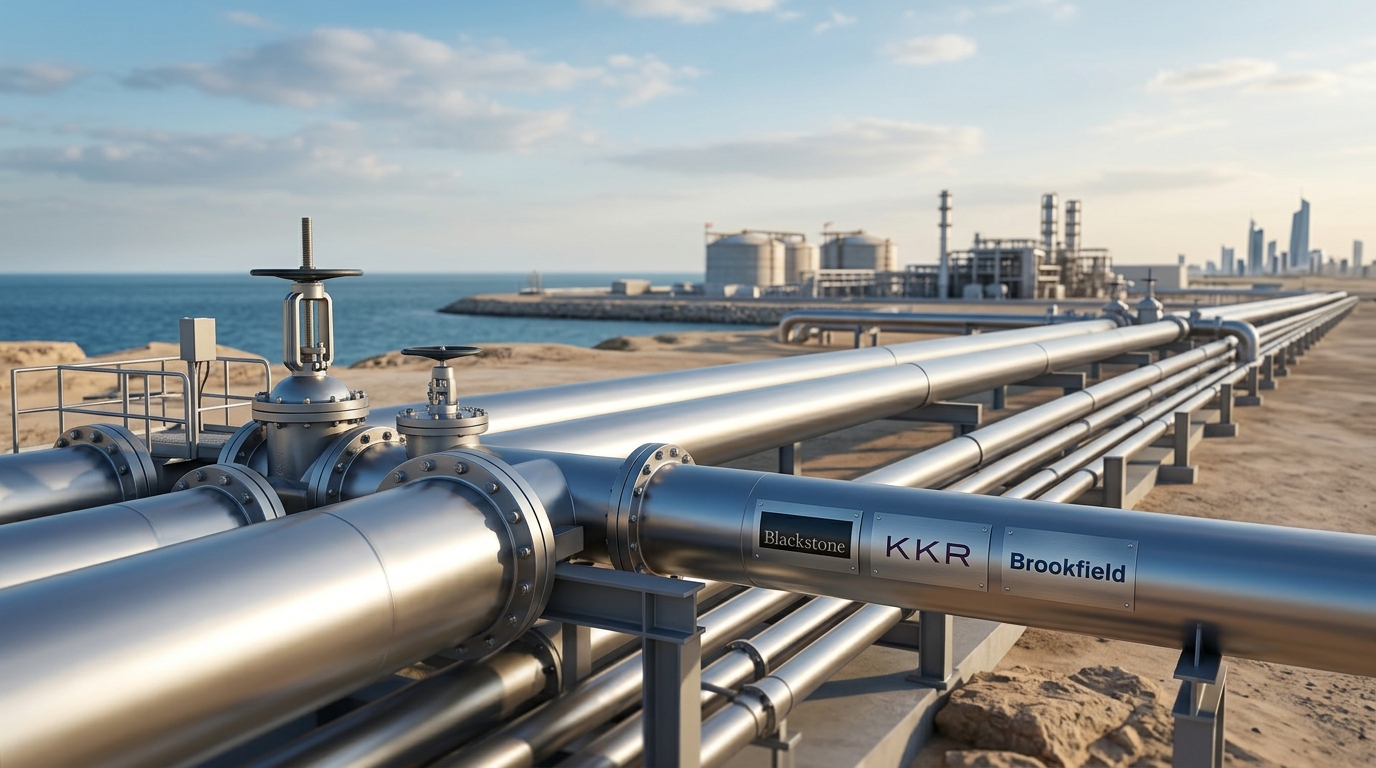
The transaction, formally called Project Peregrine, is a lease-and-leaseback agreement. Kuwait Oil Company (KOC) retains full ownership and operational control of the network. What Blackstone, KKR, and Brookfield are acquiring is economic exposure to the cash flows those pipelines generate over time.
- Deal size: $16 billion
- Structure: Lease-and-leaseback joint venture
- Term: 20.5 years
- Private equity stake: 49% collectively (equal split among the three firms)
- KOC stake: 51% controlling interest, full operational control retained
- Upfront proceeds to Kuwait: $7.85 billion at closing
- Revenue model: Volume-based tariff on crude oil transported
- Network covered: 13 pipelines spanning approximately 320 kilometers (199 miles)
- Financial advisors to KPC: Centerview Partners, HSBC, and JP Morgan
The pipelines link Kuwait’s oilfields to export terminals on the Arabian Gulf. The tariff structure means the three funds get paid based on volume throughput, not oil prices directly. That is a meaningful distinction for how institutional capital underwrites this kind of asset.
Elon’s Latest Take-Over: The U.S. Dollar?
Elon Musk is on the brink of his biggest launch to date. It has nothing to do with satellites… or cars… or even AI. And one analyst close to the story says – it could dwarf all his innovations, combined.
Why This Deal Matters
Kuwait described Project Peregrine as the largest foreign direct investment in the country’s history. That framing is doing real work domestically. But for investors, the more relevant context is what this deal represents in a longer chain of Gulf infrastructure transactions.
The Gulf pipeline monetization wave started with ADNOC in 2019, which sold a 40% stake in its oil pipeline network to BlackRock and KKR. Saudi Aramco followed in 2021. Bahrain’s Bapco Energies came next. Kuwait in 2026 is the model going mainstream. Each successive deal has been faster to close and has drawn a wider pool of institutional capital, because the asset class now has real precedents and years of performance data behind it.
Slight tangent, but it matters: this deal closed while Kuwait is under near-daily attacks from Iran. Kuwait has suffered strikes on its oil infrastructure, including two refineries and KPC’s own headquarters. The country cut production when the Strait of Hormuz was closed and storage tanks filled. Output had fallen to levels not seen since Iraq’s invasion in the early 1990s. Production has since recovered, though exports remain constrained. And yet three of the world’s largest private equity firms still showed up with $16 billion. That tells you something about the risk-adjusted math they’re running.
Who’s in the Room and Why
Blackstone, KKR, and Brookfield collectively manage well north of $2.6 trillion in assets under management. They are not choosing Kuwait because they lack options. This is a deliberate allocation.
- Blackstone manages more than $1 trillion across private equity, infrastructure, and real estate. Its infrastructure strategy is built around predictable, contracted cash flows. A volume-based tariff on a state-owned crude network fits that model precisely.
- KKR has been aggressively expanding its global infrastructure platform into energy, transportation, utilities, and real assets. This is also KKR’s first direct investment in Kuwait.
- Brookfield Asset Management crossed the $1 trillion AUM threshold in 2025, built in large part by owning exactly this kind of long-duration, real-asset yield. One of the world’s largest infrastructure investors, it manages assets spanning energy, utilities, transportation, and digital infrastructure.
When three firms of this size show up together on a single deal, the read is usually that the risk-adjusted return is compelling enough that none of them wanted to pass. It is also a signal to every other sovereign wealth fund and national oil company in the Gulf that this structure works.
Wall Street: “Let Me Buy Your Algorithm”
This 20-year trading veteran once created a stock algorithm so powerful, Wall Street tried to buy it from him. Now, he’s built a BRAND-NEW market-crushing algo… and it’s flashing a HUGE opportunity that’s set to move THIS MONDAY.
Kuwait’s Longer Play
The $7.85 billion in upfront proceeds does not sit in a sovereign account earning nothing. KPC has stated it will support the oil company’s capital expenditure plans, including a target to reach crude output of 4 million barrels per day by 2035. Kuwait currently produces approximately 2.4 to 2.5 million barrels per day under OPEC+ production agreements. Getting to 4 million requires substantial capacity expansion. This deal helps fund that build-out without Kuwait giving up ownership of the infrastructure itself.
That is the whole point of the lease-and-leaseback model. The state gets capital now, keeps operational control, and uses the cash to grow production capacity. The private investors get contracted cash flows tied to throughput volume over two decades. Both sides have a reason to want the pipelines running at full capacity.
Forward Scenarios
- Bull: Kuwait hits its 2035 production targets, throughput volumes on the 13 pipelines remain high, and the volume-based tariff structure delivers consistent returns for the PE funds over the full 20.5-year term. The deal becomes the model for additional Gulf infrastructure fundraisings. KKR, Blackstone, and Brookfield each have a marquee Gulf infrastructure asset on their books heading into the next decade.
- Base: Regional tensions remain elevated but manageable. Kuwait’s production recovery continues at a moderate pace. Throughput volumes hold at current levels, delivering steady but unspectacular returns. The deal earns its cost of capital without being a breakout return driver.
- Bear: Regional conflict escalates further, Strait of Hormuz disruptions become persistent, and Kuwait’s production capacity recovery stalls. Throughput volumes fall short of projections, compressing the volume-based returns. Geopolitical risk that was priced in proves more severe and longer-lasting than the funds modeled.
What Investors Should Watch
- Closing timeline for the $7.85 billion upfront proceeds and when that capital flows into KPC’s capex program
- Kuwait’s crude production trajectory toward the 4 million bpd target by 2035
- Regional conflict developments, particularly any further Strait of Hormuz disruptions or strikes on Kuwaiti oil infrastructure
- Whether additional Gulf sovereigns follow with similar pipeline monetization transactions in the next 12 to 18 months
- How Blackstone, KKR, and Brookfield individually book and communicate this asset in upcoming investor reports
The Elon Crash
Every bank in America is now facing an imminent crisis. One that could see trillions of dollars rush out of the traditional financial sector… and into a new store of wealth.
Ultimately, this could trigger a collapse of the entire banking system. The catalyst isn’t the war in Iran, rate cuts, or pumped-up AI stocks… It’s Elon Musk.
This has to do with a new project he’s just launched that almost no one is talking about (except this one banking insider). It’s a direct threat to every bank in America, including yours.
Bottom Line
The real debate here is not whether Blackstone, KKR, and Brookfield got a good deal. They almost certainly did. The more interesting question is what it means that deals of this size and complexity are closing in a region under active military pressure.
The Gulf infrastructure capital market has developed enough depth that institutional investors are now willing to underwrite geopolitical risk at a scale that would have been unthinkable five years ago. Whether that confidence is justified depends entirely on how the next chapter in the region plays out.
Project Peregrine closed. The bigger question is what comes next.
For informational purposes only.