August 3, 2026
Three Short-Term Bond ETFs Worth Your Attention Right Now
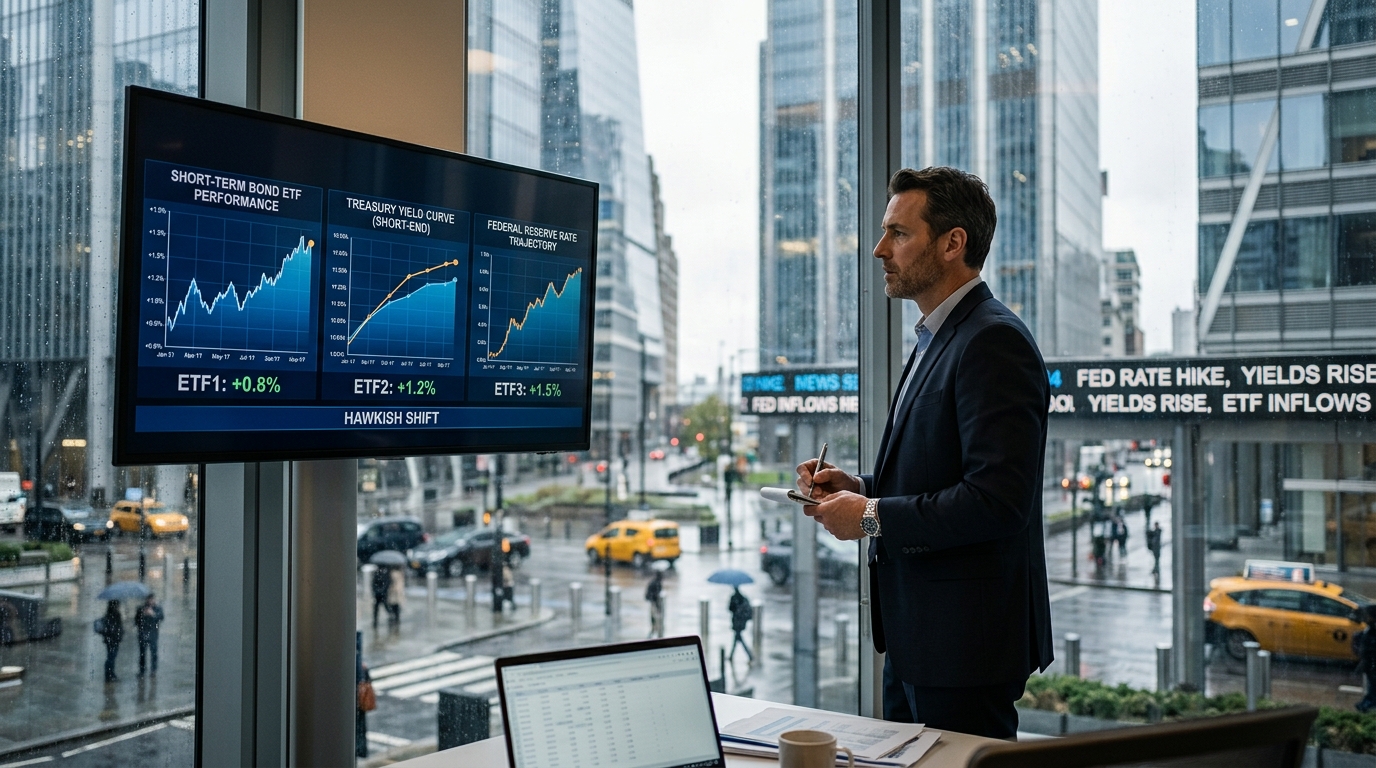
The Fed’s hawkish shift makes the short end of the curve more interesting than it has been in years.
SpaceX just put Big Telecom on notice, telling investors its plans to launch a U.S. mobile service for consumers. For most investors, that sounds like a shakeup for the $1.6T telecom industry.
For Mode Mobile, it could mean more revenue.
More connected phones could mean more places for EarnOS, the platform that turns everyday smartphone activity into earning potential.
Mode already reaches 490M+ users, helped users earn and save $1B+, and generated $115M+ in cumulative revenue. With $MODE secured, investors can still access pre-IPO shares at $0.52/share, plus up to 20% bonus shares.
Get the details before this window closes.
Please read the offering circular at invest.modemobile.com. This is a paid advertisement for Mode Mobile’s Regulation A Offering.
Three Short-Term Bond ETFs Worth Your Attention Right Now
TITLE: Three Short-Term Bond ETFs Worth Your Attention Right Now
SUBTITLE: The Fed’s hawkish shift makes the short end of the curve more interesting than it has been in years.
BODY (HTML):
Here is the thing about short-term bond ETFs. Most investors treat them like a waiting room. You park cash there until something more interesting comes along. That framing is costing people money right now.
The backdrop matters. The Fed held rates at 3.50%–3.75% on July 29, its fifth consecutive hold. But the vote was 9-3, and the June dot plot told a more complicated story: nine of nineteen FOMC members projected at least one rate hike in 2026. The market is now pricing a meaningful chance of a September move. Not a cut. A hike.
That changes the calculus at the short end of the curve in a way that most casual fixed-income coverage is not fully addressing.
Why This Moment Is Different
After a turbulent first quarter marked by the escalation of the Iran war, the bond market found some footing in Q2, though in another challenging stretch for fixed-income investors, the Morningstar US Core Bond Index earned just a 0.10% gain in the first quarter. That is not exactly a ringing endorsement. But the point is not the return on long duration. The point is what is happening at 1–5 years.
The Fed has not made any rate cuts in 2026. The current target range sits at 3.5%–3.75%. That means the short end of the curve is still yielding real income, and if the September meeting produces a hike, the income story gets better, not worse.
Total money market fund assets were $7.9 trillion as of June 10, 2026, up roughly $1.1 trillion from late 2024. That is a wall of cash sitting in funds that will instantly reprice downward if and when the Fed eventually eases. Short-term bond ETFs lock in duration and give investors a way to hold yield rather than just float on overnight rates.
A new way to profit from the AI boom
There is a new way for you to play the AI boom.
One that has nothing to do with buying stocks or guessing who will win the AI race.
Best of all, every 90 days you get fresh chances to make a profit.
It all comes down to what Wall Street legend Larry Benedict calls “AI Profit Loops.”
Played the right way, one of these “Loops” could have turned every $1,000 into $9,000 in a matter of weeks.
Discover how you can get started with “AI Profit Loops” today.
The Three Worth Taking a Closer Look At
VCSH: The Income-First Pick
The Vanguard Short-Term Corporate Bond ETF (VCSH) pays a higher yield and has outperformed its sibling BSV in recent years, while BSV holds a wider array of bond types and has weathered downturns with slightly less volatility. Both are designed for investors seeking modest risk and stable income from bonds with maturities of one to five years, but their approaches differ: VCSH leans into investment-grade corporate bonds, while BSV casts a wider net by including Treasuries, corporates, and select international bonds.
As of early 2026, VCSH posted a one-year return of 6.98% and carries a dividend yield of approximately 4.3%, all at a 0.03% expense ratio. That yield-for-cost ratio is hard to replicate anywhere on the risk-free curve right now.
The trade-off is credit exposure. About 54% of VCSH’s holdings are A-rated bonds and above. However, about 45% are BBB-rated bonds, which are still investment grade but carry greater risk. If the economy softens alongside rate pressure, BBB spread widening is the thing to watch. For investors comfortable with modest corporate credit exposure, VCSH is the stronger income choice.
BSV: The Diversified Anchor
BSV is not a yield maximizer. It is a portfolio anchor. About 70% of BSV’s holdings are in U.S. government bonds, with the remainder comprising corporate debt. Its massive AUM of about $70 billion indicates it is a popular fund.
The main selling points for BSV are its low fees and broad diversification. It charges a 0.03% expense ratio and holds more than 3,100 bonds. The ETF tracks the Bloomberg U.S. 1–5 Year Government/Credit Float Adjusted Index, meaning it owns a mix of Treasuries and investment-grade corporate bonds rated BBB or higher. That gives investors a balanced blend of safety and yield. Its average portfolio duration of 2.6 years helps limit price swings when interest rates move.
BSV suits investors who prioritize stability above all else. In a scenario where September actually brings a hike and credit spreads widen, BSV’s government-heavy tilt becomes a meaningful advantage over pure corporate bond funds.
SCHO: The Treasury Purist
SCHO is designed to track the short-term U.S. Treasury bond market, holding around 97 securities that essentially are all U.S. government bonds maturing within 1–3 years. Most of them are AA-rated, offering an extremely low chance of debt default.
The Schwab SCHO ETF focuses on U.S. Treasuries, ensuring low risk with a roughly 3.81% yield. Yes, that is a lower headline yield than VCSH. But the beta tells the real story. VCSH provides a higher dividend yield, while SCHO offers less volatility with a considerably lower beta. For investors who want income that is essentially immune to corporate credit stress, and who think the macro path stays bumpy, SCHO is the cleaner instrument.
URGENT: A new type of AI could unleash gains of up to 10,000%
You won’t hear this in the media…
But we are at the inflection point right before a new type of AI called “Accelerated AI” explodes into the mainstream… and unlocks an entire new dimension of exponential growth.
If history is any guide, we could be looking at potential gains of up to 10,000% from here.
If you want to find out more about “Accelerated AI” and why it’s about to crack open the next wave of AI profits…
And get the name and ticker of the #1 “Accelerated AI” play everyone should buy right now – for free…
And here is where the Fed backdrop loops back in. With some level of policy rate movement expected, many investors are taking a closer look at their portfolio’s cash exposure. Historically, yields on money-market funds and short-term instruments have reacted to Fed cuts in real time, so attempting to time the market can be perilous if those yields tumble. SCHO sidesteps that by locking in 1–3 year government yields regardless of what the overnight rate does next month.
Which One Fits What Scenario
Short-term bonds often serve as a volatility buffer in a diversified portfolio, providing better returns than cash without the significant price swings associated with long-term debt. Investors choosing between these funds are typically deciding between the relative safety of government-backed securities and the slightly higher income potential found in corporate notes. Both fund types target the one- to five-year maturity segment, providing a balance of stability and income that may appeal to those with shorter time horizons.
The simplest framework for right now:
- If you believe the September FOMC meeting produces a hike and credit spreads hold, VCSH gives you the best income with manageable downside.
- If you want duration protection plus reasonable yield without making a credit call, BSV is the all-weather pick.
- If you want pure Treasury exposure and the absolute minimum in volatility, SCHO is the instrument. Less yield, more certainty.
The Federal Reserve is expected to remain cautious as inflation remains above target and economic growth moderates. Markets have shifted from expecting rate cuts to pricing in the possibility of rate hikes this year. In that environment, sitting in a money market fund and waiting for clarity is a decision too, it just means you are exposed to overnight rate moves instead of managing your duration intentionally.
The short end of the bond market is not glamorous. But right now, it is actually interesting. That does not happen very often.
For informational purposes only.