Editor’s Note: Named the #1 stock picker by TipRanks, Luke Lango has identified 40 stocks before they soared by 1,000% or more. Today he’s betting his reputation on a $15 stock… at the center of a $126 trillion shift. Click here to get the full details or read more below.
Dear Reader,
A tiny $15 stock recently inked a huge contract with SpaceX…
And now some outlets are wondering if it could be “a millionaire-maker stock.”
I’ll say this much…
I’ve recommended 40 stocks that soared by 1,000% or more…
And this investment has all the hallmarks of my biggest winners.
It involves orbital data centers, autonomous drone warfare, artificial superintelligence…
And a $126 trillion plan to irreversibly upgrade human civilization.
Bestselling author Peter Diamandis predicts that it could create…
“A world in which everyone can have access to all the food, water, energy, healthcare, and education that they need and desire.”
Click here to see for yourself!
If you’re only planning to buy one more stock before the end of the year, I recommend making it this one.
Regards,
Luke Lango
Senior Investment Analyst, InvestorPlace
P.S. This SpaceX contract could put this $15 stock on the map in a major way. Click here to discover the full story before the masses get wind of this.
Iron and Sodium Win Billion-Dollar Grid Storage Contracts
The U.S. power system added 8.3 gigawatts of utility-scale battery storage in the first half of 2026, pushing operational capacity to nearly 52 gigawatts. Lithium-ion still dominates that number. But the contracts being signed right now tell a different story about what comes next.
The Duration Problem Lithium Cannot Solve
The four-hour threshold that lithium-ion has long dominated is no longer sufficient for grid operators managing multi-day renewable intermittency. Iron-air, vanadium redox flow, and related technologies each offer a distinct cost-duration profile for the 10-to-100-plus-hour storage market, and the race to commercial scale is accelerating. The cost math is stark: lithium-ion system costs for stationary grid applications are often cited in the low-hundreds of dollars per kilowatt-hour installed, while iron-air developer Form Energy has publicly targeted roughly $20 per kilowatt-hour on a long-duration basis.
Iron’s Unlikely Contract Run
Form Energy’s pipeline six months ago looked ambitious. It now looks conservative. In October 2025, CEO Mateo Jaramillo said the company had more than 200 MW of batteries under contract.
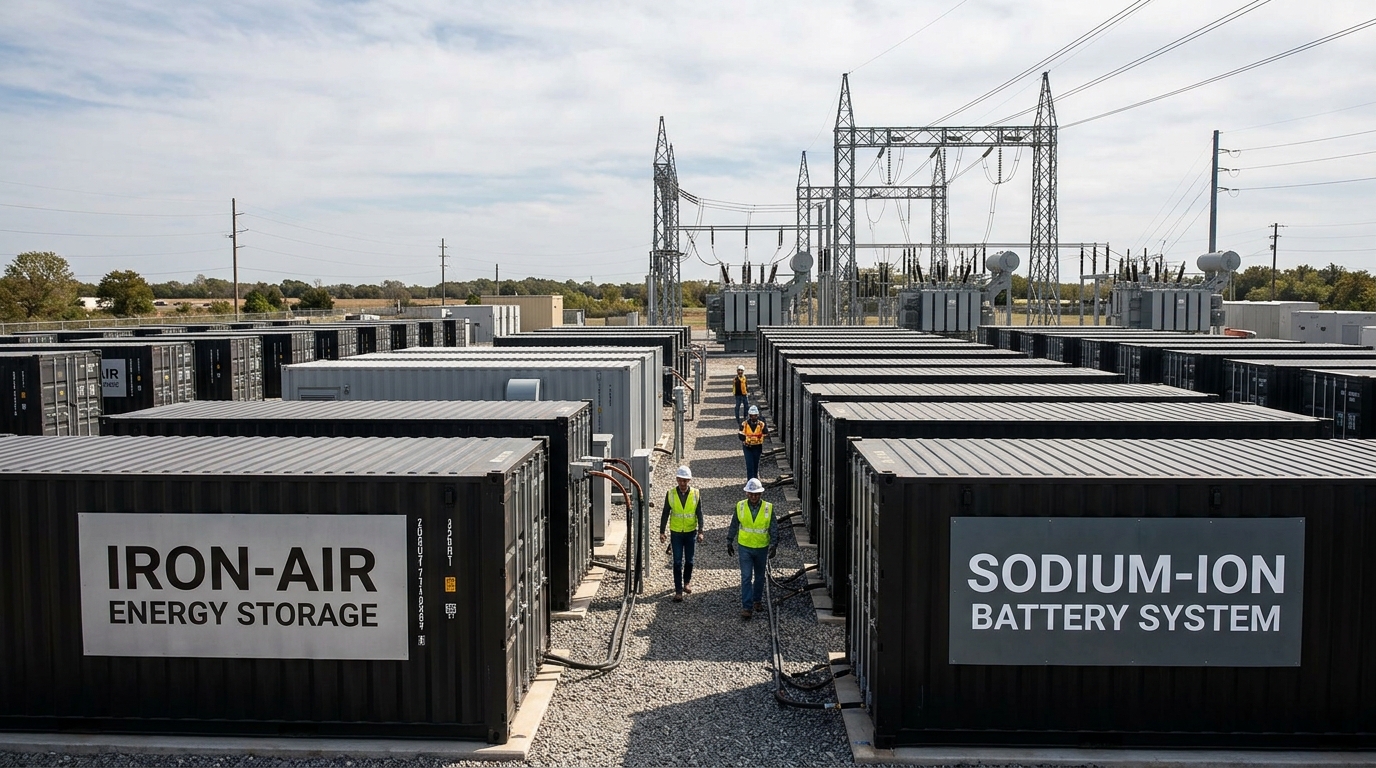
The single largest energy storage project announced globally, measured by watt-hour capacity, pairs Form Energy iron-air batteries with an Xcel Energy agreement supporting a new Google data center in Pine Island, Minnesota at 30 GWh, enabling 100-hour duration dispatch. Form has also signed a separate 12 GWh capacity agreement with AI data center developer Crusoe. Iron and rust, scaled to the gigawatt-hour level.
Sodium’s Quieter Advance
Sodium-ion is gaining ground through a different channel: supply chain politics. Sodium-ion cells do not require lithium, cobalt, or nickel, reducing exposure to supply concentration risks associated with those materials, and sodium-ion chemistries are generally positioned as stronger performers in cold conditions than many lithium-ion variants. In late April 2026, CATL and Beijing HyperStrong announced a three-year, 60 GWh sodium-ion energy storage supply agreement, described by the companies as the world’s largest sodium-ion storage cooperation agreement to date. Domestically, Alsym Energy and Juniper Energy announced a 500 MWh sodium-ion deployment program in California in May 2026.
Why Procurement Is Shifting Now
Beginning in 2026, U.S. tax credit rules tied to “foreign entity of concern” restrictions set a 55% threshold that tightens over time for energy storage technology, rising to 75% after 2029. That framework is pushing procurement teams toward chemistries and supply chains that can more plausibly meet escalating domestic-content and sourcing requirements. Iron is abundant domestically. Sodium is derived from soda ash with significant U.S. reserves.
Communities across the U.S. are also enacting moratoria on battery deployments over fire safety concerns. In New York, industry groups have told state lawmakers that more than 100 local governments have enacted moratoria affecting energy storage projects in the interconnection queue. Non-flammable alternatives can carry a permitting advantage lithium cannot buy.
Bottom Line
The contracts being written today extend 15 to 20 years. Utilities signing iron-air and sodium agreements are not placing technology bets; they are solving a duration problem and a compliance problem simultaneously. The mineral race is not about displacing lithium. It is about capturing the market segment lithium was never built to serve.