The AI infrastructure trade has a new risk factor, and it did not come from an earnings miss or a Fed meeting. It came from a Sunday-night letter.
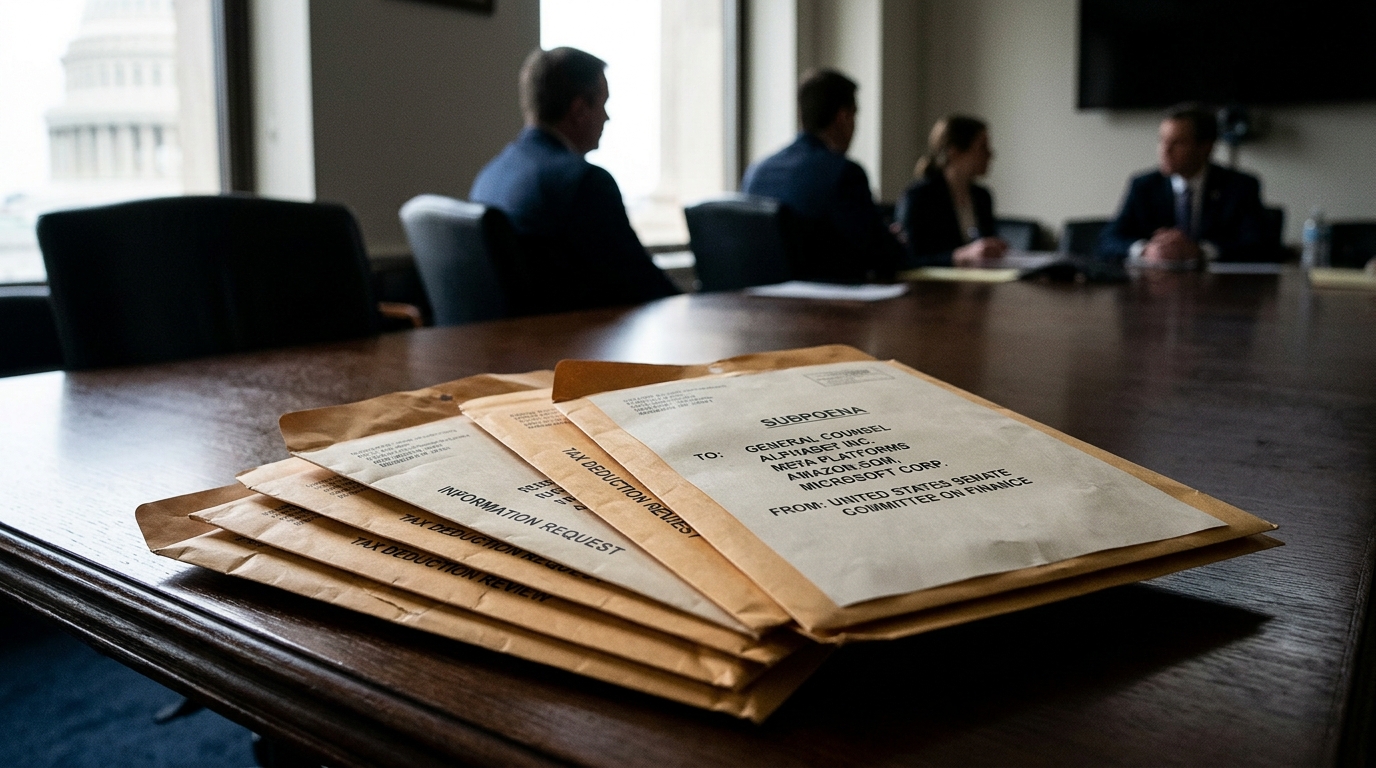
Senate Democrats are seeking information on how AI and data center spending by Meta, Amazon, Alphabet, and Microsoft has been subsidized by tax breaks authorized in the 2025 Republican legislation. Senator Elizabeth Warren led the letters, sent Sunday night and shared exclusively with CNBC, to the CEOs of all four companies. The letters requested that each company explain what deductions it had taken connected to AI and data center investments, and detail any lobbying it conducted before the legislation became law. Responses are due October 11, 2026.
Why Portfolio Managers Are Paying Attention
The surface story is political theater, five weeks from the midterms. The underlying story is a tax-subsidy dependency that has never been fully priced into how the Street models these stocks.
The Congressional Budget Office reported a 25% year-over-year decline in corporate tax receipts based on the first eleven months of fiscal year 2026. The absolute decline was $96 billion, from $390 billion in FY 2025 to $294 billion in FY 2026, on top of a 15% annual decline the year before. The CBO has pointed to provisions that increased the amount businesses can immediately deduct for some investment costs, including expanded expensing and bonus depreciation, as a key driver of lower corporate receipts relative to what would otherwise have been expected given higher corporate income.
The company-level figures are specific enough to matter to any investor running a tech-heavy book. Microsoft’s current federal tax expense dropped by over $11 billion between FY 2025 and FY 2026, while the company’s pre-tax income increased $42.3 billion. Meta’s current federal tax expense decreased by nearly $7 billion between 2024 and 2025, while its pre-tax income increased by over $15 billion. Amazon’s federal tax payments fell nearly $8 billion from FY 2024 to FY 2025, and Alphabet’s combined federal and state tax expenses shrank by over $7 billion.
The Bull Case Holds, for Now
The strongest argument in favor of the current situation is also the most honest one: the tax incentives were not designed with AI in mind specifically; they are available for all kinds of business investments. These letters are requests for information. They are not findings, not charges, and not evidence that any company did anything improper. The deductions at issue are provided by statute, and claiming them is lawful.
Moving from a tax system of depreciation to one of expensing, as the OBBBA does in part by making 100% bonus depreciation available again for some investments, involves a short-term transition cost: corporate tax receipts dip and then largely recover as firms can immediately deduct new investment. That is the Tax Foundation’s read, and it is not a fringe view.
The Bear Case Is About Legislative Risk, Not Just Politics
The more uncomfortable question for a long-term holder is what happens if the political pressure produces legislative action. Warren called in a May 27, 2026 op-ed for an excise tax on the electricity data centers use, designed so that “the bigger the data center, the more they pay,” paired with a wealth tax, higher corporate and capital gains rates, and a stronger corporate minimum tax. That package is unlikely in the current Congress. But it defines where the legislative ceiling sits if the political environment shifts after November.
Data centers and AI more broadly have become a flash point leading up to the 2026 midterm election, as Washington scrambles to address growing backlash to the technology and the facilities that power it. New Pew Research Center survey data show American sentiment around data centers has grown more negative since the start of the year. More than half of U.S. adults now say data centers have a net negative impact on the environment, up from 39% in January, while half cite negative impacts on home energy costs, up from 38%.
Stocks to Watch
Meta (META) is the clearest exposure. In the senators’ materials, Meta is cited as having paid $2.8 billion in federal income tax in 2025, down from $9.6 billion in 2024, while earning roughly the same profit in both years. If immediate expensing on its $72.2 billion 2025 capex program gets curtailed, the after-tax economics of that spending change materially.
Microsoft (MSFT) and Alphabet (GOOGL) face the same structural question with less political profile, which may be why their deduction figures have attracted less public scrutiny than Meta’s. The senators’ own estimates put Alphabet’s implied deductions at roughly $17.9 billion and Microsoft’s at roughly $12.5 billion, per figures published by Warren’s office.
Nvidia (NVDA) is the quiet beneficiary of the current fight. The company sells the hardware that generates the deductions; it does not take them. If the investigation slows hyperscaler capex decisions while companies assess legislative risk, Nvidia’s order book becomes the most direct indicator of whether the political noise is changing actual spending behavior. Watch Q4 guidance closely.