Below is an important message from one of our highly valued sponsors. Please read it carefully as they have some special information to share with you.
The next few weeks may be the most important of your life.
Because I believe, starting December 8th, Elon Musk will create 1,806,000 new millionaires over the coming years.
Will you be one of them?
That’s the decision you need to make today.
Hi, James Altucher here.
And I have compiled proof that Elon Musk plans to launch his biggest project yet.
Elon Musk has worked tirelessly to keep this plan under wraps.
Because for the first time in his career, Elon is NOT trying to make headlines…
He’s trying to avoid them.
And the moment this hits the mainstream… it’s going to absolutely explode.
And there will be NO going back to the way life used to be.
Forget Paypal. Forget Tesla. Forget SpaceX. This will dwarf everything Elon has ever done before.
It’s bigger. It’s better. And I believe it will be the biggest wealth creation event in history.
Right now, only a small percentage of the world’s population knows what to expect.
Among them? A hedge fund titan… the world’s largest asset manager… a global hedge fund giant…
And after today, you.
Click here, and you’ll know everything there is to know about what Elon is planning…
You’ll understand why it could create the most wealth we have seen in human history…
You’ll have the proof that this is ALL coming to a head on December 8…
And you’ll know exactly what to do over the coming days to become one of Elon’s next millionaires.
Imagine on December 8…
Thinking back to THIS email.
Will it be the moment you made the single decision that could transform the rest of your life?
Or will it be your biggest regret?
That’s the choice in front of you today. And the best part – this masterclass is completely free to watch.
There’s zero risk to you. Just a few minutes of your time to see THE PROOF for yourself.
There’s even a gift worth $1,000 waiting inside – only for a limited number of people who act fast today.
But first, a warning:
December 8th is quickly approaching – and this masterclass is for action takers only.
If that’s you, then click here now.
And welcome to the inside…
James Altucher
Editor, Altucher’s Investment Network
Plastic Waste Is a Monomer Mine. AI Enzymes Are the Pick.
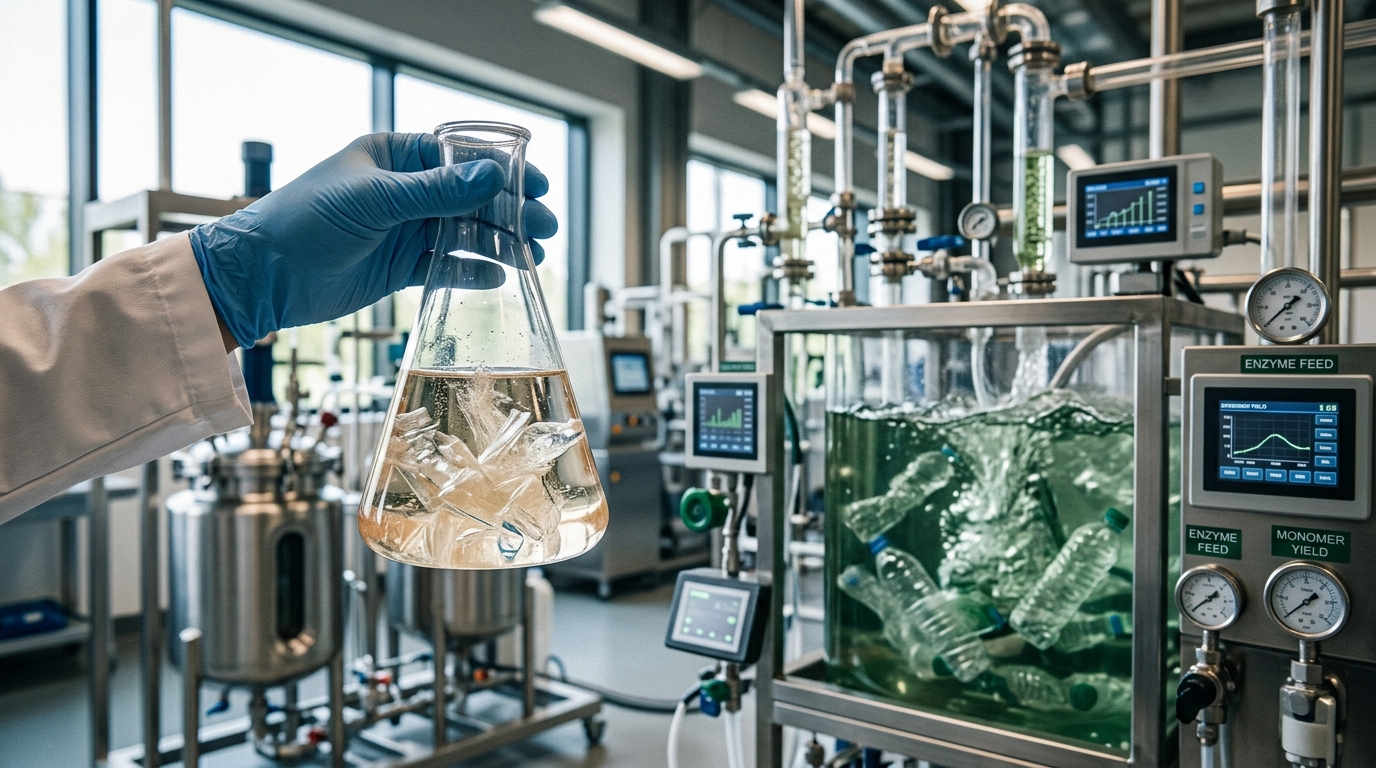
The economics of plastic waste just changed. Enzymatic depolymerization of PET, the polymer in beverage bottles, food trays, and polyester garments, is moving from lab to industrial demonstration. But the specific cost figures in play are still the debate: the article’s €63 per ton enzymatic-cost claim, the €250 per ton conventional-recycling claim, and therefore the implied €187 per ton gap are not supported by the same kind of public, apples-to-apples disclosures. Treat the cost advantage as directional until a like-for-like techno-economic assessment is cited side-by-side.
What closed the performance gap was not incremental chemistry. It was protein design powered by machine learning.
The Design Problem AI Solved First
Natural enzymes were never built for synthetic polymers. PET persists for decades in the environment because nothing in the microbial world evolved specifically to dismantle it at industrial speed. Nature operates on evolutionary timescales, and facing a biosphere saturated with synthetic polymers, computational biology stopped waiting for evolution and began inventing solutions from scratch.
Scientists at Murdoch University’s Bioplastics Innovation Hub are combining machine learning and biochemistry to filter through large enzyme candidate sets, using pipelines trained on previously characterized enzymes to predict how protein structures interact with and degrade target pollutants. The scale of that search is the point: Murdoch itself describes “millions upon millions” of potentially relevant enzymes sitting in global databases, largely untested. Machine learning converts that raw inventory into a ranked shortlist for lab validation.
On the engineering side, published research in The FEBS Journal engineered the current gold-standard PET-hydrolyzing enzyme, LCC-ICCG, into a mutant called LCC-ICCG-C09. The paper reports a 3.5°C increase in melting temperature versus LCC-ICCG and, under optimal conditions, roughly two-fold higher efficiency hydrolyzing amorphous PET into terephthalic acid. Two-fold efficiency on a platform already operating at industrial demonstration scale is meaningful compression of the cost curve.
From Bench to Industrial Floor
Carbios, listed on Euronext Growth Paris, is the furthest along commercially. On July 21, 2026, the company said it had completed 100 production batches at its Clermont-Ferrand industrial demonstration plant and expanded its licensing offering to the textile market. In the same announcement, Carbios said that since 2025 it has been extending its enzymatic biorecycling process to textile waste rich in PET polyester fibers, citing global textile consumption of roughly 67 million tonnes per year and describing that as nearly twice the size of the PET packaging market. That expansion reframes the addressable volume entirely.
Research published in May 2026 highlights the promise of designing enzyme systems capable of processing more heterogeneous waste mixtures, potentially reducing the need for rigorous waste-stream sorting. Sorting is often where economics break down in practice. Enzymes that tolerate contamination and blended materials remove that barrier.
The Startup Layer
Berkeley-based Rhea’s Factory is attacking the same problem from a purer AI-first position. In its June 8, 2026 announcement, the company said its process runs at mild temperatures with low energy input and returns polyester to virgin-quality building blocks at greater than 99% purity, while also handling contaminated and blended materials that make much textile waste hard to recover. In June 2026, Rhea’s Factory was named one of ten winners of the H&M Foundation’s Global Change Award, validating its early-stage model before it has demonstrated commercial scale.
What Investors Should Watch
- Carbios licensing velocity: Its July 2026 textile expansion signals a shift toward a high-margin licensing model that does not require Carbios to build every plant itself. Watch how quickly signed licenses convert to operating royalties.
- Enzyme immobilization progress: Reusable, immobilized enzymes are the lever that compresses per-ton cost further. Lab results already show significant degradation rate improvements over free enzyme equivalents.
- Regulatory tailwinds: EU recycled-content mandates are tightening. Per the OECD’s Global Plastics Outlook, plastic waste is projected to almost triple by 2060, and recycling is projected to remain below one-fifth even then; OECD also estimates recycling was about 9% in 2019. Mandatory minimum recycled-content rules reward whoever can supply virgin-quality monomers at scale.
- Carbios Longlaville timeline: The company has described its Longlaville project as targeting production start in H1 2028, conditional on financing, and in August 2026 said the previously announced target for financial close by September 30, 2026 would not be met, which would push the timeline. Any acceleration or slippage can move the stock.
Bottom Line
The question for this market is no longer whether AI-designed enzymes can dissolve industrial plastic. The published science and the demonstration-scale milestones support that they can. The question is who captures the monomer supply chain that this technology unlocks. Carbios holds the longest operating track record at industrial demonstration scale. Rhea’s Factory represents the hypothesis that a pure machine-learning enzyme platform can close the gap faster than a decade of conventional protein engineering did. Both are worth watching. The cost advantage over conventional recycling is the number that will eventually draw larger capital into this space, but investors should demand like-for-like comparisons before underwriting a precise per-ton spread.