
If you haven’t downloaded my “Top 10 Stocks to Buy This Quarter” report yet, please do it right now.
It takes about five seconds.
And once we swap in next quarter’s list, this edition won’t be available anymore.
Good Trading,
Bill Poulos
p.s. It’s the 10 stocks we like most right now, each one explained in plain English. Normally $29.97. Free here.
The Water Grid Is Already Being Hacked. The Firmware Fix Is the Trade.
The attack is already underway. It just has not landed yet.
Nation-state actors are intercepting encrypted communications from water-treatment plants, power substations, and pipeline control networks right now, archiving everything they cannot yet read. The strategy has a name: Harvest Now, Decrypt Later. The 2026 Thales Data Threat Report found that 61% of respondents ranked it as their top quantum-related concern. When a cryptographically relevant quantum computer eventually arrives, that stored traffic becomes readable, and whoever holds it holds the keys to physical infrastructure.
That is the threat companies like SEALSQ (Nasdaq: LAES) and Forward Edge-AI are being built to answer. Not the threat of a future breach. The threat of a breach that is already in progress.
Why OT Is the Hard Problem
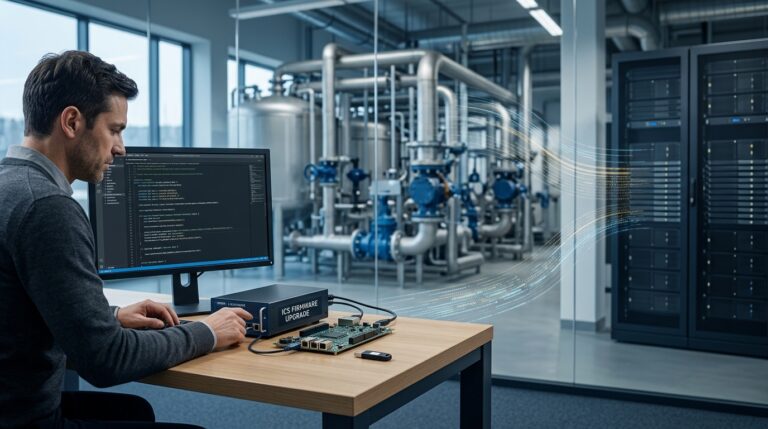
The reason embedded firmware in industrial settings is so exposed has less to do with neglect than physics. Forescout Technologies reported 2,155 ICS vulnerabilities across 508 advisories in 2025, describing it as the highest volume on record in that research. Yet the underlying cryptography protecting most of that equipment remains RSA or elliptic-curve variants that a large enough quantum processor will break retroactively.
NIST finalized its first post-quantum cryptography standards in August 2024, but critical-infrastructure compliance deadlines vary widely by jurisdiction and program and are not universally set for 2028 to 2030. In the U.S., the White House’s June 2026 post-quantum migration directive focused on federal systems and planning milestones, rather than a single set of critical-infrastructure cutover dates. A proposed FAR Council rule would mandate quantum-safe standards across federal contractors, tightening that timeline for industrial suppliers inside the defense industrial base. The gap between deadline and readiness is where the investment opportunity sits.
Hardware vendors are not moving uniformly. Vendors supplying software-layer tools such as analytics, PKI, and certificate management are advancing quickly on PQC support. Those supplying the hardware layer, including intelligent electronic devices, RTUs, and PLCs down to the firmware level, remain fragmented. That fragmentation is the addressable market.
Where the Smaller Names Are Positioning
SEALSQ reported 66% revenue growth in fiscal 2025 to roughly $18.3 million, with management guiding to a commercial pipeline above $200 million for 2026 through 2029, including more than $60 million tied to its QS7001 and QVault TPM post-quantum chips. Cantor Fitzgerald carries an Overweight rating with a $4 price target, and the firm has published a note cutting that target from $7 on concerns that included cash burn and dilution risk. As of October 12, 2026, the stock closed around $2.02. The company’s market cap was about $520 million in early October 2026, which means any acceleration in regulated procurement is not yet priced.
Forward Edge-AI’s Isidore Quantum takes a different angle: a compact hardware device positioned as a one-way data diode, designed to plug into existing environments and add post-quantum protection without requiring firmware replacement. That matters because many PLCs run firmware several revisions behind current, and some OT devices have limited patching paths once deployed. A drop-in diode approach can sidestep parts of the patching problem entirely.
The Scenario Split
Bull: FAR Council mandates and the 2028 compliance clock force federal-adjacent utilities and water operators to deploy PQC firmware solutions at scale, compressing adoption timelines from years to months. SEALSQ’s QS7001 validation and $200 million pipeline start converting. Micro-caps in this lane re-rate sharply.
Base: Adoption proceeds in pockets. Defense-adjacent operators move first; municipal water and smaller power co-ops lag. Vendors generating real revenue in 2025 and 2026 build durable footholds while the broader market remains fragmented through 2028.
Bear: Compliance deadlines slip, as they did in prior IT security mandates. Cash burn at pre-revenue firms outpaces contract wins. Larger OT vendors absorb the category through acquisition rather than organic build.
Bottom Line
The debate around post-quantum firmware in industrial settings has moved from academic to regulatory. The threat is not theoretical: exploitation of internet-connected PLCs across U.S. critical infrastructure sectors, including water and wastewater systems and energy, was detailed in a joint advisory released by CISA with the FBI, NSA, EPA, DOE, and U.S. Cyber Command in April 2026. The firms rewriting foundational device code for these environments are small, early, and execution-dependent. But the compliance window is closing, and the infrastructure running today’s water and power systems was built for uptime, not for quantum-era cryptography. That gap is the whole business case.