October 21, 2026
Bonus Content: CATL’s Profit Engine Stalls. A New Tax Is Why.
Dear Reader,
If you don’t trust Sam Altman …
I think you’re onto something.
My research says he’s hiding something so potent and revealing …
It could spark the biggest monetary crisis of our lifetime ….
As soon as Dec. 18 around 4 p.m.
That’s when I believe he will be forced to reveal something …
That could trigger a $40 trillion wealth shift.
For a chance to be on the right side of history, click here.
CATL’s Profit Engine Stalls. A New Tax Is Why.
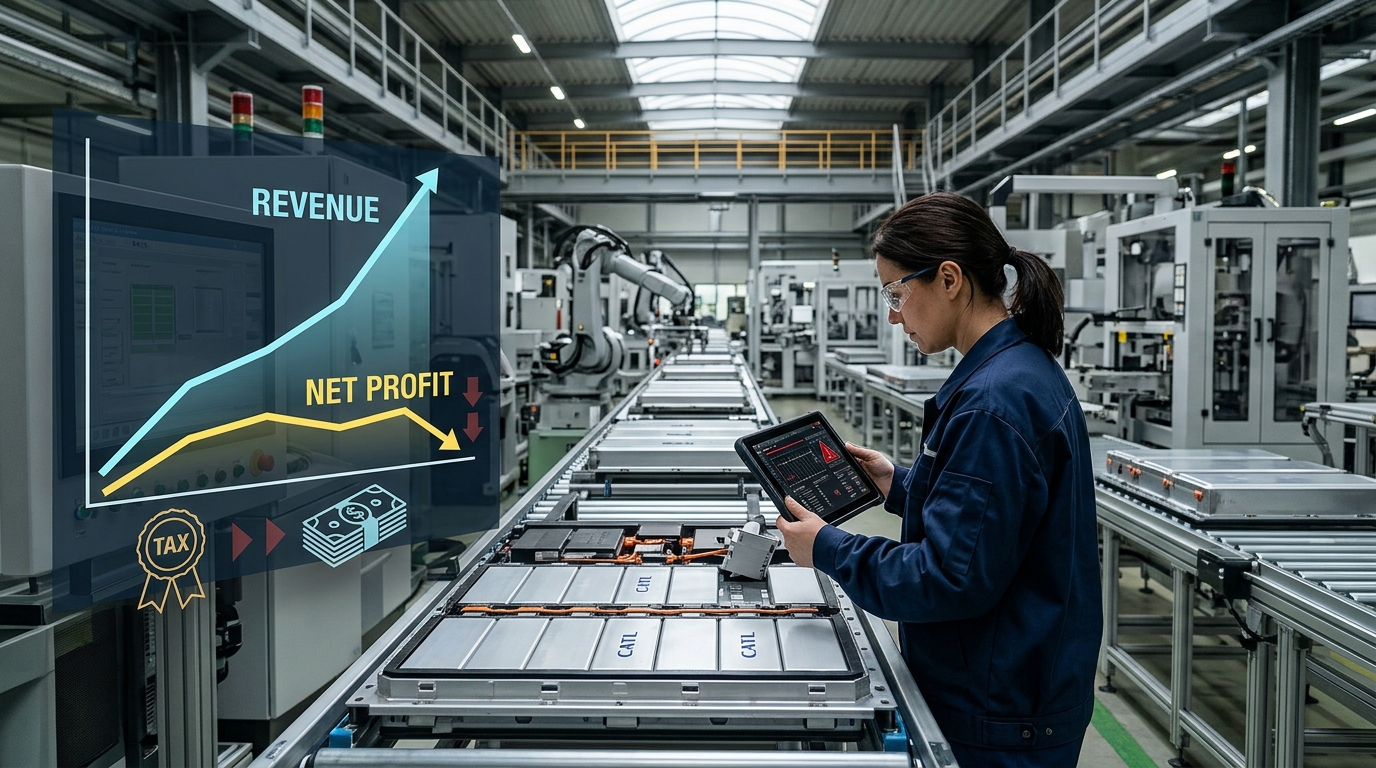
The world’s largest battery maker reported record revenue on Tuesday and still got punished for it. CATL’s Shenzhen-listed shares fell as much as 12% intraday Wednesday, and the Hong Kong line dropped more than 10% to its lowest level since July 2025. The gap between what the company sells and what it keeps is now the story.
The Numbers
- Q3 revenue: CNY 165.22bn, +58.6% year-on-year
- Q3 net profit: CNY 21.25bn, +14.5% year-on-year, slowest growth in roughly two years
- Consensus estimate (LSEG SmartEstimate): net profit growth of 41.2%
- Sequential decline: profit fell 5.77% from Q2’s CNY 22.55bn
- Q3 gross margin: 20.69%, down from 25.80% a year earlier; second consecutive quarterly decline
- Unit net profit: approximately CNY 82/kWh, versus CNY 112/kWh a year ago
- Nine-month revenue: CNY 442.14bn, +56.2%; nine-month net profit CNY 64.53bn, +31.6%
Revenue growth accelerated each quarter this year: 52.5% in Q1, 56.9% in Q2, 58.6% in Q3. Profit growth went the other direction: 48.6%, 36.4%, then 14.5%. The lines are diverging, not converging.
Why the Tax Broke the Margin Line
Three headwinds collided in Q3. Product mix shifted toward lower-margin energy storage systems. Export VAT rebates were cut and are set to be abolished entirely on Jan. 1, 2027. Most consequentially, China ended an 11-year tax exemption for lithium-ion batteries on Sept. 1, reinstating a 2% consumption tax at the point of factory shipment.
The problem is structural timing. The tax arrived in September, meaning it hit only one month of Q3 results. The full-quarter impact lands in Q4. Some analysts pointed to an even lower margin number once the quarter absorbed late-period policy and mix effects, highlighting the combined pressure from mix, reduced export rebates and the reinstated consumption tax.
The consumption tax is an embedded levy: unless buyer and seller agree otherwise, the manufacturer absorbs it. Management said on the earnings call it is “actively communicating” with customers on cost-sharing, but acknowledged no sharing ratio has been finalized. If CATL, commanding the industry’s strongest bargaining position, cannot pass the tax through, smaller rivals have no chance.
What It Means for Tesla and European Customers
Tesla’s Shanghai Gigafactory is the company’s highest-volume production site globally, sourcing cells from CATL and other Chinese suppliers. A cost increase at CATL’s factory gate touches every pack that leaves it, regardless of where the vehicle is ultimately assembled. Export-oriented shipments may be exempt from the domestic consumption tax itself, but reduced VAT rebates raise total export costs by an estimated 6% to 10% per unit. European automakers relying on CATL for both vehicles built in China and those supplied from Chinese plants face the same math.
European automakers were already absorbing a demand collapse in China before this cost shock arrived. BMW’s China deliveries fell more than 20% in the first half of 2026, and its automotive margin guidance was cut to 1%–3%.
The rate doubles to 4% on Sept. 1, 2027. That escalation is already in the calendar.
Forward Scenarios
Bull: CATL secures 50% cost-sharing with key customers by end of Q4, high-margin new products grow as a share of mix, and gross margin recovers toward 22%. Goldman Sachs estimates net profit downside of only 1% to 6% under this scenario.
Base: Negotiations drag into H1 2027. CATL absorbs 50% to 70% of the tax burden through the transition, unit profitability stabilizes near CNY 85 to 90/kWh. Full-year 2026 net profit growth lands around 25%, below prior consensus.
Bear: Zero pass-through achieved. JPMorgan models a 3% to 16% net profit decline for affected companies with full absorption. Combined with the 4% rate coming in 2027 and the VAT rebate elimination, CATL faces a pre-tax drag of approximately CNY 14bn. Margin does not recover before mid-2027.
Technical Overlay
Hong Kong shares touched HK$370.20 intraday, the lowest level since July 2025. The dual-listed stock is down roughly 33% in Shenzhen and 25% in Hong Kong from early-year highs. The Q3 gap lower has no obvious technical support until prior consolidation zones near HK$340 to HK$350. A close below today’s intraday low confirms a fresh 15-month low on volume.
What Investors Should Watch
- Tax pass-through disclosures: Any customer agreement announced before Q4 results changes the calculus immediately
- Q4 gross margin: The first full-quarter consumption-tax hit; a print below 19% signals the bear scenario is live
- Analyst revisions: Goldman Sachs, JPMorgan, UBS, and Jefferies have all cut forward estimates; watch whether BYD’s own Q3 results echo the margin pressure
- New product mix: Sodium-ion and solid-state batteries are exempt from the consumption tax; acceleration there is the cleanest structural offset
Bottom Line
The bear argument today is not about volume. CATL is shipping more batteries than at any point in its history. The question is who pays for Beijing’s tax policy shift. Until cost-sharing agreements are signed, CATL absorbs the gap. Q4 is the first full-quarter reckoning. That is the only number that matters between now and January.