October 24, 2026
Bonus Content: Kering Falls 17% and Gucci’s Decline Is Getting Worse
Below is an important message from one of our highly valued sponsors. Please read it carefully as they have some special information to share with you.
Dear Reader,
They were wrong.
Right before the vote, Jim Rickards went on TV, show after show, and said Trump would win.
He was right.
Now Jim has issued a new warning.
“Beware November 3rd.”
He’s so concerned about what’s coming, he’s moved more than a million dollars of his own money to get ready.
Click here to see it. It’s a BOMBSHELL…
When it hits, it will send shockwaves through the financial markets.
Regards,
Matt Insley
Publisher, Paradigm Press
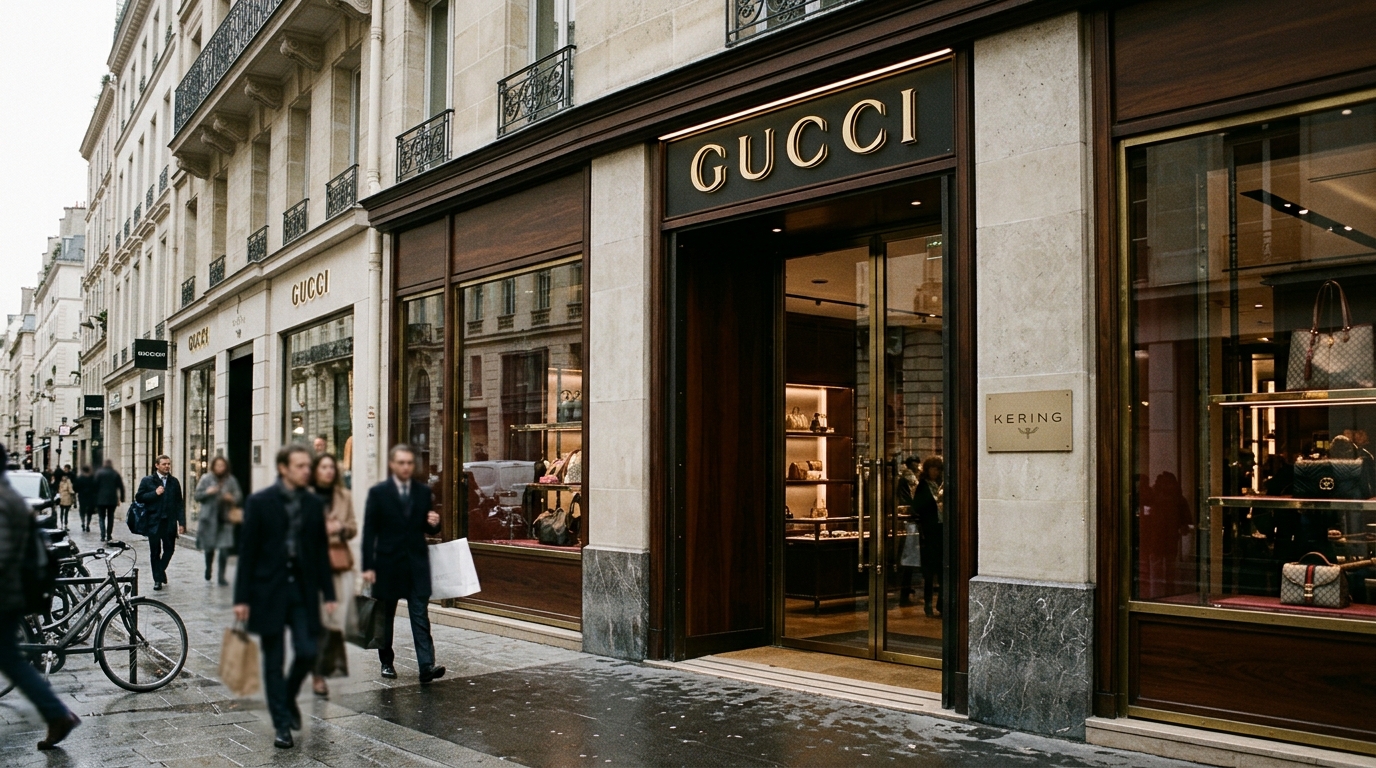
Kering Falls 17% and Gucci’s Decline Is Getting Worse
Analyst Targets
- RBC Capital: Hold, EUR 260 target (maintained October 22, 2026)
- Bernstein: Hold, EUR 270 target (maintained October 15, 2026)
- Citi: Neutral, EUR 243 target (cut from EUR 282 in early October)
- UBS: EUR 224 target (cut from EUR 285)
- TD Cowen: EUR 235 target (cut from EUR 280, October 13, 2026)
- Morgan Stanley: In-line, EUR 250 target (cut from EUR 320)
The Setup Coming In
Kering had spent much of the summer convincing investors that the worst was behind it. Second-quarter revenue came in at €3.65 billion, up 2% comparable, with Gucci retail improving seven percentage points sequentially. The stock traded around EUR 216 to EUR 218 ahead of Thursday’s release. CEO Luca de Meo had warned explicitly that Q3 would face tougher year-on-year comparisons and might look flat. The market had priced in caution. What it had not priced in was another acceleration of the decline.
The Numbers
Group revenue: €3.35 billion, flat as reported, down 1% comparable. Consensus was approximately €3.34 billion, so the headline cleared the bar.
- Gucci: €1.29 billion, down 4% reported and down 6% comparable. Gucci retail specifically fell 9% comparable, with management citing lower traffic in Mainland China and Japan as the main factors.
- Kering Fashion and Leather Goods: €2.74 billion, down 3% comparable.
- Kering Jewelry: €239 million, up 11% comparable.
- Kering Eyewear: €373 million, up 4% comparable.
Retail sales, which account for 75% of group revenue, declined 3% comparable. The group now operates 1,614 directly owned stores after 105 net closures year-to-date, already past its original full-year target. Management raised that target to at least 125 closures by year-end.
First-half net income had already collapsed 60% to €189 million. The Q3 top-line weakness at Gucci makes a second-half profit recovery harder to model. Management confirmed no margin improvement is expected in the second half versus the first half.
The macro backdrop behind Gucci’s traffic decline runs deeper than brand execution. Weakening Chinese consumer demand has been decelerating across the industrial economy, signalling a structural spending problem rather than a luxury-specific one.
Why the Stock Moved
The group headline was fine. Gucci was not.
The brand fell 6% comparable, roughly in line with market expectations, and investors focused on management’s warning that the second half would not show a margin improvement versus the first half. On the call, management also said October trends were broadly in line with the third quarter in most regions. That phrase, “broadly in line,” is not what a turnaround looks like.
“The progress made on improving brand desirability remains in its very early stages,” JPMorgan analyst Chiara Battistini said in a note. The shares fell about 17% in Paris on Friday, closing around EUR 178.
Macro Context
China was once the luxury industry’s most reliable growth engine, powered by rising wealth and property gains. That engine has slowed sharply as property weakness, softer consumer confidence and tighter scrutiny of wealthy individuals reduce spending. Beijing’s recent tax crackdown on affluent households has added another layer of caution.
China’s demand problem is not confined to European luxury. Nike’s China slump forced a full-year guidance reset, showing how broadly the same consumer pullback is hitting global premium brands.
Even high-end Hermès is showing signs of slowing, with its ready-to-wear and accessories division falling 2% in the third quarter due to weak Chinese demand. Reuters reported Hermès posted its weakest quarterly sales growth in six years. Kering’s problem is not unique, but its exposure is more acute: Gucci remains Kering’s largest brand, so its ongoing struggles dictate the entire group’s financial trajectory.
Forward Scenarios
Bull
Demna’s Primavera collection, which only fully reached stores in September, drives a Q4 retail uptick. China traffic stabilises as Beijing stimulus measures gain traction. Jewelry and eyewear compound at double digits, offsetting Gucci softness. The stock re-rates toward EUR 240 as sequential improvement resumes.
Base
Gucci comparable sales stabilise in a 2%-to-4% decline range through early 2027. Store closures improve retail productivity gradually. The group holds its margin guidance. Shares find a floor near current levels and trade sideways ahead of the February 2027 full-year results.
Bear
China demand deteriorates further. Gucci comparable declines accelerate past 8% in Q4. Margin guidance is withdrawn. The stock revisits and breaks its 52-week low, with consensus targets migrating toward the EUR 175 floor already in analyst models.
Technical Overlay
Kering closed Friday, October 23, 2026 at about EUR 178 in Paris. That move places the stock beneath every meaningful moving average. Its position near its 52-week low reflects the extent of investor concern about execution risk at Gucci and the uncertain timeline for a meaningful recovery in China. The next identifiable technical reference is the prior 52-week low. A close beneath it on volume would signal capitulation; a failure to reclaim EUR 200 in coming sessions would confirm the bear scenario is pricing in faster than the turnaround can counter.
What Investors Should Watch
- Gucci Q4 retail comparable: any sequential improvement from the 9% Q3 retail decline is the minimum the bull scenario requires.
- China traffic data: the CFO’s own words were “there is still a lot of work to be done in China.”
- Analyst revisions: the consensus target of EUR 261 sits far above the current price, but that gap closes with every downgrade cycle.
- Full-year results, expected in February 2027: that is the next hard checkpoint for margin guidance and Gucci trajectory.
Bottom Line
The debate about Kering is not whether Gucci is struggling. Everyone agrees it is. The debate is whether the Q2 sequential improvement was a genuine inflection or a one-quarter statistical fluke against easy comparisons. Q3 answered that question unfavorably. Q2 had shown progress by posting the first comparable sales increase in three years, but CEO Luca de Meo had warned the recovery would not be linear, flagging that Q3 could be flat due to more unfavorable comparisons. Flat would have been manageable. Minus 6% is not flat.
The stock now trades at a price that embeds deep skepticism. Whether that skepticism is fully priced depends entirely on one variable: when Gucci retail traffic in China turns. Until management can point to that shift with hard data, the analyst consensus target is a theoretical anchor, not a near-term destination.