
November 5, 2026
A strong Q3, $108.4bn in revenue and $2.09 adjusted EPS, could not survive the market’s verdict on a 2028 split that raises more questions than it answers.
Analyst Targets
- UBS: Kevin Caliendo – separation perceived as defensive, not strategic; cautious near-term read
- Barclays: Andrew Mok – cited absence of financial detail on the breakup as the primary investor concern
- Leerink Partners / Oppenheimer: Acknowledged solid operational results; investor focus has shifted to execution risk of the split
What Happened
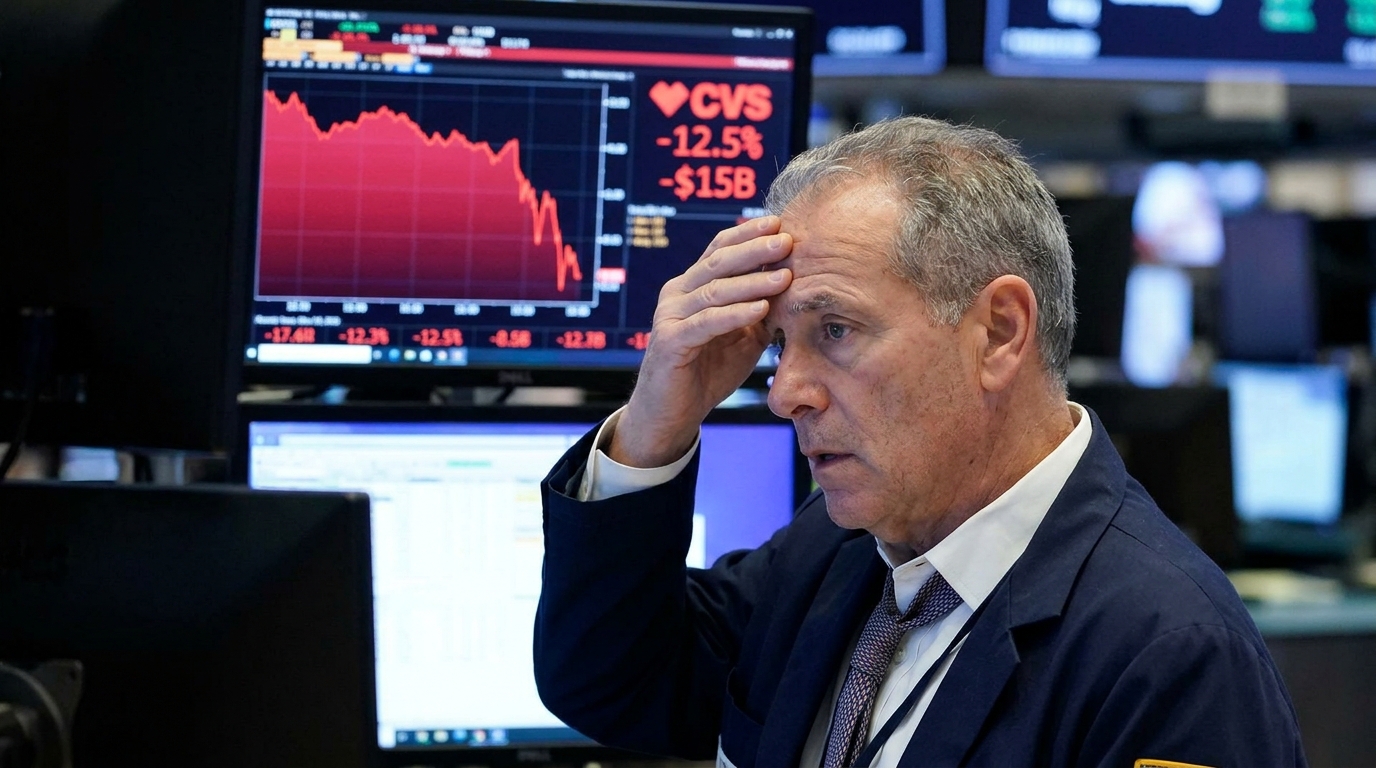
CVS shares fell 12.53% on November 4, hitting their lowest level since early May, following the announcement of a planned separation into two independent publicly traded companies in the first half of 2028. The quarter itself was arguably the company’s cleanest in two years.
‘Please, Please, Please’: OpenAI CEO Sam Altman Begs Small Company for Help
As reported by Financial Times, those are the exact words OpenAI CEO Sam Altman spoke on an open line to a small company in Arapahoe County, Colorado… which now controls what could be the most important technology in the world. Altman is desperate to get his hands on it… and he’s not alone. This tech is now backed by Elon Musk, Jensen Huang, and more.
Click here to learn how you could invest in this breakthrough alongside Sam Altman and Elon Musk.
CVS reported adjusted earnings about 30% above a year earlier and topped Wall Street expectations, posting adjusted earnings of $2.09 a share on revenue of $108.4 billion, against analyst forecasts of $1.65 a share and about $104.7 billion in sales. For the last eight quarters, CEO David Joyner noted, the company had beaten Wall Street expectations. None of that was enough.
Company Profile
CVS Health operates more than 9,000 drugstores and retail health clinics under one roof, with its Aetna health insurance and Caremark pharmacy benefit operations forming a second major pillar. The plan to split into two publicly traded companies represents a reversal of the company’s massive 2018 acquisition of Aetna, the nation’s third-largest health insurer at the time. The integrated model, retail pharmacy, PBM, and managed care under one entity, was the entire thesis.
The Numbers
- Revenue: $108.4bn, up 5.4% year over year; beat consensus by about $3.7bn
- Adjusted EPS: $2.09 vs. $1.65 expected; up about 30% year over year
- Adjusted operating income: $4.194bn for the quarter
- Health Care Benefits (Aetna): Revenue $36.855bn, up 2.4%; adjusted operating income climbed to $912mn from $314mn a year earlier; medical benefit ratio improved to 91.3% from 92.8%
- Health Services: Adjusted operating income $2.106bn, up 2.7%; Pharmacy and Consumer Wellness adjusted operating income $1.635bn, growing 10.6% year over year
- Guidance raised: Full-year 2026 adjusted EPS to at least $8.20 (from $7.90-$8.10); 2027 adjusted EPS set at at least $8.65; operating cash flow raised to at least $15.5bn
Why the Stock Is Moving
The quarter was not the problem. The split is.
The split proposal lacks financial details, making it difficult for investors to model. Questions regarding debt allocation, capital allocation policies, and the magnitude of one-time separation costs remain unanswered. UBS analyst Kevin Caliendo said CVS shares are weak “because the announced split of the company came as a surprise, and is perceived as happening as a defensive move against regulation rather than an offensive move.”
Barclays analyst Andrew Mok cited the lack of financial detail as a primary concern, noting that when CVS bought Caremark about 20 years ago, the company said it would generate synergies of at least $500 million. Now investors must price the cost of unwinding those same synergies, with no concrete figures provided.
Jeff Brown Says “SpaceX Supercycle” Could 39x Your Money
According to legendary tech investor Jeff Brown…
Three words on page 37 of the SpaceX IPO filing…
Signal Musk is about to trigger a rare wealth supercycle…
And send billions into a sector nobody associates with tech.
The synergy question cuts both ways across CVS’s supply chain. McKesson’s six-year distribution extension with CVS locked in a major revenue stream for both companies well before the breakup was announced.
Two independent public companies mean two separate management teams, dual sets of compliance and investor relations costs, and the loss of cross-referral, centralized procurement, and backend sharing capabilities.
Macro and Industry Context
Health insurers have grappled with higher medical costs in recent years, while drugstores face mounting competition from Amazon and declining foot traffic. CVS’s Aetna has been recovering from a bruising stretch: Aetna’s medical benefit ratio rose to 95.2% in the third quarter of 2024, before CEO Joyner took over. The turnaround is real. The irony is the market is now discounting the very structure that produced it.
The managed-care sector’s cost pressures have not been uniform. Humana’s path back to four-star Medicare Advantage status shows how much a single ratings decision can shift the earnings outlook for a standalone insurer.
The decision comes amid vertical integration challenges from lawmakers. Senators Elizabeth Warren and Josh Hawley introduced the Break Up Big Medicine Act in February 2026, which has drawn public support from Mark Cuban. Morningstar analyst Julie Utterback noted that management “probably thought that it was a better time to move somewhat preemptively rather than wait for a legal or legislative decision that forced their hand.”
Forward Scenarios
Bull
Dis-synergy costs prove manageable, as CFO Brian Newman suggested. Each standalone company attracts a valuation premium: CVS Pharmacy as a pure-play retail and community health operator, the health solutions entity (Aetna, Caremark, Oak Street, Signify) as a focused managed-care platform. The 2027 adjusted EPS floor of $8.65 already exceeds analyst consensus of $8.53. Shares recover to pre-announcement levels by mid-2027 as separation details firm up.
5 Little-Known Stocks Behind Today’s Defense Tech Shift
Behind the headlines, a major transformation is underway.
Modern warfare is being driven by AI, autonomous systems, and next generation technology. A handful of lesser known companies are helping power this shift.
This report uncovers five stocks quietly playing a critical role in the future of defense.
Base
The separation completes on schedule in early 2028, but one-time costs and lost synergies weigh on combined earnings power for two to three years. The company’s free cash flow yield of approximately 10% and resumed share buybacks provide a floor. CVS trades in the low-to-mid $80s through 2027 as investors await clarity on each entity’s standalone cost structure.
Bear
Unanticipated developments delay or prevent the separation. Dis-synergy costs and restructuring expenses exceed estimates. Elevated medical costs return under a newly independent Aetna without Caremark’s data advantages. The integration between Caremark, specialty, and Aetna that management described as central to managing total cost of care is disrupted in the transition. The stock tests $70.
Technical Overlay
CVS closed at $79.96 on November 4, 12.53% below the prior close of $91.41, touching an intraday low of $77.33. The gap down through the $85 area removes a zone that had served as support since late spring. The six-month low print at $77.33 is now the nearest reference. Any near-term recovery attempt will find overhead supply between $85 and $91. Volume on the breakdown will make a one-day reversal unlikely without a material catalyst, specifically quantified separation financials.
What Investors Should Watch
- Separation filing detail: Debt split, standalone cost structures, and one-time transaction costs are the variables the market needs before it can rebuild a model
- Aetna MBR trajectory: Full-year guidance targets the lower half of an 89.75% range; any reacceleration in medical costs reopens the 2024 wound
- Peer read-across: Elevance Health and Cigna gained on the day, likely benefiting from a relative value trade as neither faces CVS’s breakup uncertainty
- 340B program and regulatory developments: Both were top-of-mind on the earnings call and do not disappear with a corporate restructuring
Bottom Line
The quarter was not in dispute. CVS cleared the Wall Street consensus of $1.65 by more than 26%, and the Aetna turnaround that looked uncertain two years ago now looks durable. The stock fell 12% anyway because the breakup announcement converted a known, recoverable business into an unmodeled one. The gap down is not about Q3. It is about two years of execution risk, unknown dis-synergy costs, and a split that management framed as strength but the market read as preemption.
The question that determines the next move is not whether CVS can run two good businesses. It is whether the market will get enough financial detail to model them before 2028. Until that filing arrives, the discount stays.