
May 1, 2026
Chip Mania: Intel Erases 26 Years of Resistance, AMD Crosses $500B
Two seismic moves in one session – here is what the semiconductor tape is actually telling you
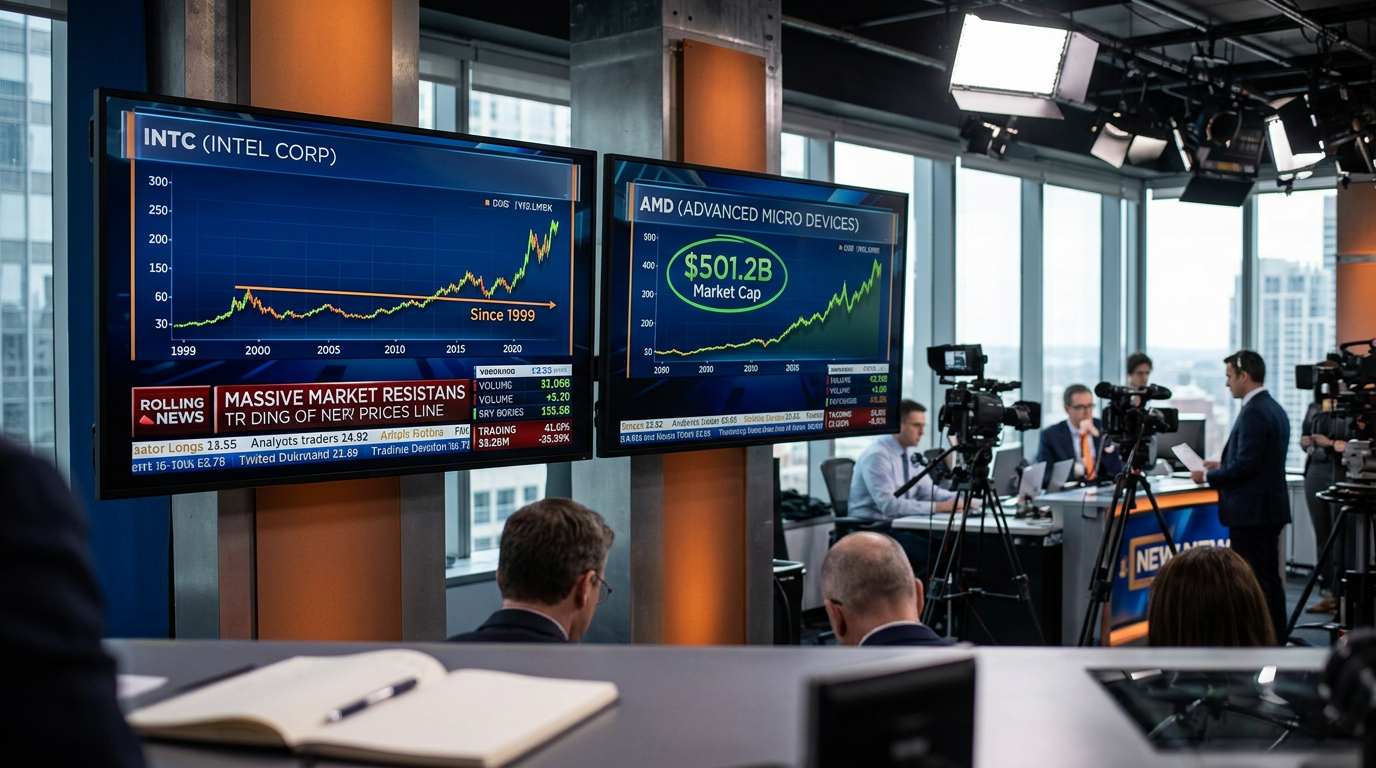
The Session That Rewrote the Charts
Intel surged through a technical ceiling that had held since the dot-com era, while AMD quietly crossed the $500 billion market capitalization threshold — a milestone that would have seemed fantastical as recently as 18 months ago. In a single May 1 session, the semiconductor sector did not just move. It repriced. And the Philadelphia Semiconductor Index, for the first time in its history, closed above 10,000.
These are not momentum flukes. They are the product of converging macro forces, a generational AI infrastructure buildout, and two companies executing fundamental strategic pivots — at the same time, in the same direction.
What’s interesting is how little fanfare surrounded AMD’s move relative to Intel’s. The market had a headline to chase, and it chased it. But AMD’s structural story may be the one that compounds longer.
15X Bigger Than SpaceX: Elon’s New Launch
While the rest of the market goes crazy for “the mother of all IPOs”, a new Elon Musk innovation is quietly being rolled out nationwide. It’s been 27 years in the making, and it could have a radical impact on how millions of people manage their money… and even collect Social Security.
Why Intel Is Breaking Out Now
Twenty-six years of technical resistance is not a number to dismiss. That ceiling — forged during the peak of the 1990s PC supercycle — had rejected every meaningful Intel rally since the dot-com collapse. Today it gave way, and the volume behind the move was unambiguous. Nearly 185 million shares traded on the breakout days in early April, and the follow-through into May has been relentless. Intel’s Q1 2026 revenue came in at $13.6 billion, clearing the Wall Street midpoint estimate by $1.4 billion. Non-GAAP EPS hit $0.29 against a consensus of just $0.01. That is not a beat — that is a restructuring.
- Data center acceleration: Intel’s DCAI segment posted 22% year-over-year revenue growth to $5.1 billion, driven by server CPU demand for AI inference workloads — supply is now tighter than demand
- Foundry credibility: Intel 18A reached high-volume manufacturing in January 2026, with yields exceeding 60% and improving at roughly 7% per month — Microsoft is using Intel Foundry for custom AI accelerators, Amazon is commissioning custom Xeon chips
- Terafab catalyst: Intel signed on as the primary foundry partner for Elon Musk’s $25 billion Terafab project — a joint venture between Tesla, SpaceX, and xAI targeting one terawatt of AI compute per year — the single largest marquee customer win in Intel’s foundry history
- Government anchor: The U.S. government’s 9.9% equity stake, converted from CHIPS Act grants, is now worth approximately $36 billion — Nvidia holds an additional ~4% from its $5 billion investment, and SoftBank holds ~2% — together these three strategic investors control roughly 16% of the company
- Cost restructuring: After an $18.8 billion net loss in 2024, Intel reached near-breakeven in 2025; Q2 2026 guidance calls for $14.3 billion in revenue, ahead of the $13.07 billion the Street expected
The market is not just buying earnings recovery. It is buying optionality on Intel becoming a genuine third foundry option in a world desperate to reduce TSMC concentration risk. Intel’s share of the global foundry market sits below 5%, against TSMC’s 64%. The gap defines both the risk and the upside.
Slight tangent, but it matters — the advanced packaging angle is underappreciated. Intel’s EMIB and Foveros technologies are positioned to hit 40% gross margins, and CFO Dave Zinsner revised external packaging revenue guidance upward to “well north of $1 billion” annually, arriving before meaningful wafer revenue even kicks in. Packaging may be the lever that re-rates the foundry segment before the wafer business proves itself.
Get YOUR Pre-IPO Exposure to ChatGPT’s Trillion Dollar IPO!
No Accreditation… No Qualifications…
AMD at $500 Billion — Earned, Not Given
AMD’s move on the session was the quieter but arguably more structurally significant signal. The $500B cap is a psychological line that forces generalist allocators to treat AMD as a mega-cap holding rather than a high-beta semiconductor trade. The framing shifts. The mandate requirements change. That is not trivial.
The MI300X GPU family continues to take AI inference share. Data center revenue in Q4 2025 came in at a record $5.38 billion, up 34.1% year-over-year. The company’s server CPU market share has crossed 41%. DA Davidson upgraded AMD to Buy after Intel’s blowout quarter, calling Intel’s results a “precursor for a huge step-up for AMD’s CPU franchise” driven by agentic AI workloads. Susquehanna set a $375 target ahead of AMD’s own Q1 report on May 5. Wells Fargo added AMD to its Q2 Tactical Ideas List with an Overweight rating.
At $500B, AMD is no longer growing into its valuation — it is defending it. That demands a different quality of execution. The MI300 ramp, partnerships with Meta, OpenAI, Oracle, and HPE, and the upcoming Helios GPU in H2 2026 are the execution checkpoints that determine whether this level holds. Data center revenue is projected to grow roughly 4.5-fold from $17 billion in 2025 to $58 billion by 2027. That is the embedded expectation now sitting inside the multiple.
The part people skip: AMD’s 52-week gain now sits at approximately 269%. The stock added 65% in just the last month alone. These are numbers that historically attract crowded positioning — which is worth watching even for long-term holders.
Macro Context: Why This Cycle Feels Different
Alphabet and Amazon both confirmed massive, accelerating AI infrastructure spending in recent earnings — a direct read-through for CPU and GPU suppliers across the board. The Nasdaq hit a fresh all-time high near 24,837 on the same session. The broader environment is not just tolerating semiconductor valuations at these levels; it is actively bidding them. World Semiconductor Trade Statistics is forecasting a 26% spike in global semiconductor sales to $975 billion this cycle. That is the tide, and both Intel and AMD are positioned in the current.
Geopolitically, the case for domestic chip manufacturing has only strengthened. Taiwan Strait tensions, U.S. export controls, and the administration’s active interest in onshoring advanced production have created a policy tailwind that is structural, not cyclical. Intel is the primary beneficiary. That “geographic alpha” — domestic sourcing for defense, government, and hyperscale clients nervous about single-geography concentration — is a moat that TSMC structurally cannot offer.
Your Download Link (Expiring)
If you still haven’t downloaded the free Simple Options Trading For Beginners guide…
…please take a few seconds and download it right now before your download link expires.
I eventually plan to charge money for this report, so do yourself a favor and download it now…
That way, no matter what it costs in the future, you’ll have a free copy on your computer.
Make sense?
Simple Options Trading For Beginners (Download Link Expires)
Bottom Line
When Intel clears a 26-year chart level and AMD earns mega-cap status in the same session, the semiconductor sector is sending a message that transcends short-term trading. The AI infrastructure cycle is broadening. Foundry geopolitics are creating new winners. Both stocks just repriced to reflect a future that looks less uncertain than it did 90 days ago.
Intel’s turnaround narrative has shifted — in the words of one analyst framing — “from managed decline to aggressive recovery.” That is a significant change in how institutional capital models the name. AMD heads into its own May 5 earnings report with the bar now elevated by Intel’s beat. Whether the follow-through matches the elevation is the question neither chart can answer.
What happens next probably depends less on the next print and more on whether 18A yields hold, whether AMD’s MI300 guidance raises or resets, and whether the hyperscaler capex commentary stays this loud into Q3. Those are the variables worth watching — not the headlines that already moved.
For informational purposes only.