June 27, 2026
Lilly’s Obesity Pill Just Changed the Math
Foundayo is live. The real opportunity isn’t where most investors are looking.
Analyst Ratings: LLY
- JPMorgan – Overweight | Price Target: $1,300
- Morgan Stanley – Overweight | Price Target: $1,313
- Goldman Sachs – Buy | Price Target: $1,283
- Jefferies – Buy | Price Target: $1,300
- BMO Capital – Outperform | Price Target: $1,300
- TD Cowen – Buy | Price Target: $1,250
- HSBC – Reduce | Price Target: $850
- Consensus (28 analysts) – Buy | Avg. Target: ~$1,225
The injection era for obesity drugs may not be ending. But it just got a serious competitor.
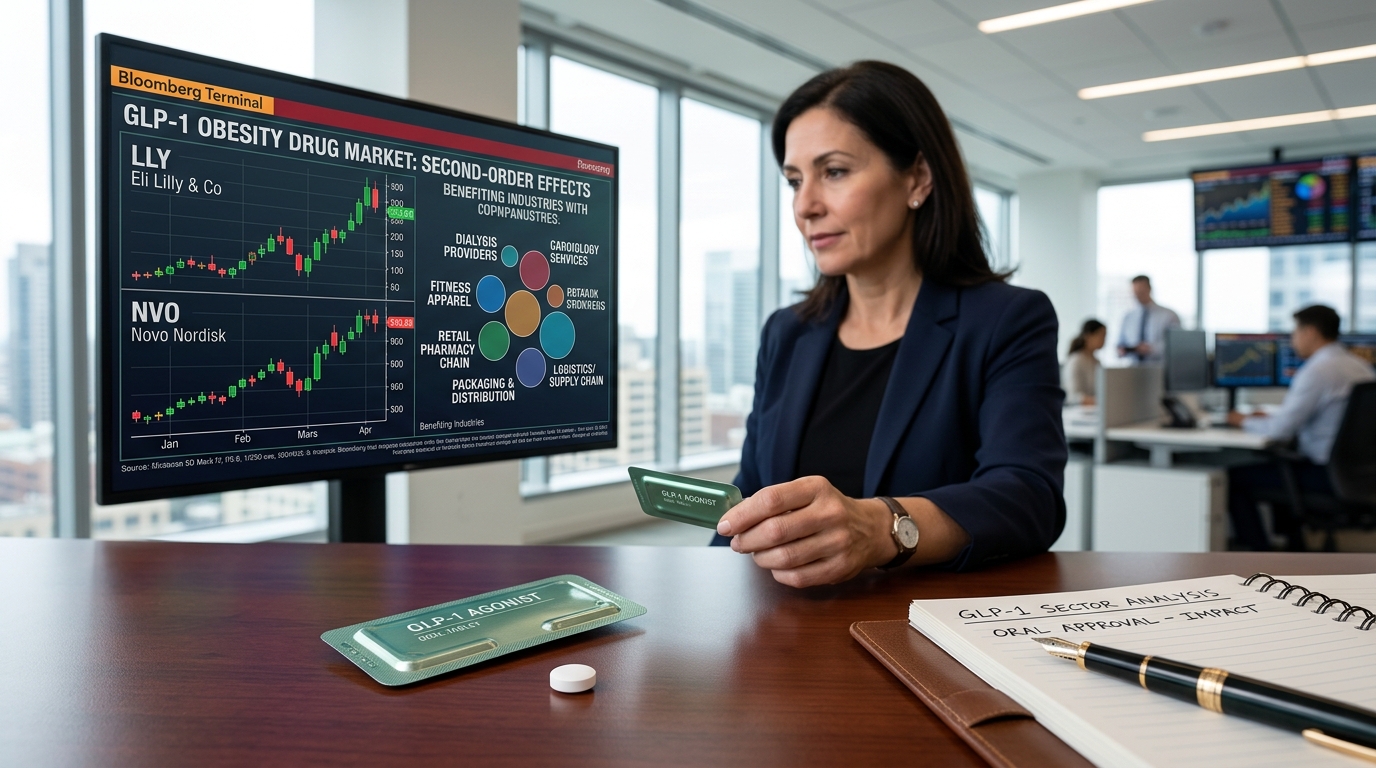
Here’s what happened. On April 1, 2026, the FDA approved Foundayo (orforglipron), Eli Lilly’s once-daily oral GLP-1 receptor agonist for chronic weight management in adults with obesity or those overweight with at least one weight-related comorbidity. What makes this different from Novo Nordisk’s oral Wegovy, which launched in January? Unlike existing injectable GLP-1 therapies and Novo Nordisk’s oral semaglutide, which must be taken on an empty stomach with limited water, Foundayo can be taken at any time of day without food or water restrictions. That sounds small. It isn’t.
A bet that doesn’t fit the pattern
A wealth manager overseeing $31.7 billion owns hundreds of stocks, mostly the names you’d expect.
Then there’s one exception: a small industrial company they’ve poured roughly $705 million into. The position is so large they must disclose every move. Their latest filing wasn’t a sale.
They bought more.
David Ricks, chair and CEO of Lilly, notes that fewer than one in ten people who could benefit from a GLP-1 therapy are currently taking one, held back by access barriers, stigma, and the complexity of existing treatment options.
That number — fewer than 1 in 10 — is the only number that actually matters here. The entire market debate has been about Lilly vs. Novo. The bigger debate should be about the 90% of the addressable population who aren’t using any of these drugs at all.
The FDA approval sets off a commercial fight as the two metabolic drug giants seek to grab an increasing share of a market forecast to reach $100 billion a year by 2030. And that estimate was built before either pill was actually on pharmacy shelves. Morgan Stanley Research goes further, projecting the global GLP-1 market could reach $190 billion by 2035, with oral treatments and expanded Medicare coverage among the main drivers of growth.
Here’s where most investors are stopping the analysis. They’re tracking the horse race — Lilly vs. Novo, efficacy comparisons, pricing. On efficacy, the Wegovy pill produced approximately 13.6% weight loss in its 64-week Phase 3 trial, slightly above Foundayo’s 11.2% in its 72-week study. Novo wins on weight loss data. Lilly wins on convenience. And both of them win if the market expands, which it almost certainly will.
The part people are skipping is the downstream supply chain. Oral pills don’t require cold storage. They don’t require trained healthcare staff for administration. As a small molecule, Foundayo has more straightforward manufacturing and scalability processes compared to Wegovy, which is a peptide-based therapy.
That changes the distribution math entirely. Retail pharmacy becomes the front line. Foundayo is available via LillyDirect, with prescriptions accepted immediately and shipping beginning April 6, followed shortly after by broad availability through U.S. retail pharmacies and telehealth providers. The companies with the scale and infrastructure to handle high-volume, recurring oral prescriptions have a structural advantage that wasn’t there two years ago.
Most Traders Get Earnings Wrong – Here’s a Different Approach
Many traders try to predict earnings and get burned.
This strategy waits until after the news is released, then looks for specific momentum signals.
Learn why some investors prefer this approach today.
Slight tangent, but it matters: Foundayo’s approval also makes history as the first new molecular entity approved under the National Priority Voucher Program, with an exceptionally accelerated review timeline. Lilly submitted the NDA in January 2026 and had approval by April 1. That kind of regulatory velocity is not normal, and it signals something about how urgently policymakers want this class of drugs in patients’ hands.
In addition to chronic weight management, orforglipron is being studied as a potential treatment for type 2 diabetes, obstructive sleep apnea, osteoarthritis knee pain, hypertension, peripheral artery disease, and stress urinary incontinence. The obesity approval is the opening chapter. The pipeline expansion is the longer story.
GlobalData forecasts that orforglipron will reach $13 billion in annual sales by 2031. That’s a projection. Projections are wrong. But the direction of travel here isn’t. On pricing, self-pay patients typically pay around $149 to $349 per month, while those with commercial insurance may pay as low as $25. Eligible Medicare Part D enrollees may pay as little as $50 per month beginning July 1, 2026. The cost barriers that kept 90% of eligible patients on the sidelines are coming down, one by one.
The real question is not whether Lilly or Novo wins. Approximately 25 million Americans are expected to be on GLP-1 treatment by 2030, up from around 10 million in 2025. The question is whether anyone is positioned for what happens when that many new patients start filling monthly oral prescriptions. That infrastructure question hasn’t been seriously considered yet.
For informational purposes only.